

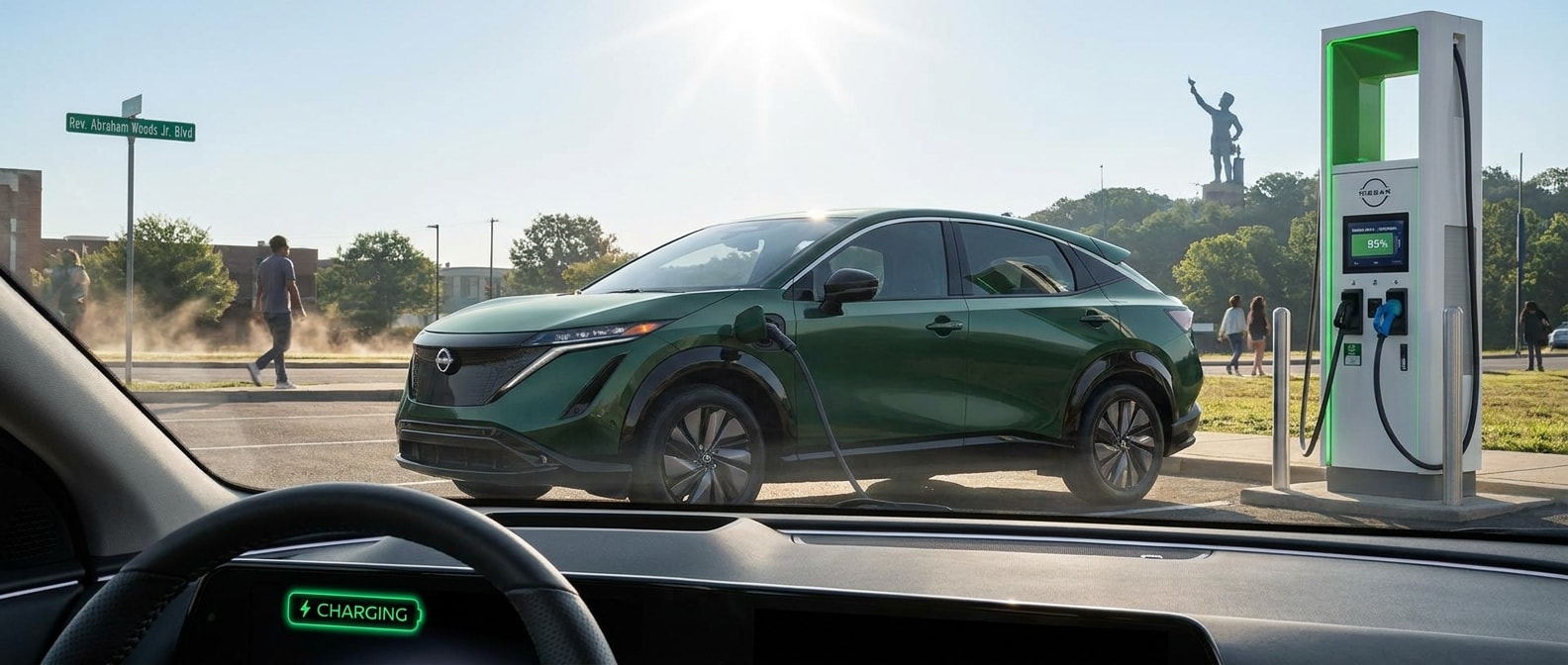
The 2025 Nissan Ariya is one of the most composed electric crossovers we've had on our lot, and it rewards drivers who take fifteen minutes to understand its charging behavior before they need a charge in a hurry. The EPA rates the Ariya's range between 216 and 289 miles depending on trim and battery pack. In Birmingham's summer heat, that number deserves a closer look. This guide covers where you'll actually charge around the metro, how long to plan for, and the unwritten rules that keep the EV charging community working smoothly for everyone.
If you're also weighing Nissan's current electric lineup, the Nissan LEAF is worth a look right alongside it before you decide.
How Far Will It Really Go Around Birmingham?
Range depends on which Ariya you drive, and our working answer is to plan a bit under the sticker rather than right at it, because the EPA figures assume mild weather that Birmingham simply does not deliver in July or August. The base Engage with the 66 kWh battery is rated at 216 miles combined. The Evolve+ with the 91 kWh battery hits 289 miles on front-wheel drive, or 272 miles with e-4ORCE AWD. Those figures come from temperate testing, and Birmingham summers are anything but temperate.
Birmingham runs hot, and the numbers feel it. August afternoons push into the mid-90s, and running the climate system hard on I-65 or across I-459 trims your real-world range. So our advice to Ariya owners is to plan longer drives at about 80 percent of the EPA estimate. A 289-mile rating then becomes a comfortable 230-mile planning target, one that leaves real buffer for traffic, a detour, or a stop that runs long.
| Trim / Pack | EPA Range (combined) | 80% Planning Target | Connector |
|---|---|---|---|
| Engage FWD (66 kWh) | 216 miles | ~173 miles | CCS1 |
| Evolve+ FWD (91 kWh) | 289 miles | ~231 miles | CCS1 |
| Evolve+ AWD (91 kWh) | 272 miles | ~218 miles | CCS1 |
| Platinum+ AWD (91 kWh, 19 in.) | 267 miles | ~214 miles | CCS1 |
One detail catches owners off guard. The Ariya uses a CCS1 charging inlet, while the Nissan LEAF uses CHAdeMO for DC fast charging. So the plug from your old car will not fit this one. CCS happens to be the more widely available fast-charge standard around Birmingham, which is good news for you. The Ariya also works with Tesla Superchargers through Nissan's NACS-to-CCS1 adapter kit, which opens up locations like the 16-stall Tesla Supercharger site in the Target lot on US-280. More range on tap.
Where Do You Charge Locally in Birmingham?
You have more charging options across the metro than you might first assume, from dealership plugs to a 350 kW site out toward Bessemer, and knowing which one fits which errand saves you real time on a busy day. Not every stop suits every situation, so match the site to the trip.
Hallmark Nissan (1424 5th Ave North, Birmingham). We run CCS, CHAdeMO, and J1772 charging on site. Schedule a service visit and top off while you're here. A practical stop if you're already in the neighborhood.
Brookwood Village (531 Brookwood Village, Birmingham). Six charging ports with both CCS and CHAdeMO, open 24 hours. A Level 2 session works well here while you shop. The social contract is simple. When your session ends, move the car, because the lot stays busy and other drivers are counting on turnover on evenings and weekends.
Birmingham-Shuttlesworth Airport (5900 Messer Airport Hwy). Nine-plus ports split across two parking levels. Level 3 puts chargers in hourly parking, and Level 6 covers daily parking. Handy for a top-off during a pickup run, or when you're leaving a car there for a few days.
Buc-ee's Bessemer (near I-20/59). Four 350 kW CCS stalls. These are the highest-output public DC chargers near Birmingham, and they earn their keep on a run toward Tuscaloosa or heading west. The Ariya maxes out at 130 kW regardless of stall rating, so a 350 kW stall isn't "wasted" on this car. You'll draw the full 130 kW the Ariya can accept. Expect 10-to-80 percent in about 40 minutes on the 91 kWh pack, per Nissan's published specs.
Hoover (RED_E, 2551 AL-150). Seven ports with J1772 and CCS. A reliable pick for Hoover-area errands, or a longer Level 2 session before you head back toward Birmingham.
See current inventory at Hallmark Nissan to check what's available.
Connector reminder. At stations that offer both CCS and CHAdeMO (including Hallmark Nissan), confirm you're grabbing the CCS handle for the Ariya. The two plugs look different up close, but it's a common reach-for-the-wrong-one moment in a busy lot.
Nissan specifies that the Ariya's 91 kWh battery charges from 10 to 80 percent in approximately 40 minutes on a DC fast charger at up to 130 kW.
See Current Ariya Offers at Hallmark Nissan
Build These Habits Into Your Routine
A handful of small habits make Ariya ownership around Birmingham feel easy instead of anxious, and none of them take more than a few seconds once they become routine, especially on the days you are in a hurry. Build them in early and you'll rarely think about charging again.
Charge at home overnight. Alabama Power's off-peak window falls roughly between midnight and 6 AM. Plug in before midnight, wake up to a full battery, and you keep your demand off the grid's peak hours while paying less to do it. The Ariya's 7.2 kW onboard charger on a 240V Level 2 home setup takes about 10 to 14 hours for a complete charge, so an overnight plug-in covers it.
Stop the fast-charge session at 80 percent, not 100. The Ariya's DC charging curve tapers hard past 80 percent. From 10 to about 50 percent the car pulls near its full 130 kW, and by 70 to 80 percent the output has stepped down a lot. Topping from 80 to 100 percent eats disproportionate time and holds the stall for other drivers. Grab your miles and move on. Finish at home.
Match your car to the charger. The Buc-ee's Bessemer site has stalls of different output levels. If you pull in and a slower stall is open while cars that truly need the 350 kW stalls have them, hanging back a few minutes is reasonable. But if a slower stall sits open and nobody's queuing, take it. The Ariya pulls the same 130 kW either way.
Move your car when the session ends. Moving your car once charging finishes is the habit that matters most in a growing charging community. A finished session with the car still plugged in is a blocked stall, plain and simple. ChargePoint and EVgo both impose idle fees once a session ends. Set your app notification before you walk away. Come back when it pings.
Use summer pre-conditioning from a plug. After a few hours in a Birmingham parking lot in August, your Ariya's cabin gets hot enough to eat into your range in the first few miles of driving. The remote climate pre-conditioning feature lets you cool the interior while the car is still connected to a charging session or a home outlet, so that cooling runs on grid power rather than the drive battery. The feature is easy to skip until a 95-degree August afternoon reminds you why it's there.
Talk to our team about financing options for making an Ariya yours.
By the Hallmark Nissan Team | August 2026
Frequently Asked Questions
Does the 2025 Nissan Ariya use CHAdeMO or CCS for fast charging?
The Ariya uses a CCS1 (Combined Charging System) inlet for DC fast charging, where the Nissan LEAF uses CHAdeMO. At multi-standard stations that offer both plug types, grab the CCS handle for the Ariya. With Nissan's NACS-to-CCS1 adapter kit, the Ariya can also reach Tesla Supercharger locations.
How does Birmingham's summer heat affect Ariya range?
The EPA rates the Ariya between 216 and 289 miles depending on trim and battery. Real-world range in Alabama summer heat with the climate system running will land below those figures. A planning target of around 80 percent of the EPA rating covers active cooling loads and highway speeds. Running the Ariya's remote pre-conditioning while plugged in (at home or at a charging session) keeps the cabin cool without drawing on the drive battery, which helps protect your real driving range.
Is it bad etiquette to leave your Ariya plugged in after the charge completes?
At a DC fast charger, yes. A finished session with the car still plugged in blocks the stall for other drivers, and networks like ChargePoint and EVgo impose idle fees once the session ends. At a Level 2 station the pressure is lower since those sessions run for hours anyway, though a prompt departure when you're done is still the right call. The practical fix is easy. Enable session-complete notifications in your charging app before you walk away.
Categories:
Social