

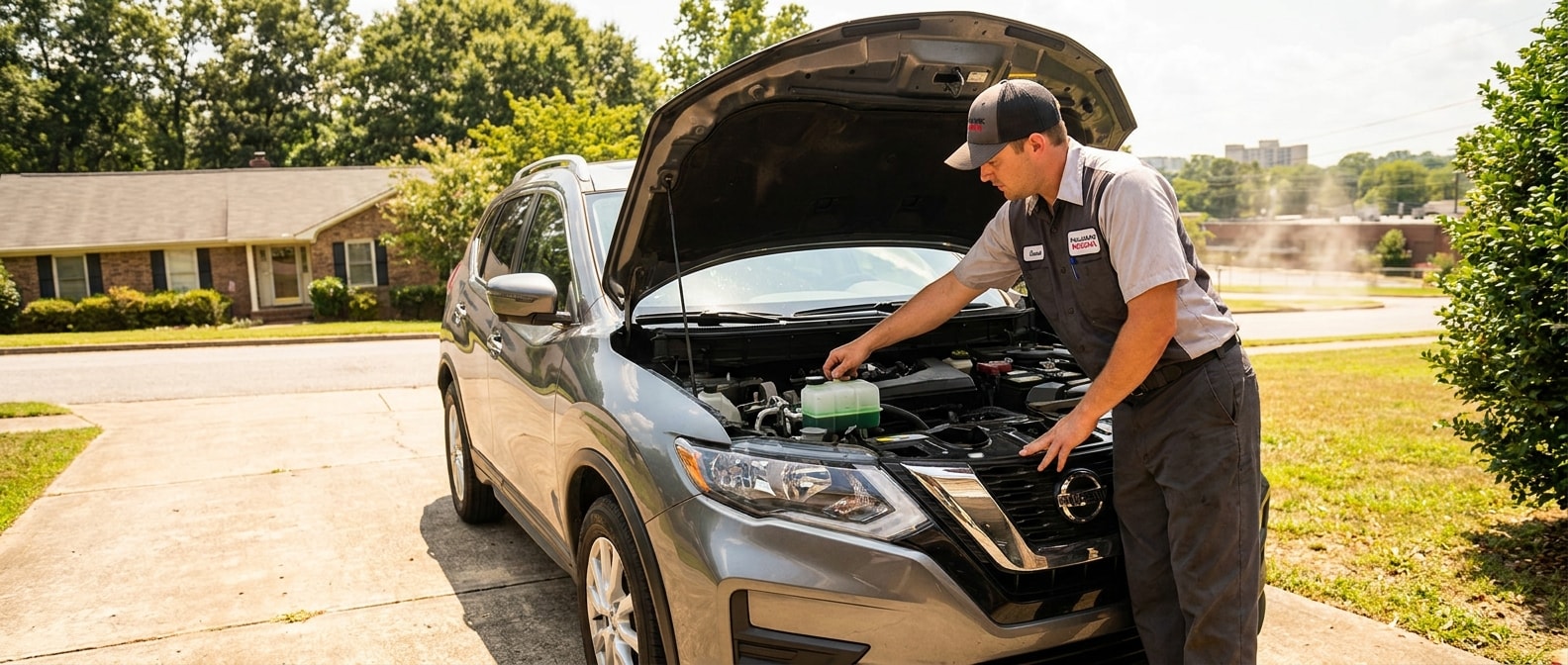
August in Birmingham is its own category of heat. High humidity pushes heat index values between 95 and 105 degrees on a typical afternoon, and this year the region has seen Heat Advisories with index levels near or above 105 degrees Fahrenheit stretching across multiple days. That kind of sustained thermal load won't just make your commute miserable. It quietly stresses every fluid system in your vehicle while you sit on I-65 with the A/C cranked and traffic barely crawling.
Plenty of fluid-check articles skip one thing about fall driving in Alabama. Fall here comes on gradually, unlike Ohio, where temperatures fall off a cliff in September. What changes is the driving pattern. School runs, weekend trips, and football-Saturday traffic replace the lazy mid-August rhythm, so your fluids are about to work harder right when they've already soaked up a full summer of heat and humidity abuse. Now is the window. Check them before the demand climbs.
Our service team can walk through any of this with you, and this guide covers exactly what to look for and why Birmingham's conditions make each check matter.
The short version
- Coolant: Look inside the translucent reservoir (engine cold). If the level is below the "MIN" line or the fluid looks brown or rusty, schedule service before fall.
- Brake fluid: Dark brown or black fluid is a warning. In humid Birmingham summers, DOT 3 and DOT 4 fluids absorb moisture that lowers their boiling point, soft-pedal feel is a red flag.
- Transmission fluid: Healthy ATF is pink or light red. Burnt smell or dark color after a summer of stop-and-go means it's absorbed heat stress it won't fully recover from.
- Engine oil: Check the dipstick on a level surface, engine cold. Dark, gritty oil or a level below the "MIN" mark means it's overdue.
- Windshield washer fluid: Not a safety fluid, but Birmingham's afternoon thunderstorms and bug season make it surprisingly urgent.
How Do These 5 Fluids Compare for Fall Readiness?
Not every fluid carries the same risk coming out of an Alabama summer, and the two that genuinely surprise people are coolant and brake fluid, because they don't just run low, they actually degrade in ways that make your car less safe at highway speed while the other three stay more routine. The others are more straightforward maintenance calls. Below is how all five stack up.
| Fluid | What Healthy Looks Like | Alabama Risk Factor | Action Threshold |
|---|---|---|---|
| Coolant | Clear bright green, yellow, or red in the reservoir | Heat stress + age degrades the inhibitors that prevent corrosion | Brown or rusty color, or level below MIN |
| Brake Fluid | Clear to light amber, full reservoir | Humidity causes hygroscopic DOT 3/4 to absorb moisture, lowering the boiling point | Dark brown or black, or soft pedal feel |
| Transmission Fluid | Pink or light red, no burnt smell | Stop-and-go commutes and high ambient temps push ATF above 220 degrees F where breakdown begins | Dark/burnt-smelling fluid, rough shifts |
| Engine Oil | Amber/brown on dipstick, above MIN | Oil breaks down faster under sustained high-heat operation | Gritty texture, black color, or below MIN |
| Washer Fluid | Full reservoir (check visually) | Bug splatter and afternoon storms hit visibility hard in late summer | Low level or empty |
Any Nissan Rogue used for weekend driving or school-run duty will feel all five of these pressure points before October arrives.
Why Does Birmingham Humidity Actually Change Your Brake Fluid Risk?
Humidity changes your brake fluid risk because the fluid is hygroscopic, meaning it pulls water straight out of the air, and DOT 3 fluid can absorb up to 2% water every year through the cap, through worn seals, and even slowly through the rubber brake lines. A wet Birmingham summer speeds it up.
Now add Birmingham's context. Humidity in Birmingham during August ranges from 68% to 75%, which is the kind of sustained high-moisture environment that accelerates that absorption all summer long. The consequence is measurable. DOT 3 fluid has a minimum dry boiling point of 401 degrees Fahrenheit, but a minimum wet boiling point of only 284 degrees Fahrenheit. The gap runs 117 degrees. During a hot stop-and-go crawl on I-20, brakes cycle heat with every application, and if your fluid's already moisture-saturated from a Birmingham summer, its boiling point sits significantly closer to what your brakes can generate under sustained use.
Color is the clearest tell here. Fresh brake fluid is nearly translucent with a golden tint. If yours is dark brown or black, it must be flushed. And low brake fluid can also indicate a leak or that your brakes need to be inspected.
Treat this one as a genuine safety check that's worth the time.
Nissan Pathfinder and Frontier owners who tow anything, even occasionally, should treat this check as non-negotiable. Towing compounds the brake heat buildup considerably.
Schedule a Pre-Fall Service Check
Coolant: Alabama's Summer Doesn't Let It Rest
Most engines operate best when coolant temperature stays between 195 degrees Fahrenheit and 220 degrees Fahrenheit, and that's a range your cooling system works hard to maintain when ambient temps are already in the 90s and your AC condenser is adding heat load to the front of the radiator.
Coolant is a mix of water and typically ethylene glycol. That mixture raises the boiling point and lowers the freezing point of the fluid, helping it perform in extreme temperatures, and a proper 50/50 mix is what keeps your engine operating in that safe window. The problem after a long Alabama summer runs two ways. First, the coolant level can drop from minor evaporation or a small leak you haven't noticed yet. Second, the inhibitor chemicals inside the coolant that prevent internal corrosion degrade over time and heat cycles.
Check the coolant with the engine fully cold, not just warm. Let it cool. Locate the translucent reservoir, read the level between the minimum and maximum marks, then look at the color. Coolant should be bright green, yellow, or red, depending on the type. If it's brown or has particles floating in it, that's a sign it needs changing.
A low or degraded coolant level is one of the fastest routes to a head-gasket failure, which is among the most expensive engine repairs a driver can face.
Transmission Fluid: The Quiet Heat Victim
Automatic transmission fluid rarely gets much attention until something goes wrong, and that's a mistake after a hot Alabama summer, because most automatic transmissions operate between 175 degrees Fahrenheit and 200 degrees Fahrenheit during everyday driving. Temperatures may rise above 200 degrees Fahrenheit when towing, climbing hills, or driving in hot climates, and anything above 220 degrees Fahrenheit should be monitored closely.
What makes it relevant right now is heat. If transmission fluid temperature climbs above 220 degrees Fahrenheit, the fluid itself can start to degrade, losing some of its lubricating properties. Severely hot weather and stop-and-go traffic drive transmission temperature up, which is exactly what a Birmingham summer commute delivers day after day.
The check is simple for vehicles that have a dipstick (some modern transmissions are sealed and require service-bay inspection). With the engine warm and running, pull the dipstick, wipe it, reinsert, and pull again. The fluid color should be pink or red. If it's brown or smells burnt, it may be time for a change. Rough or hesitant shifting is the other tell, and catching it now is far cheaper than a rebuild later.
- Watch for a delayed response when shifting out of Park
- Notice any unusual shudder during low-speed acceleration in traffic
- Smell for anything acrid or sweet-burnt when you open the hood after a long commute
- Check fluid color against a white rag (pink/red = healthy, brown/dark = stressed)
- Flag this for service if the vehicle has seen more than 30,000 miles since the last change
Picking Your Service Priority Before Fall
Not every vehicle heads into fall in the same shape, so the fluid that deserves your most urgent attention depends on how you actually drive, and the quickest way to sort it is to match the check to your commute rather than run all five at once.
If you do a lot of stop-and-go commuting through Birmingham and Bessemer, put brake fluid and transmission fluid first. The heat cycles they've absorbed this summer are cumulative, and the DOT fluid's moisture absorption is real in this humidity. Bessemer sits southwest of Birmingham.
Highway drivers should flip the order. Coolant health and engine oil become the priority checks, since sustained highway speeds at high ambient temps put steady pressure on the cooling system, and engine oil's protective chemistry breaks down faster when it runs hot for extended periods.
Tow with a Nissan Armada or a Frontier, and all five checks matter before fall, though transmission fluid should come first. Towing is the single fastest way to push ATF past its safe temperature range, and doing it with already-stressed fluid shortens the transmission's life measurably.
Washer fluid lands last on the urgency list, but don't leave it empty. Birmingham's afternoon thunderstorms and the inevitable bug accumulation from summer driving make visibility a real issue that's worth handling.
Frequently Asked Questions
Does coolant need to be changed every year?
Not necessarily on a fixed annual schedule, but it does need to be checked regularly. Most coolant formulations are rated for a certain number of miles or years, but Alabama's heat accelerates the breakdown of the corrosion inhibitors in the fluid. The honest answer is: check the color and level now, and ask your service advisor to test the freeze/boil protection with an inexpensive tester. If it's been three or more years since a flush, it's worth the conversation.
Can I just top off my brake fluid if it's low?
You can, and it'll bring the level up, but low brake fluid by itself is a signal worth investigating, not just solving. Low brake fluid can indicate a leak or that your brakes need to be replaced, since the level drops naturally as pads wear down. Topping it off without checking pad thickness or looking for a leak is treating the symptom. If the fluid's also dark in color, a full flush is the right call, not just a top-off. ---
Categories:
Social