

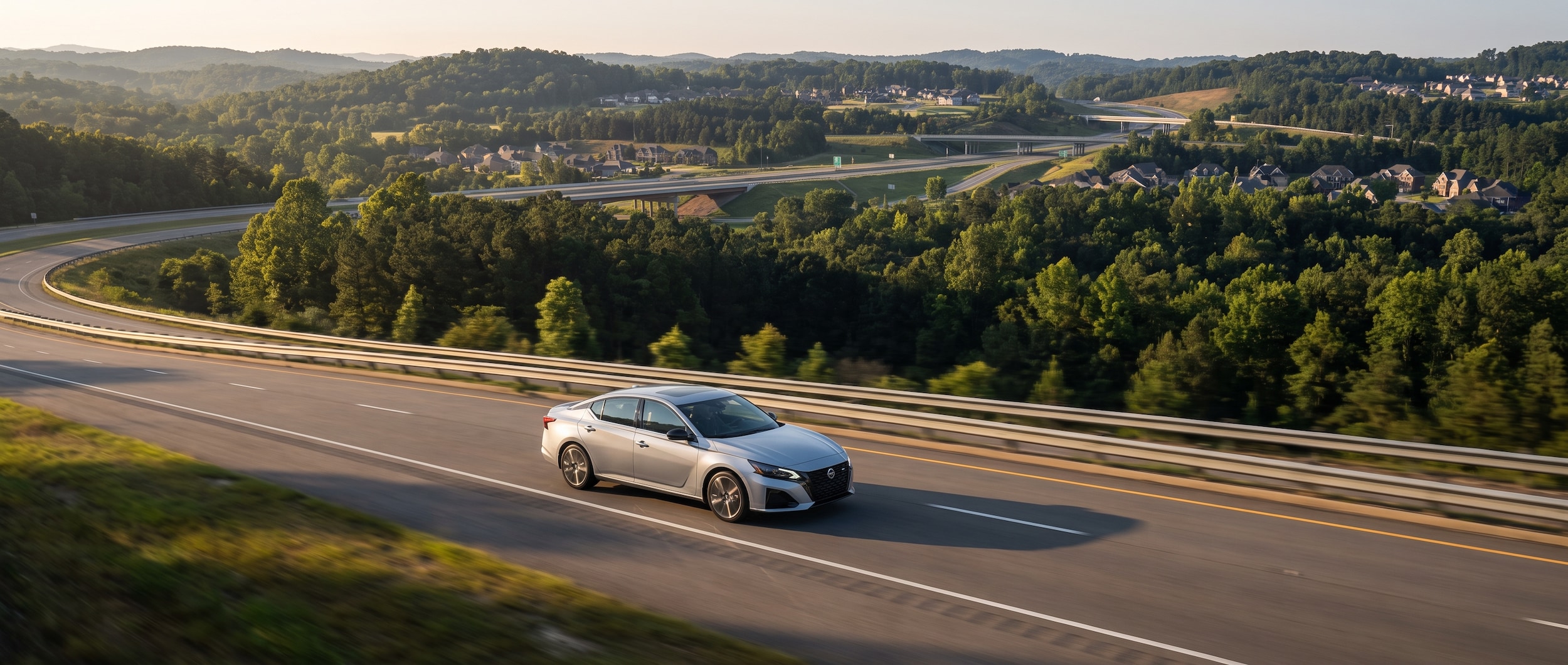
Commuting on I-459 asks different things of a car than a flat, straight city loop does. The bypass runs 32.8 miles through genuine Appalachian foothills, swings through stack interchanges at Irondale, and right now carries active construction near the Trussville end where I-59 is being widened to three lanes. That mix of 65-70 mph open highway and sudden slow-downs asks something specific of a vehicle. For our team's money, the 2026 Nissan Altima is the strongest all-around answer for this particular corridor. But the pick that's right for YOU depends on whether you're commuting solo, hauling kids, or watching every dollar you spend on gas.
We ranked the Nissan lineup for this specific commute below. The order follows how each one actually drives the corridor, not just the spec sheet.
The I-459 Commuter Rankings at a Glance
| Rank | Model | Best For | Standout Spec |
|---|---|---|---|
| 1 | Altima (FWD) | Solo or couple, pure highway miles | Nissan-stated 36 mpg highway |
| 2 | Sentra (S/SV) | Budget commuter, solo driver | EPA-est 38-40 mpg highway |
| 3 | Kicks (FWD) | Solo or small family, SUV height | EPA-est 35 mpg highway, 30 cu-ft cargo |
| 4 | Rogue (FWD) | Family commuter, elevation changes | Nissan-stated 36 mpg highway, 201 hp |
Before we dig in, note that the Nissan Versa was discontinued after the 2025 model year, so it doesn't appear here. If you're open to used options, 2025 Versas are still on the market and worth a look. But for a new vehicle today, these four are the real conversation.
The Altima Earns Its Top Spot on a Highway Run
The Altima takes the top spot because 36 highway miles per gallon on a front-wheel-drive midsize sedan actually matters when you're clocking twenty-plus miles each way, five days a week, though you give up rear-seat room to get there. Nissan states the 2026 Altima FWD at 26 city and 36 highway on a 2.5-liter inline-four making 188 horsepower and 180 lb-ft of torque. The tank covers serious distance (16.2 gallons on the FWD) before you're pulling off for fuel.
The piece that's easy to overlook until you're forty-five minutes into stop-and-go near the US-280 interchange is front seat comfort. The 2026 Altima's front seats are genuinely all-day accommodating with ample headroom and legroom. On an I-459 run where you're cruising at 70 mph through the Irondale foothills and then braking hard for construction slowdowns near Exit 32, a composed ride matters more than extra cargo cubbies.
The tradeoff worth naming is the rear seat, which is tighter than you'd want for adults. Rear legroom is 35.2 inches, fine for kids or occasional passengers but cramped for two adults back there every day. If you're a solo commuter or a couple who puts passengers in front, the Altima is your car. Rear-seat family haulers, read on.
The Sentra Wins the Efficiency Argument Outright
The 2026 Nissan Sentra wins the efficiency argument outright, and the ninth-generation redesign stiffened the chassis for less road noise, a real upgrade for anyone who spends an hour on the beltline every day, though you trade away quick acceleration to get it. The EPA rates the Sentra S and SV at up to 30 city and 40 highway with a 12.4-gallon tank. Forty highway is the highest number in this entire lineup, by a clear margin.
The Sentra's 2.0-liter four-cylinder makes 149 horsepower and 146 lb-ft of torque. We'll be straight with you. That output is enough for steady-speed interstate cruising but noticeably modest when you need a quick merge onto I-20 from the Exit 29 interchange, where lanes tighten fast. The Sentra needs 9.1 seconds to 60 mph in independent testing. Not dangerous (just deliberate). On an open I-459 cruise you'll never care. In a construction-zone merge under pressure, you'll want to plan ahead and give yourself room.
If efficiency is your primary filter and you're commuting solo or with one passenger, the Sentra makes the case cleanly. It's also the only model here with a standard 12.3-inch touchscreen across all trims in the 2026 redesign, a small daily comfort that adds up.
The Kicks Earns Its Place for Solo and Small-Family Commuters
The 2026 Nissan Kicks earns its place as a subcompact SUV with 30.0 cubic feet of cargo behind the rear seats (FWD models) and an 8.4-inch ground clearance that Nissan says leads the subcompact segment, so you get SUV height and utility, though not the fuel range of the Altima. For reference, that clearance matters less on smooth I-459 pavement and more when your exit ramp has a gnarly dip or you're rolling over the speed plates near an active construction zone.
The FWD Kicks returns an EPA-estimated 28 city and 35 highway. The 2.0-liter engine produces 141 horsepower and 140 lb-ft of torque. The output puts it right between the Sentra and Altima on power, with a higher seating position that pays off on long daily drives. You can see over traffic. Sight lines like that matter in a construction zone where jersey barriers cut your view.
One fair caveat is worth flagging. The 11.8-gallon fuel tank on FWD models is smaller than what you get in the Altima, which means more frequent stops if highway range is critical to your routine. For a shorter I-459 leg, or a commuter who wants a little SUV utility in one package, the Kicks earns its spot here.
Buying Caution: Don't skip the test drive on the highway. The Sentra's ride stiffening for 2026 is genuine, but the Kicks and Altima have meaningfully different highway composure. I-459's sweeping curves and elevation changes near Irondale put real lateral load on a vehicle. Your sense of confidence at 70 mph is worth confirming in person, not just on a spec sheet.
| Pros | Cons | |
|---|---|---|
| Altima FWD | 36 mpg highway, all-day front seats, composed highway ride | Tight rear seat (35.2 in legroom), no hybrid option |
| Sentra S/SV | Up to 40 mpg highway, lowest running cost, reduced road noise for 2026 | Slowest 0-60 in this group, smaller fuel tank (12.4 gal) |
| Kicks FWD | Higher seating position, 30 cu-ft cargo, 8.4 in ground clearance | Smallest tank (11.8 gal), 141 hp can feel light fully loaded |
| Rogue FWD | 201 hp VC-Turbo, 36 mpg highway, largest interior | Heavier vehicle, slightly more complexity than a sedan |
The Rogue Is the Right Call When You're Hauling More Than Yourself
The 2026 Nissan Rogue is the right call when you're hauling more than yourself, since its 1.5-liter VC-Turbo three-cylinder makes 201 horsepower and 225 lb-ft of torque, enough to pull a full cabin up the Irondale grades without strain, though you'll spend a bit more to own it than the smaller models. The torque number shows up on I-459's grade climbs near the Irondale interchange, where the highway rises and falls through the foothills and a light-feeling sedan can feel strained carrying a full cabin. The Rogue doesn't strain. It pulls cleanly.
Nissan states 29 city and 36 highway for the FWD Rogue (matching the Altima on highway efficiency despite carrying a significantly larger, more capable crossover body). If you're adding AWD (and Alabama summers occasionally produce the kind of afternoon thunderstorm that makes standing water a real thing on I-459's fast sweepers), the AWD version comes in at 28 city and 35 highway. Still solid.
The Rogue is the move when your commute includes school drop-off, a Costco run on the way home, or a carpool with two colleagues in the back seat. The cabin is bigger where it counts. You get the space, the torque, and the AWD option, and you spend a bit more to own it than you would a Sentra or Kicks.
Categories:
Social