

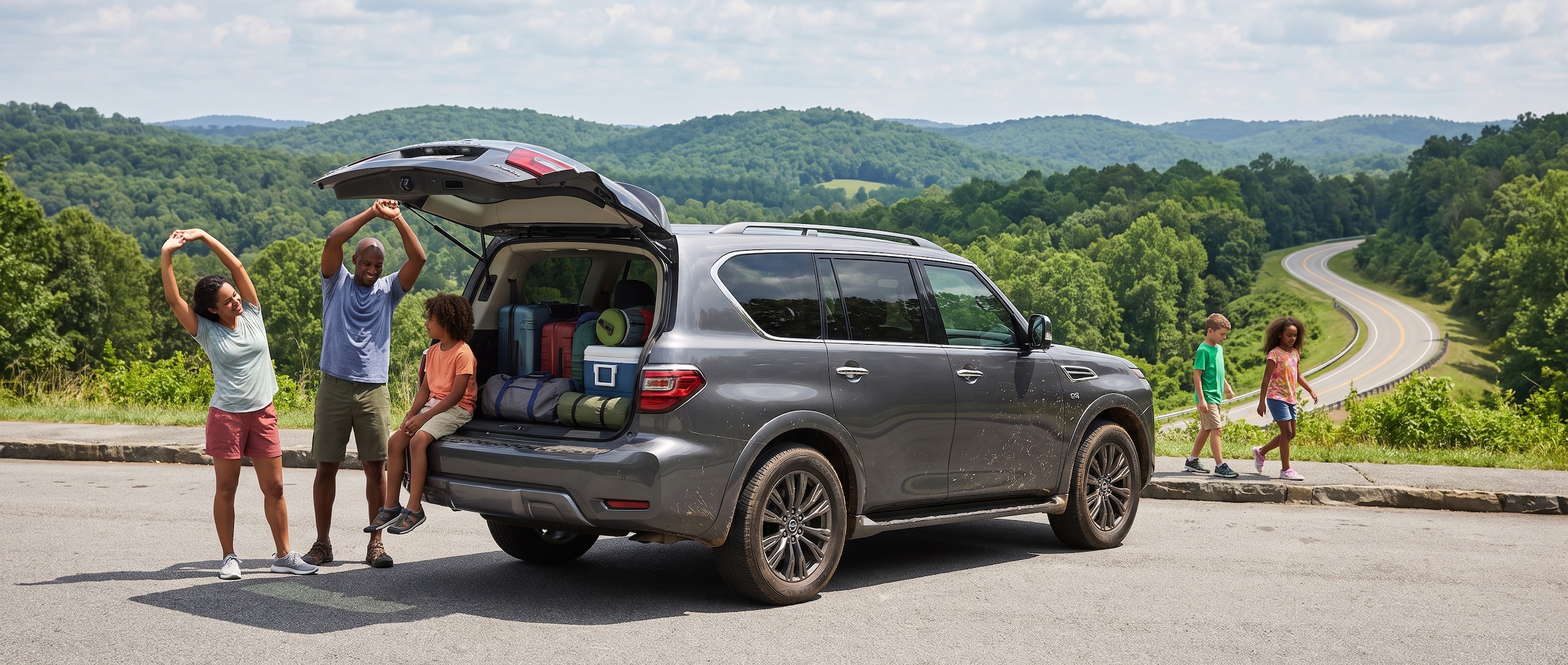
A lot of Birmingham families cross the Nissan Armada off the list before they ever sit in one. The reasoning usually sounds like this: it is too hard to maneuver, the fuel economy will hurt, and the third row is just for kids on short hauls. Those concerns make sense when you are shopping a vehicle by reputation. But the 2026 Armada is a meaningfully different machine than the one those myths describe -- and for a big-crew summer run out of Birmingham, the verified numbers tell a different story.
The 2026 Nissan Armada is built around three rows of real seating, a twin-turbo V6, and enough cargo room to handle what a Birmingham family actually travels with. Let's go through the misconceptions one at a time.
The short version
- Myth: the third row is too cramped for adults. Reality: Nissan added nearly five extra inches of legroom to the 2026 third row over the previous generation, bringing it to 32.9 inches -- more than many mid-size SUVs.
- Myth: fuel economy makes the Armada impractical for long trips. Reality: the EPA rates the rear-wheel-drive 2026 Armada at 16 city / 20 highway / 18 combined mpg, and the 23.9-gallon tank supports a highway range of approximately 425 miles.
- Myth: a vehicle this size is hard to drive and park. Reality: the 2026 Armada comes standard with Nissan Safety Shield 360, a 3D Around View Monitor (on available trims), and an EZ FLEX seat system that makes everyday maneuvering manageable.
- Myth: eight seats means no room for gear. Reality: 20.4 cubic feet of cargo space remains behind the third row with all seats occupied -- enough for a week of bags for a full crew.
- The Armada is a genuine road-trip SUV, not just a parking-lot showpiece.
Is the Armada Really Too Big to Drive Comfortably on a Road Trip?
Full-size body-on-frame SUVs carry a reputation for being cumbersome, and some earn it. The 2026 Armada, though, has built in enough driver-assist technology that "too big" stops being an accurate description for most real-world situations.
Every 2026 Armada comes standard with Nissan Safety Shield 360 -- a package that includes automatic emergency braking with pedestrian detection, blind-spot warning, and rear cross-traffic alert. On upper trims, available ProPILOT Assist 2.1 adds hands-free highway driving capability on mapped routes. For parking, the available 3D Around View Monitor projects a stitched, bird's-eye view of the area immediately around the vehicle, including an Invisible Hood View that lets you see what is directly in front of the bumper. That is a useful tool when you are navigating a crowded rest stop off I-20 or pulling into a downtown Birmingham garage.
The suspension does its part too. Available adaptive electronic air suspension adjusts ride height and damping for highway cruising versus more demanding roads, which keeps the Armada feeling planted and controlled at Interstate speeds rather than floaty. A 9-speed automatic transmission handles the power delivery from the twin-turbo V6 with smooth, predictable shifts that do not demand attention from the driver on long hauls.
The short version: the 2026 Armada is large. It is not unmanageable.
Are the Fuel Economy Numbers Actually Manageable?
This is the myth that does the most damage, and it is partly based on old data. Earlier Armada generations used a naturally aspirated V8, and those real-world numbers were noticeably worse. The 2026 model switched to a 3.5L twin-turbo V6.
The EPA rates the 2026 Armada (rear-wheel drive) at 16 city / 20 highway / 18 combined mpg. Four-wheel-drive configurations come in at 16 city / 19 highway / 17 combined. For a body-on-frame SUV seating up to eight, those figures are competitive within the class. Paired with a 23.9-gallon fuel tank, the rear-drive Armada has a highway range of approximately 425 miles -- enough to clear Birmingham and reach the Gulf Coast, Smoky Mountains, or Atlanta without a scheduled fuel stop en route.
The 2026 Armada's 23.9-gallon tank and EPA highway rating support a highway range of approximately 425 miles -- enough to reach the Gulf Coast from Birmingham on a single fill.
Premium fuel is recommended to achieve the advertised 425 horsepower output. That is a real ownership consideration, and it is honest to name it. But the fuel cost of operating the Armada over a week-long road trip is not the budget disaster the myth suggests -- particularly on predominantly highway miles where the 20 mpg highway rating applies most directly.
The Myth/Reality Breakdown: What the 2026 Armada Actually Delivers
| Myth | What the 2026 Armada Actually Does | Source |
|---|---|---|
| Third row is only for small kids | Third row offers 32.9 in. of legroom; the current generation added nearly 5 extra inches vs. the previous gen | Nissan interior specs |
| Fuel economy makes it impractical | EPA rates 2WD at 18 mpg combined; ~425-mile highway range on a 23.9-gallon tank | EPA / Nissan |
| Eight seats means no room for luggage | 20.4 cu. ft. of cargo remain behind the third row with all seats occupied | Nissan cargo specs |
| It is hard to park and maneuver | Standard Safety Shield 360 + available 3D Around View Monitor (Invisible Hood View on higher trims) | Nissan USA features |
| The ride beats you up on long hauls | Available adaptive air suspension; Zero Gravity front seats available with heating, ventilation, and massage | Nissan USA features |
| You need 8 passengers or it is wasted space | EZ FLEX second-row seats and available power-folding third row convert to 56.3 cu. ft. or 97.1 cu. ft. of cargo | Nissan cargo specs |
What the Third Row Is Actually Like for a Birmingham Big Crew
The third-row objection deserves its own section because it shows up in nearly every online discussion of the Armada -- and the 2026 model changed it significantly.
The 2026 third row offers 32.9 inches of legroom, and Nissan gained nearly five extra inches of rear legroom compared to the previous generation in the current redesign. For context, a lot of mid-size three-row crossovers land in the 29-31 inch range for their third-row seats. The Armada's 63.1 inches of shoulder room across the third row means three passengers are not forced into each other.
The seat design itself follows a comfort-oriented approach similar to the Zero Gravity front seats, meaning the cushioning is built to reduce pressure points over time rather than going firm. That matters when you are two hours south of Birmingham heading toward Perdido Key or four hours east toward the Smoky Mountains.
Is it as spacious as the second row? No. Most body-on-frame SUVs in this class place a higher floor under the third row due to the chassis layout, which limits how low the seat cushion can sit. Taller adults on a six-hour run will want the second row. But for a family of six, seven, or eight -- kids through teens to shorter adults -- the third row is genuinely functional, not a penalty.
- Third-row legroom: 32.9 inches (Nissan specs)
- Third-row shoulder room: 63.1 inches (Nissan specs)
- Third-row headroom: 36.2 inches (Nissan specs)
- Gained nearly 5 extra inches of legroom vs. the previous generation
- Power-folding third row available on SL trim and above
The Nissan Pathfinder is worth considering if your crew caps at seven and you prefer a slightly smaller footprint -- it runs a different frame architecture with its own third-row packaging. But if you are routinely loading six to eight people for a full summer road trip, the Armada is the one that makes sense.
So What Should You Actually Do Before Deciding?
The myths around the 2026 Armada persist because most people never sit in one before forming an opinion. The third-row legroom surprise is not something you read yourself into -- you have to put an adult back there and close the door. The highway ride quality on a body-on-frame SUV with adaptive air suspension reads differently in motion than any specification table predicts.
The Nissan Murano handles two-row family needs well. The Nissan Rogue covers everyday commuting and smaller crews efficiently. But if your road-trip situation regularly involves six or more people and real luggage -- Birmingham to the beach, extended family reunions, a full sports team travel weekend -- the Armada is the vehicle that stops forcing compromises.
Here is the practical checklist before you decide:
- Sit in the third row yourself, not just the front seat
- Check how the cargo area handles your actual gear with all seats up (20.4 cu. ft. is the real number to work from)
- Ask about the seating configuration: the bench seats eight, the captain's-chair option seats seven but gives cleaner third-row access
- Confirm whether 2WD or 4WD fits your travel patterns -- the 2WD carries the better fuel economy and highway range
- Drive it on the highway, not just a parking lot test
Frequently Asked Questions
Does the 2026 Nissan Armada have enough cargo space for a full family road trip?
Yes, and the numbers are specific. With all eight seats occupied, the 2026 Armada offers 20.4 cubic feet of cargo space behind the third row -- enough for several rolling suitcases or a mix of bags and gear. Fold the third row and that expands to 56.3 cubic feet. Fold both rear rows and the maximum reaches 97.1 cubic feet. The EZ FLEX second-row seat system makes switching between configurations straightforward without requiring you to wrestle with the seats.
What is the realistic fuel economy for the 2026 Nissan Armada on a highway road trip?
The EPA rates the rear-wheel-drive 2026 Armada at 20 mpg on the highway and 18 mpg combined. On a predominantly highway trip -- the kind you would take from Birmingham to Gulf Shores or up through Tennessee -- you will operate close to the highway figure for much of the drive. The 23.9-gallon tank supports an EPA-estimated highway range of approximately 425 miles on the rear-drive model. Premium fuel is recommended to achieve full rated output, which is an honest trade-off for a 425-horsepower engine in a vehicle this size.
Categories:
Social