

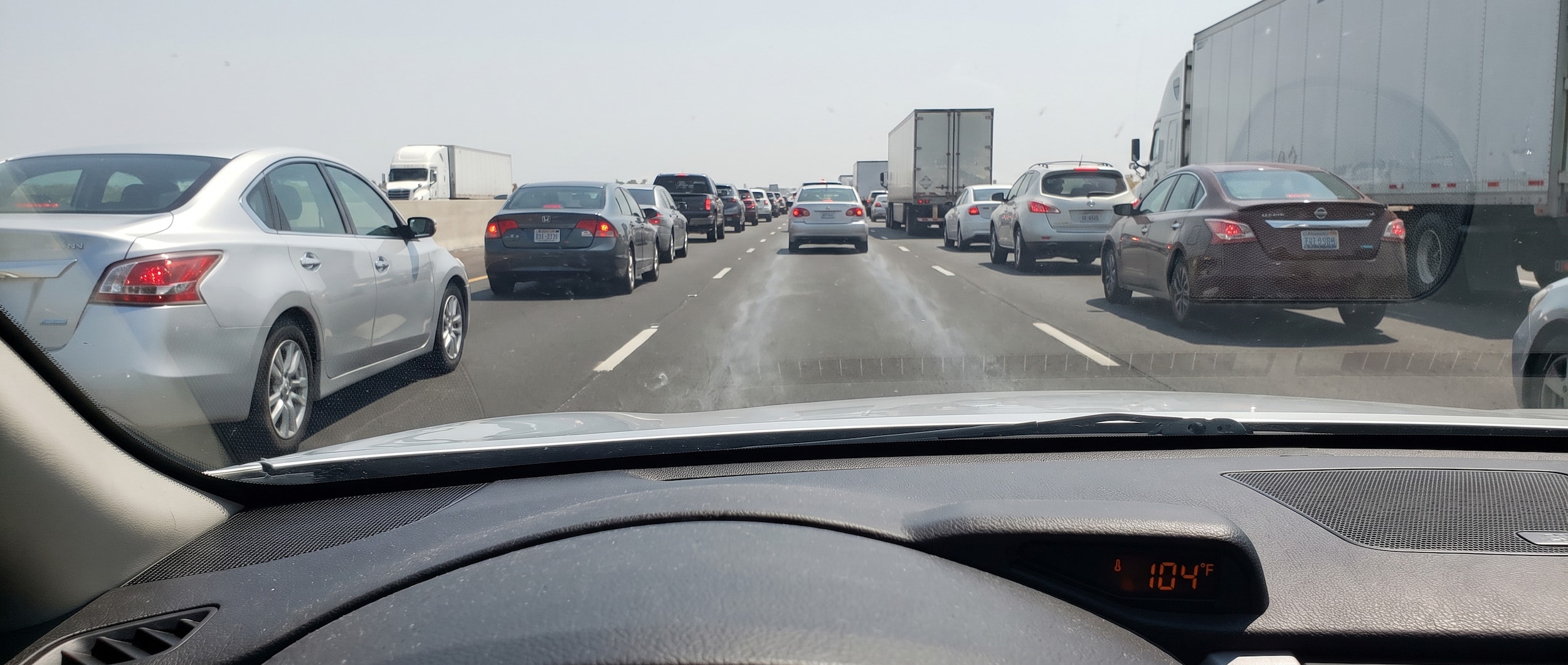
The National Weather Service in Birmingham is issuing heat advisories with afternoon heat index values climbing above 105 degrees across Central Alabama right now. If you drive a Nissan and you spend any meaningful time sitting in traffic on I-65 or crawling through the Malfunction Junction backup where I-20, I-59, and I-65 converge, your cooling system is doing real work today -- and a few widely repeated myths about engine cooling can quietly make things worse.
None of these myths are exotic. Most come from well-meaning advice passed down in parking lots. But they conflict with how modern Nissan cooling systems actually function. Here is what the engineering and the data say.
The short version
- Turning the AC off does not cool your engine faster -- the two systems run on separate circuits, and your AC compressor often triggers an extra cooling fan.
- Your Nissan's temperature gauge sitting at midpoint is normal; that steady needle is designed behavior, not a lucky sign.
- Adding straight water in an emergency is acceptable as a short-term measure, but water alone boils at 212 degrees F -- far below what a proper 50/50 mix can handle.
- Removing or bypassing the thermostat makes overheating more likely, not less.
- If the gauge is moving into the danger zone, turning the cabin heater to full blast is a real, effective emergency technique -- not a myth.
Is It True That Turning Off the AC Will Save Your Engine in Traffic?
This is the single most common cooling myth among Birmingham commuters, and it is also the most consequential to get wrong. The Nissan Altima and every other Nissan in the current lineup uses two completely separate heat-management circuits: the engine cooling circuit (coolant, radiator, water pump, thermostat, electric fans) and the AC circuit (refrigerant, compressor, condenser, evaporator). They share one thing -- the airflow path through the front of the car -- but they do not share coolant, and disabling one does not meaningfully speed up the other.
There is also a counterintuitive wrinkle. On most modern Nissans, engaging the AC compressor signals the secondary electric cooling fan to activate. That fan pulls additional air through the radiator, which benefits the engine. Switch the AC off to "save" the engine and you may actually lose one fan cycle.
| Cooling Myth | What Is Actually True | Source Basis |
|---|---|---|
| Turning off the AC cools the engine faster | Engine and AC circuits are independent; AC activation often triggers an extra cooling fan | Auto-engineering technical sources |
| Temperature gauge staying at midpoint means "fine" regardless | The gauge is deliberately designed to appear stable over a wide range; actual coolant temp can vary 195-210 degrees F before the needle moves | Nissan owner community + NWS-documented heat load context |
| Adding straight water is a good emergency fix | Water boils at 212 degrees F; a proper 50/50 mix raises the boiling point to approximately 260 degrees F | Industry cooling system data |
| Removing the thermostat prevents overheating | Without the thermostat, coolant moves too fast through the radiator to shed heat -- especially in stop-and-go traffic | Engine cooling engineering sources |
| Running the cabin heater hotter makes overheating worse | Turning the heater to max draws heat away from the engine block -- a legitimate emergency measure per Nissan's own guidance | Nissan official service guidance |
Your Temperature Gauge Is Not as Honest as You Think
The Nissan Rogue, the Altima, the Sentra, and most mainstream Nissan models share a design decision that frustrates a lot of owners: the temperature gauge on the dash is intentionally dampened. It is calibrated to sit at midpoint across a wide band of actual coolant temperatures -- roughly 185 to 210 degrees Fahrenheit -- so it will look perfectly steady whether the engine is running comfortably or pushing close to the threshold. The goal is to prevent driver panic over normal thermal cycling. The side effect is that a needle parked at center tells you less than you might expect.
What this means on a 91-degree July day sitting in the Malfunction Junction backup: the gauge may look fine while your electric fans are working hard to keep coolant from climbing into dangerous territory. The warning light and the gauge moving toward red are both late signals. An earlier clue is the AC blowing noticeably less cold while you are at a dead stop -- that can indicate the electric fans are struggling, since the same fans serve both circuits.
On most modern Nissans, the primary cooling fan activates around 200 degrees F and the secondary fan engages around 212 degrees F or when the AC draws extra demand -- which is why a hot idle with working fans rarely becomes an overheating event when the cooling system is healthy.
If you notice the AC underperforming during a slow crawl on I-65 southbound toward Hoover, that is a practical signal worth paying attention to, not just a comfort complaint.
Schedule a Cooling System Inspection
What Straight Water Actually Does in an Emergency
This myth has two layers. The first is the emergency layer: if your gauge is climbing and you have nothing but tap water available, adding water is better than running the engine dry. That part is true. The second layer is where the myth hardens into bad habit -- leaving water as a permanent fix.
Plain water boils at 212 degrees Fahrenheit. A healthy 50/50 mix of antifreeze and water raises that boiling point to approximately 260 degrees Fahrenheit, which is why a pressurized system with the correct coolant mix can handle Birmingham's stop-and-go summer heat without boiling over. Antifreeze also carries corrosion inhibitors that protect aluminum engine components. Running straight water for more than a short emergency strips those inhibitors and begins corroding internal passages over time.
- Check the coolant reservoir level when the engine is cold, not hot
- Look for a sweet, slightly syrupy smell near the front of the car -- that is the scent of coolant leaking onto a hot surface
- A slow, consistent drop in reservoir level without a visible puddle can point to an internal leak
- Never open the radiator cap when the engine is warm -- pressurized coolant can cause burns
- Top off with the correct premixed Nissan coolant, or a 50/50 distilled water and ethylene glycol mix, as a short-term measure only
So What Should You Actually Do When the Gauge Climbs?
If your temperature gauge moves out of its normal midpoint band while you are sitting in traffic, the steps below give you a real chance to protect the engine without making things worse.
First: turn the cabin heater to maximum heat and the fan to high. This sounds backward, but it is not a myth -- the heater core pulls heat out of the coolant loop and dissipates it into the cabin. Nissan's own service guidance confirms this as an appropriate emergency measure. It will not fix an underlying problem, but it buys you time and may bring the gauge down enough to get safely off the road.
Second: shift to neutral or park at a red light if traffic allows. Keeping the engine at idle rather than under load reduces heat generation while letting the electric fans continue working.
Third: pull over when it is safe. Turn the engine off and leave the vehicle in accessory mode if possible so the fans can continue to run. Wait at least 30 minutes before checking under the hood. A pressurized coolant system that is hot enough to move the gauge into the red is hot enough to cause serious burns if you open the radiator cap immediately.
Fourth: do not continue driving. Driving an engine that is genuinely overheating risks warping cylinder heads or blowing a head gasket -- repairs that are far more involved than a coolant service or a thermostat replacement.
The average Birmingham commuter spent 57 hours sitting in traffic congestion in 2024, according to the Texas A&M Transportation Institute. With Highway 280 and the I-65 corridor running hot all summer, keeping the cooling system in good working order before a problem develops is a practical choice, not optional maintenance. The Nissan Versa and every other current Nissan model share the same cooling system logic: healthy coolant, working fans, and an intact thermostat handle Birmingham summers reliably. Get the cooling system checked before the next heat advisory.
Frequently Asked Questions
Does running the AC actually help keep the engine cool in stop-and-go traffic?
In a healthy Nissan cooling system, yes -- indirectly. The AC compressor triggers the secondary electric cooling fan to activate, and that fan also pulls air through the radiator. This helps the engine as well as the AC condenser. Turning the AC off to "protect" the engine can remove that extra fan activation. If the gauge is already climbing toward the red zone, turning the AC off and switching to maximum heat is the appropriate emergency step -- but the goal is to get off the road, not to continue driving.
How often should the coolant be flushed in a Nissan driven in Birmingham summers?
Nissan's maintenance guidance for most models points to coolant replacement at 60,000 miles or four years under normal conditions. Vehicles driven frequently in stop-and-go traffic -- which describes most Birmingham commuters navigating the Highway 280 and I-65 corridors -- place more thermal stress on coolant than highway cruising does. Coolant degrades chemically over time and loses its corrosion-inhibiting properties even if the level stays steady. If you are not sure when the coolant was last serviced, a visual check of color and condition (healthy coolant is typically bright green, orange, or blue depending on type; murky or rust-colored fluid is overdue) is a reasonable starting point before the height of summer heat.
Categories:
Social