

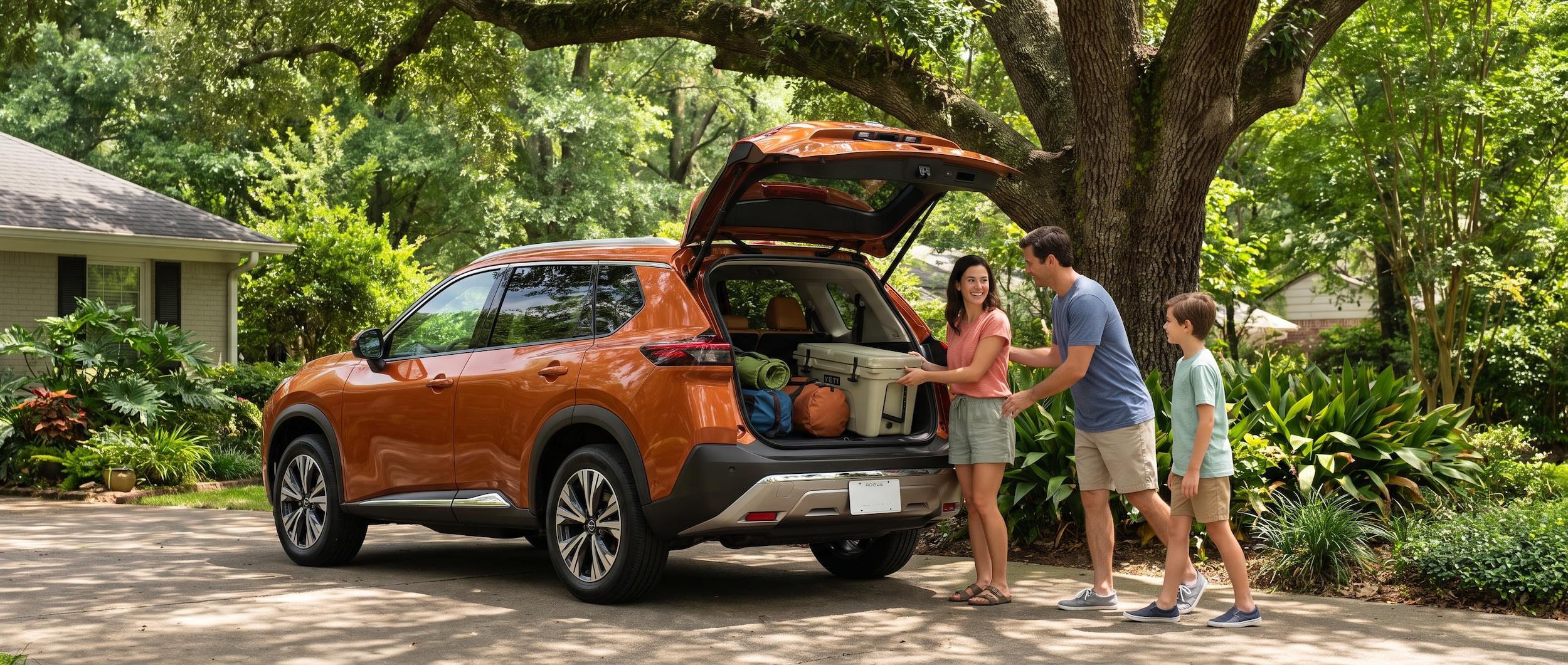
When the heat index pushes past 105 degrees on a Birmingham July afternoon and you are running two kids to soccer practice with a cooler in the back, the fine print in a compact SUV comparison starts to matter. The 2026 Nissan Rogue and the 2026 Honda CR-V are two of the most popular choices in this class, and they are genuinely close in many respects -- but they make different bets on what Birmingham families actually need day to day.
The Rogue leads on available driver-assist technology and a more powerful engine at a competitive trim entry point. The CR-V leads on raw cargo volume behind the second row and offers a hybrid powertrain with meaningfully better fuel economy. Neither is the wrong answer. The right one depends on how your family actually uses a compact SUV across a typical week.
The short version
- Cargo-first families: The CR-V puts 39.3 cubic feet behind the rear seats in gas trims (the Rogue offers 36.3) -- a practical edge when seats stay occupied and the cargo area stays full.
- Tech-forward families: The Rogue's ProPILOT Assist -- adaptive cruise plus steering assist -- is available from the SV trim up; the CR-V offers no equivalent at any trim.
- Efficiency-minded families: The CR-V Hybrid reaches an EPA-estimated 40 mpg combined FWD; the non-hybrid Rogue delivers 32 mpg combined FWD. A real gap worth calculating over the miles you drive.
- Safety baseline: Both vehicles include a comprehensive standard driver-assist suite on every trim, including automatic emergency braking and blind-spot monitoring.
- Need a third row? Neither compact SUV offers one. The Nissan Pathfinder seats up to eight and is the next step up for larger families.
How Do These Two SUVs Actually Compare?
Side by side, the 2026 Rogue and 2026 CR-V are closer than the brochures suggest on some criteria and farther apart than most shoppers realize on others. Here is where the verified numbers land.
| Feature | 2026 Nissan Rogue | 2026 Honda CR-V Gas | 2026 Honda CR-V Hybrid |
|---|---|---|---|
| Cargo behind rear seats | 36.3 cu ft | 39.3 cu ft | 36.3 cu ft |
| Max cargo (seats folded) | 74.1 cu ft | 76.5 cu ft | 76.5 cu ft |
| Engine output | 1.5L VC-Turbo, 201 hp | 1.5L Turbo, 190 hp | 2.0L Atkinson + electric |
| EPA combined MPG (FWD) | 32 mpg | 30 mpg | 40 mpg |
| EPA combined MPG (AWD) | 31 mpg | 29 mpg | 37 mpg |
| Rear legroom | 38.5 in | 40.4 in | 40.4 in |
| Standard safety suite | Safety Shield 360 (all trims) | Honda Sensing (all trims) | Honda Sensing (all trims) |
| Highway semi-auto assist | ProPILOT Assist (SV and above) | Not offered | Not offered |
| Standard touchscreen | 8 in (S/SV) / 12.3 in (SL/Platinum) | 9 in (all trims) | 9 in (all trims) |
| Best for | Highway commutes, cargo flexibility | Maximum rear cargo, passenger room | Long-term fuel savings |
The Rogue holds a horsepower advantage -- Nissan's 1.5-liter VC-Turbo delivers 201 hp and 225 lb-ft of torque, compared to the gas CR-V's 190 hp. On a merge from I-20 onto I-65 in mid-afternoon traffic, that 11-horsepower difference is not dramatic, but it is noticeable when the car is loaded with passengers and cargo.
Which Powertrain Fits Birmingham's Stop-and-Go Reality?
Stop-and-go traffic on I-65 through Birmingham is its own category of driving. Add in the afternoon thunderstorms that roll through central Alabama on a near-daily basis in July -- with the National Weather Service in Birmingham noting heat index values climbing above 105 degrees during summer heat advisories -- and you have conditions where both fuel economy and driver fatigue matter more than they would on a clear highway.
The EPA rates the 2026 Rogue FWD at 32 mpg combined and the AWD version at 31 mpg combined. Those are competitive figures for a non-hybrid compact SUV. What makes them particularly relevant for a Birmingham commuter is the Rogue's ProPILOT Assist system, available on the SV trim and above. It combines adaptive cruise control with lane-centering steering assist, which reduces the physical and mental workload on congested stretches. When traffic is slow and the air conditioning is running hard against central Alabama summer heat, that assist makes the daily commute noticeably less draining.
The CR-V Hybrid takes the efficiency argument in a different direction. The EPA rates the CR-V Hybrid Sport in FWD configuration at 43 city / 36 highway / 40 mpg combined -- eight combined mpg more than the non-hybrid Rogue. Over 15,000 miles of annual Birmingham driving, that difference is meaningful. The practical trade-off is that no CR-V trim, gas or hybrid, offers a semi-autonomous driving assist feature comparable to the Rogue's ProPILOT Assist.
Reviewing financing options before you choose between the CR-V Hybrid's efficiency premium and the Rogue's tech advantages can help you run the actual ownership math for your situation.
The Rogue FWD delivers an EPA-estimated 32 mpg combined without a hybrid system -- among the strongest figures in the non-hybrid compact SUV segment -- while the CR-V Hybrid FWD's 40 mpg combined is the clear leader if long-term fuel cost is the primary decision driver.
Does the Rogue or CR-V Handle Everyday Family Cargo Better?
This is the question that most Birmingham families actually need answered, and the honest comparison splits depending on how you measure it and how your family uses the cargo area.
By raw volume with the second row in use, the CR-V wins clearly. Honda lists 39.3 cubic feet of cargo space behind the rear seats in gas models -- three full cubic feet more than the Rogue's 36.3. Honda also builds the CR-V with a low, wide cargo opening that makes it easy to slide large items in without fighting a high load floor. For a family that keeps the second row occupied by kids and loads the cargo area with gear on most trips, that extra space is real.
Where the Rogue earns its ground back is in cargo flexibility. Nissan's Divide-N-Hide system, available on SL and Platinum trims, offers six different floor configurations -- creating under-floor hidden storage, raising or lowering the cargo floor, or setting up a flat load surface. When seats fold flat, the Rogue opens to 74.1 cubic feet of maximum cargo space, compared to 76.5 for the CR-V. For most family hauling purposes, the 2.4-cubic-foot difference at maximum is academic. The day-to-day flexibility of the Divide-N-Hide system is more useful than that number suggests.
On rear passenger space, the CR-V holds an advantage. Families with older kids who ride in the second row for longer trips -- including the drive south on I-65 toward Bessemer or across town to Hoover -- will notice the CR-V's slightly more generous rear legroom.
Browse available Rogue trims at Hallmark Nissan to see which configurations and Divide-N-Hide-equipped builds are in stock.
Insider note: The Rogue's Divide-N-Hide cargo system is a trim-specific feature -- it appears on SL and Platinum builds. If configurable under-floor storage is important to how your family uses the cargo area, confirm the trim level before you commit.
Matching the Right SUV to Your Family's Pattern
Both the Rogue and the CR-V are well-suited to Birmingham family life, but they fit different everyday patterns. Here is how to match the choice to your actual situation.
The 2026 Rogue fits you if you spend meaningful time on Birmingham's interstate corridors and want semi-autonomous driving assist to ease the commute. It also fits if cargo flexibility -- the ability to reconfigure the floor rather than just fold seats -- matters more than maximum raw cargo volume. The Rogue's engine produces more horsepower than the gas CR-V at comparable trims, which provides a bit more confidence when merging or passing on a loaded I-20.
The 2026 CR-V Gas fits you if you need every cubic foot of behind-the-seat cargo space because your family keeps the second row full and the cargo area loaded simultaneously. The 39.3 cubic feet behind the rear seats is a genuine, measurable advantage for families who load and unload daily without the option to fold seats.
The 2026 CR-V Hybrid fits you if fuel economy is the primary long-term financial driver and you drive enough annual miles for the hybrid powertrain's savings to return meaningful value over three to five years of ownership.
Need more room than either can provide? Families that have outgrown the compact SUV class -- or that routinely carry more than five passengers -- should take a close look at the Nissan Pathfinder, which seats up to eight across three rows and moves into a larger capability class.
Frequently Asked Questions
Is the Rogue's 3-cylinder engine reliable enough for a family daily driver?
The 2026 Rogue uses Nissan's 1.5-liter VC-Turbo engine, a variable-compression turbocharged three-cylinder that produces 201 horsepower and 225 lb-ft of torque. The variable-compression design continuously adjusts the compression ratio to balance power and efficiency, which is a different architecture from the fixed-compression engines in earlier Rogue generations. The current generation Rogue, which launched in 2021, uses this engine on a different platform than the models that generated reliability concerns in the 2014 to 2020 generation. For a Birmingham family doing daily commutes and mixed-speed driving, the engine delivers enough output for the segment without requiring it to be pushed hard.
Does the CR-V Hybrid actually pay off compared to the non-hybrid Rogue?
The CR-V Hybrid delivers an EPA-estimated 40 mpg combined FWD versus the non-hybrid Rogue's 32 mpg combined FWD -- an eight-mpg difference. Whether that efficiency gap justifies the higher entry cost depends on annual mileage and intended ownership length. A family putting 15,000 or more miles per year on a vehicle through Birmingham's stop-and-go summer commuting will see fuel savings accumulate at a faster rate. A family driving fewer miles annually, or planning to trade in within three to four years, may find the Rogue's lower non-hybrid entry point -- combined with its ProPILOT Assist availability and the Divide-N-Hide cargo system on upper trims -- a more practical combination overall.
Categories:
Social