

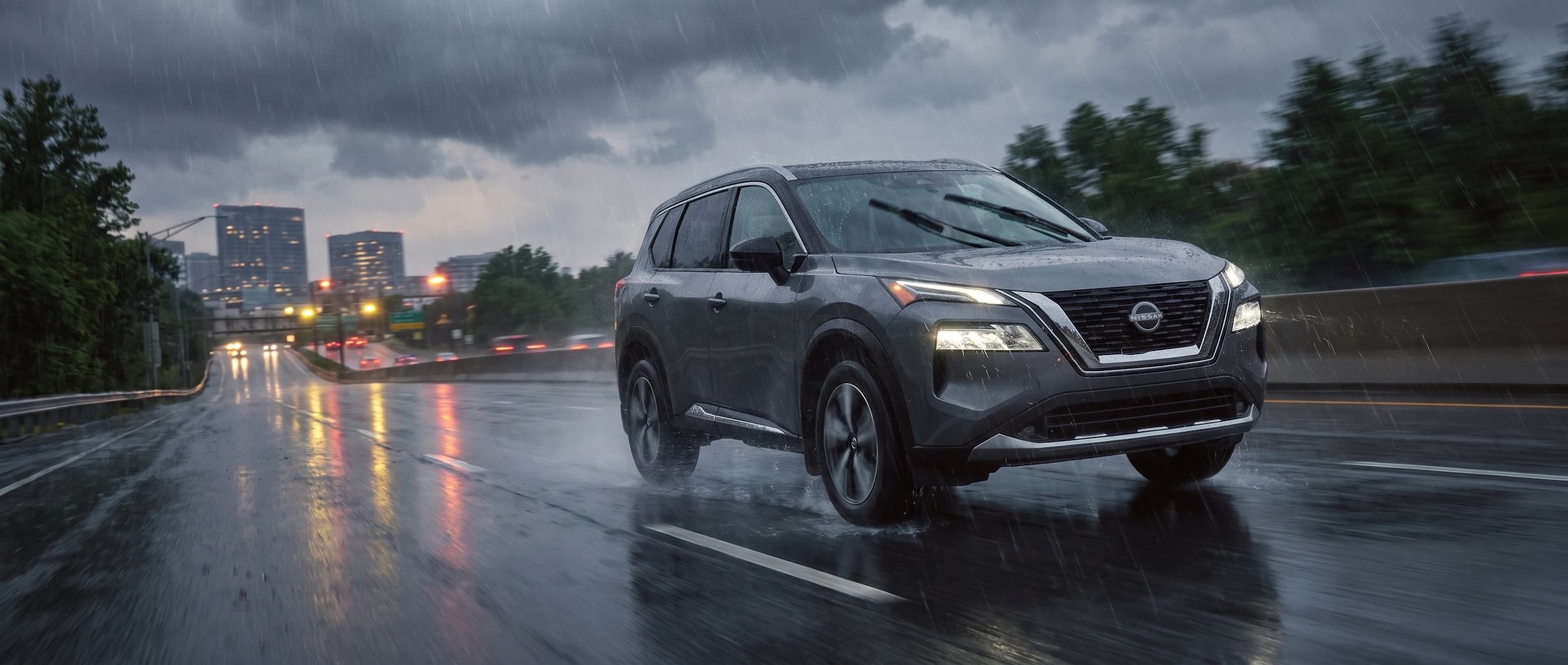
Birmingham's summer storms do not build slowly. One minute you are doing 60 on I-65 in full sun; seven minutes later you are in a wall of rain so thick the lane markers disappear. That combination -- hot pavement, sudden downpour, highway speed -- is exactly when hydroplaning happens. The good news: your Nissan is built with systems that specifically respond to that loss of grip. The important caveat: those systems work best when you know what they do and what they cannot do.
Birmingham receives roughly 56 inches of rain per year -- nearly 50 percent more than the U.S. average -- and July typically brings more rain days than any other month, according to NOAA climate normals. That is not just a weather footnote; it is the reason wet-road technique matters more here than in most American cities.
The Nissan Rogue, one of the most popular models on Birmingham roads, comes standard with Nissan's Vehicle Dynamic Control (VDC) and Nissan Safety Shield 360 on every trim. So does the Nissan Altima, the Sentra, and every other current Nissan in the lineup. Those systems are active right now, on every wet road you drive. Understanding them is the first step to using them correctly.
How Does Birmingham's Summer Weather Create Hydroplaning Conditions?
The storm pattern here is the problem. Central Alabama averages 70 to 80 thunderstorm days per year, per the National Weather Service Birmingham office, and the summer cells that roll through in July and August are fast and intense. A sudden, heavy cell can dump a half-inch of rain in 15 minutes on pavement that has been baking at 95 degrees all day. The hot asphalt repels water initially rather than absorbing it, and the road drains slowly -- so standing water builds up fast in highway dips, outside curves, and low points under overpasses.
The NHTSA notes that wet pavement contributes to approximately 1.2 million accidents in the United States each year, and that hydroplaning risk increases significantly at speeds above 35 mph. At highway speeds typical of I-20/59 or I-65 -- the two main arteries most Birmingham commuters use -- even a shallow film of standing water can lift the front tires off the pavement. The physics: when the tire cannot channel water through its tread grooves fast enough, it rides up on a wedge of water and loses contact with the road entirely.
One spot that deserves special attention: the interchange where I-20, I-59, and I-65 converge downtown, locally called Malfunction Junction, has multiple banked ramps and dips where water pools during heavy rain. If you are navigating that interchange in a summer cell, you need to be below highway speed before the water is visible, not after.
| Local Condition | Where It Shows Up | The Hydroplaning Risk |
|---|---|---|
| Sudden heavy-cell rainfall on hot pavement | I-65, I-20/59 highway lanes | Water films before drainage clears; brief standing water |
| Road dips and low points | Under overpasses, outside of ramps | Water pools; reduced visibility of depth |
| Banked interchange ramps | Malfunction Junction area | Standing water plus lateral force on tires |
| Long stretches of older pavement | Surface streets, Bessemer and Hoover approaches | Worn road texture drains poorly |
What Nissan's VDC System Actually Does on a Wet Road
This is the question most Nissan owners never get a clear answer to, and it matters. Vehicle Dynamic Control is Nissan's name for Electronic Stability Control -- it is not the same thing as traction control, and it is not a substitute for good driving habits. According to Nissan Motor Corporation's published VDC technology overview, the system automatically detects wheel slippage by reading data from wheel speed sensors, a steering-angle sensor, and a yaw rate sensor, then responds by activating individual wheel brakes and reducing engine output as needed.
During a hydroplane event, here is the sequence: one or more front tires lose contact with the road and spin freely. VDC detects the discrepancy between wheel speed and actual vehicle movement, cuts engine power, and applies braking to specific wheels to bring the vehicle back in line with where the steering is pointed. The system processes that data up to 50 times per second, which is far faster than any human reaction time.
"The VDC system automatically detects the driver's actions and vehicle behavior, and responds by activating braking and reduces engine/motor output as necessary, supporting driver confidence on a variety of road conditions." -- Nissan Motor Corporation, VDC Technology Overview
What VDC cannot do: It cannot create traction where none exists. If all four tires are fully floating on water at 60 mph, no electronic system can restore steering or braking until the tires re-contact the pavement. This is why the first line of defense is always speed and awareness, not technology.
The Nissan Pathfinder and Nissan Sentra both come standard with VDC across all trims, just like the Rogue and Altima. The flashing VDC light on your dashboard during a hard rainstorm is not a warning -- it is confirmation the system is working.
A note on summer storm timing in Birmingham: The most dangerous window is typically the first three to five minutes of a heavy cell, when rain is heaviest and road drainage has not yet caught up. If you see a dark wall approaching on the highway, reducing speed before the rain reaches you is safer than reacting after visibility drops.
The Intelligent AWD Advantage: What It Adds (and What It Does Not)
Here is where the conversation about hydroplaning gets more specific for Nissan drivers shopping across the lineup. Intelligent AWD -- available on the 2026 Nissan Altima and standard on upper trims of the 2026 Nissan Rogue and 2026 Nissan Pathfinder -- continuously monitors traction at each wheel and can shift torque rearward when the fronts start to slip.
On a wet Birmingham highway, that matters in one specific scenario: when you are pulling out of a puddle or regaining road contact after a hydroplane. The system detects the front wheel spin and can redirect drive force rearward, helping stabilize acceleration as grip returns. It does not prevent the initial loss of contact, but it can reduce how badly a vehicle wanders when traction comes back.
For the 2026 Altima specifically, Intelligent AWD is available on both SV and SR trims. Nissan Safety Shield 360 -- which includes Automatic Emergency Braking with Pedestrian Detection -- comes standard on every Altima trim regardless of drivetrain. For Birmingham families who split time between downtown surface streets and I-459 in Hoover, that combination of AWD availability and standard safety suite is a practical fit for the conditions here.
The 2026 Rogue carries 8.2 inches of ground clearance across all trims, which helps on flooded dips where lower-clearance sedans can throw a bow wave into the engine bay. It is not a boat, but that extra height does buy margin when surface water is deeper than expected.
See Current Nissan Offers at Hallmark Nissan
Five Things You Can Do Right Now to Reduce Hydroplaning Risk
Your Nissan's systems are reliable, but five driver habits make the biggest practical difference on Birmingham's wet roads:
- Check tread depth before storm season peaks. NHTSA research establishes that tires at 2/32 inch (the legal minimum) lose their ability to channel water effectively, making hydroplaning onset occur at lower speeds and shallower water depths. A quarter inserted into the tread groove -- if you can see the top of Lincoln's head, it is time for new tires.
- Reduce speed before the rain reaches you. Because VDC and AWD cannot create traction that does not exist, the most effective countermeasure is slowing to a speed where your tires can clear water faster than it accumulates under them.
- Keep VDC on. The system is designed for exactly this environment. The only reason to turn it off is a specific off-pavement recovery situation -- never on wet Birmingham highways.
- Follow tire tracks on the highway. The vehicles ahead have displaced water from those lines. Driving in their path reduces the water depth your tires face.
- If you feel the steering go light, ease off the gas -- do not brake hard. Gradual deceleration lets the tires slowly re-engage the pavement. Hard braking on a hydroplaning vehicle has no effect until tires regain contact, at which point the sudden grip can cause a spin.
Categories:
Social