

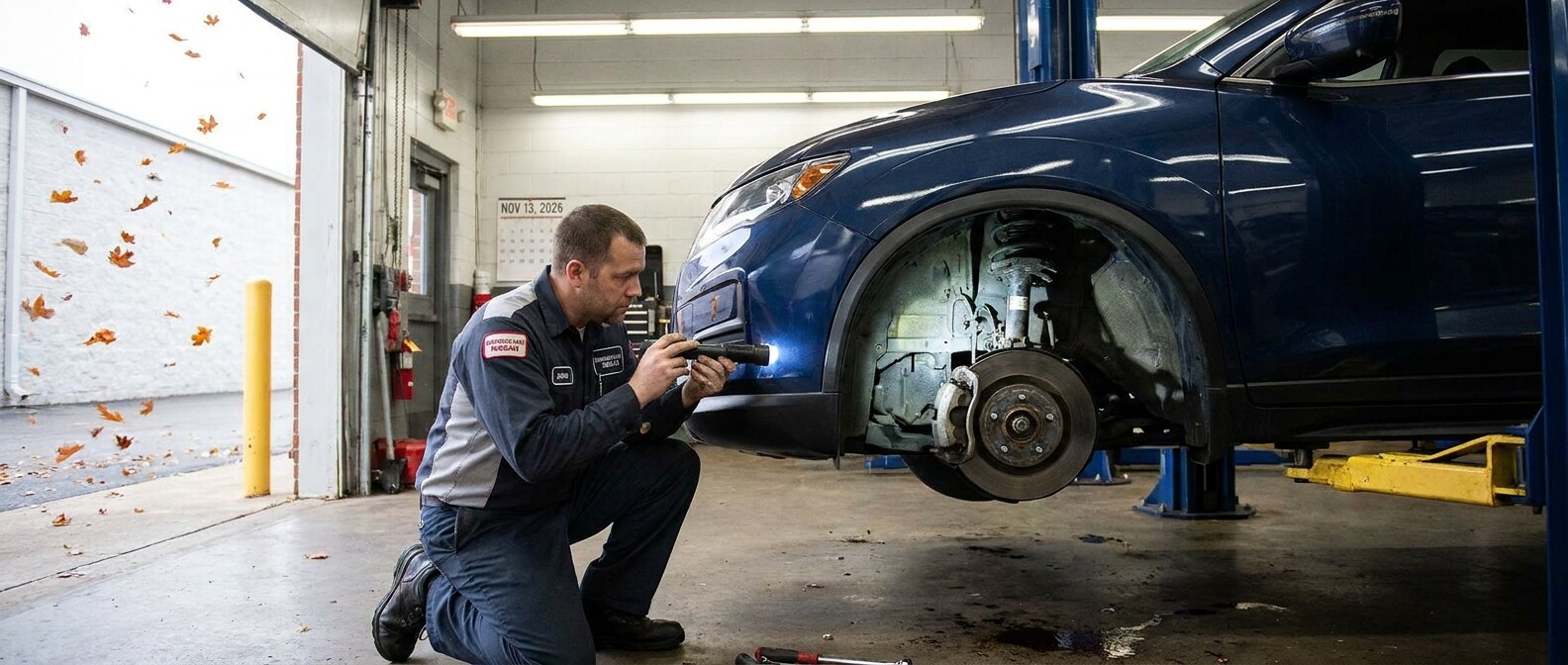
Thanksgiving sits eleven days out, and I-65 and I-20 are about to get serious. The Wednesday before the holiday is when both corridors hit peak volume, and Birmingham's late-November weather adds a wrinkle plenty of drivers miss. The region gets freezing rain more often than snow, so bridges and overpasses on those routes can ice over while the pavement around them still looks dry. We want you rolling into that traffic with a brake system you actually understand, not one that simply hasn't squealed yet.
Book your brake inspection with our service team before the rush starts.
How Does the Brake System Actually Work? The Three-Component Reality
Your brake system runs on three separate wear items, and each one carries its own measurable service limit that gets reached on its own timeline, which means reading pad life tells you nothing automatic about the rotors or the fluid beneath them. Catch one at its threshold and you still know nothing about the other two. So a real inspection checks all three.
Pads are the friction material that clamps against the rotor. New ones start at roughly 10 to 12 millimeters of usable material. At 3mm, most manufacturers call replacement mandatory, and by then the wear indicator (a small metal tab or electronic sensor) is either already screaming at you or about to. Drop to 2mm and the steel backing plate sits a hair's width from the rotor, so the pad's heat management collapses entirely. The squeal you hear is designed. It's the acoustic indicator doing its job.
Rotors are the iron discs the pads clamp against, and each carries a minimum thickness spec stamped into the edge or hub for a technician to check with a micrometer rather than eyeball. Go below that stamped number and the rotor stops shedding heat correctly, giving you the pedal pulsing that plenty of drivers wave off as bumpy roads, though it isn't the road at all.
Brake fluid is the hydraulic link between your foot and the caliper. DOT 3 fluid (the most common spec) has a dry boiling point of 401 degrees F when fresh. The catch with glycol-based fluid is that it's hygroscopic. It actively pulls moisture from the air through brake hoses and seals, and DOT 3 can absorb up to 2% water per year of service. As that moisture climbs, the wet boiling point sinks toward 284 degrees F. Boil the fluid inside the line under hard braking and it vaporizes, so your pedal goes soft. That's brake fade, and it doesn't warn you gradually. It shows up suddenly under sustained pressure.
The hero table below lays out all three side by side.
| Component | How It Works | Warning Sign You'll Notice | Service Threshold |
|---|---|---|---|
| Brake pads | Friction material clamps the rotor to convert speed into heat | High-pitched squeal (acoustic indicator) or dashboard warning light (electronic sensor) | Replace at 3mm; urgent below 2mm |
| Brake rotors | Iron disc the pads grip; absorbs and disperses braking heat | Pulsing or vibration through the pedal or steering wheel during braking | Replace at or below the MIN TH spec stamped on the rotor edge |
| Brake fluid | Hydraulic fluid that transmits pedal force to the caliper | Soft or spongy pedal feel; pedal travel feels longer than usual | DOT 3 wet boiling point drops to 284 degrees F as moisture builds; test or flush on schedule |
Which Components Matter Most on Birmingham's Holiday Routes?
Nissan Rogue owners heading south on I-65 toward Montgomery or north toward Huntsville face a specific November combination, heavy stop-and-go traffic from the holiday volume spike paired with the real possibility of freezing rain on bridges and overpasses, and that mix strains a brake system in ways dry-weather driving never does. Alabama's more common winter scenario isn't prolonged sub-20 F cold. It's temperatures hovering near 32 F when moisture is present, which turns elevated roadway surfaces icy while the surrounding pavement stays wet. Braking demand on your system turns inconsistent, and it can arrive suddenly.
How much does old fluid matter here? Enough that fluid condition can outweigh pad thickness, because stop-and-go traffic generates repeated, sustained brake heat. If your fluid has sat in the system for two or more years and never been tested, the moisture content is probably high enough to pull that effective boiling point down in a way you'd feel. A technician can test it in minutes with a probe, no guesswork.
A full brake inspection sometimes turns up more than worn pads. If the rotors are at or near their minimum thickness spec when fresh pads go on, new friction material on worn rotors buys one component time while shortening the life of everything around it. Our team will tell you what's actually on the vehicle and lay out the options straight. A fuller repair takes longer and costs more than a pad swap alone. Have it before you're on I-20 heading toward Atlanta with a family in the car.
Nissan Pathfinder and Nissan Armada owners carrying full passenger loads have extra weight working against the brakes in heavy traffic. More mass means more heat per stop. Same three components, same thresholds, just more demand on each one.
Schedule a Pre-Holiday Brake Inspection
Brake Terms You'll Hear in the Service Bay
| Term | What It Actually Means |
|---|---|
| Wear indicator / squealer | A metal tab or electronic sensor built into the pad that signals minimum safe thickness |
| MIN TH | Minimum thickness specification stamped on each rotor; the discard point |
| Brake fade | The softening of pedal response when fluid vaporizes under sustained heat |
| Hygroscopic | The property of glycol-based brake fluid that causes it to absorb moisture from the air over time |
What This Means Before You Load Up and Leave
A brake check worth the name isn't a glance at the wheel, it's a micrometer reading of pad and rotor thickness, a fluid condition test, and a caliper inspection on all four corners rather than just the fronts, which is the only way to know where each component truly stands. Our service team at Hallmark Nissan can run that inspection and give you a straight answer before the holiday travel window opens.
If everything checks out, you leave with confidence and a documented record of the inspection. If something needs attention, you find out now instead of on a bridge on I-65 the Wednesday before Thanksgiving. Either outcome beats guessing.
Frequently Asked Questions
Does a squealing brake always mean my pads are worn out?
Not always, but it's the most important signal to check promptly. The acoustic wear indicator is specifically engineered to produce a high-pitched squeal when pad friction material wears down to approximately 2 to 3 millimeters, the point where replacement is either recommended or urgent. That said, surface rust on rotors after a vehicle has sat in Birmingham's humidity can produce a brief squeal on the first few stops that disappears on its own. The difference is persistence: rust-related noise clears within a mile or two of normal braking. A wear indicator squeals consistently every time you apply the brakes, and it gets louder as the pad continues to wear. If you're hearing it consistently, don't wait to have it looked at before the holiday trip.
How often should brake fluid be replaced on a Nissan?
Nissan's recommendation varies by model and driving conditions, so your owner's manual is the right starting point. As a practical matter, DOT 3 fluid can absorb up to 2% moisture per year of service, and once water content reaches around 3.7%, glycol-based fluid is considered compromised by industry standards. That threshold is where the wet boiling point drops enough to increase brake fade risk during sustained use. For many drivers, that puts a fluid test or flush on the table every two to three years. If you've never had it changed and your Nissan has been in service for three or more years, testing the fluid condition before a long holiday run on I-65 is a reasonable and inexpensive step.