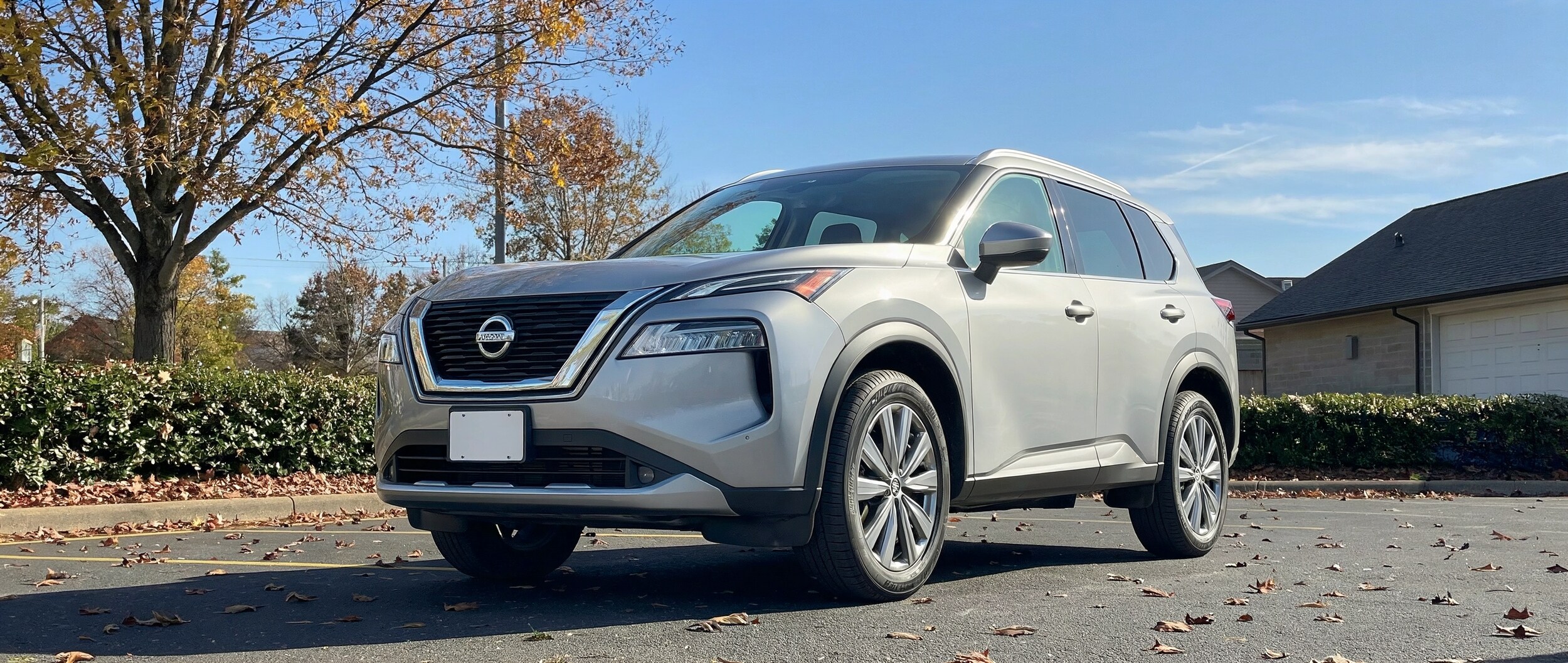
A used Rogue is a genuinely good buy. Roomy, fuel-efficient, loaded with standard safety tech. It rewards the buyer who shows up prepared, though. Two distinct generations sit in the 2019-2026 used window, they run completely different engines, and one of them carries a VIN-specific engine recall you'll want to resolve before signing anything.
Work through it efficiently and you'll leave the lot with confidence instead of questions.
Browse our current used Rogue inventory
What Goes on the Checklist?
Work through these items in order, since the first three questions cost you nothing and settle the biggest unknowns before you ever touch the car.
Before the Lot
- [ ] Identify the generation and engine (see the generation guide below)
- [ ] Pull the 17-digit VIN and run it at the federal recall lookup site. Confirm all open recalls closed
- [ ] Pull a vehicle history report and scan for accident flags, lapsed maintenance, and title issues
- [ ] Verify Safety Shield 360 is confirmed standard for that model year and trim (see guide below)
At the Lot. Under the Hood
- [ ] Ask for maintenance records; look for oil change intervals of 5,000 miles or fewer on 2022-2026 VC-Turbo models
- [ ] Check for any sign of oil leaks around the engine block or valve cover
- [ ] On 2022-2026 models: confirm the VC-Turbo recall (NHTSA 25V437000) is closed on this VIN or the ECM software has been updated
- [ ] On 2019-2020 models: check for any CVT service history or fluid replacement
At the Lot. Exterior and Tires
- [ ] Walk all four corners looking for uneven panel gaps (a sign of prior structural repair)
- [ ] Check all four tires for even tread wear; uneven wear front-to-rear or side-to-side can indicate alignment or suspension issues
- [ ] Look at the wheel wells for rust or undercarriage damage (especially on higher-mileage 2019-2020 examples)
On the Test Drive
- [ ] On 2022-2026 models: listen for any engine knock, vibration, or hesitation at startup. These are the documented complaint patterns on the 1.5L VC-Turbo
- [ ] On 2019-2020 models: watch for CVT shudder or hunting during light-throttle cruising on the highway
- [ ] Test all Safety Shield 360 functions: lane departure chime, automatic emergency braking display, blind-spot indicators
- [ ] Test the infotainment fully. Check Apple CarPlay connectivity and confirm the display responds cleanly
- [ ] Run the heat and air conditioning through a full cycle; compressor failures appear across multiple model years
Documentation
- [ ] Confirm any open recall has a scheduled repair date if parts are unavailable
- [ ] Get a written record of the recall status before you agree to terms
Understanding the Generations: Why It Changes Everything
The 2019-2026 used window covers two mechanically distinct Rogues, and which one you're buying changes everything from the engine under the hood to the recall list you'll run. Know what you're looking at before anything else.
See new Rogue inventory for comparison
Second Generation: 2019-2020
These are the final two years of the outgoing design, and they're often the most affordable used Rogues on the lot. Both run a 2.5-liter inline four-cylinder rated at 170 horsepower and 175 lb-ft of torque, paired with Nissan's Xtronic CVT. The 2020 model made Safety Shield 360 standard across all trims. On the 2019, it was standard only on SV and SL grades, so verify the trim before you assume it's equipped.
On second-gen models, the documented concern is CVT durability, and on higher-mileage examples (say, 80,000 miles and up) you want transmission service records in hand. The 2019 carries three recall campaigns and 337 complaint filings, with service brakes the most-cited area. The 2020 is cleaner, one recall campaign and 152 complaints. When clean 2020 Rogues come through here with solid records and reasonable mileage, they tend to be the best value in the whole used window.
Third Generation: 2021-2026
Nissan fully redesigned the Rogue for 2021. That first-year truck used a 2.5-liter naturally aspirated four (181 horsepower, 181 lb-ft of torque), and it piled up 10 recall campaigns in its debut production year. Fuel pump issues, wheel nut installation, seatback weld concerns, which is a lot for any first-year model. Run the VIN on a 2021 carefully.
Starting with the 2022 model year, Nissan swapped in the 1.5-liter VC-Turbo three-cylinder. That engine makes 201 horsepower, 225 lb-ft of torque, and a combined fuel economy rating of 33 mpg, a real improvement in everyday pull and efficiency. The tradeoff is the recall situation. NHTSA campaign 25V437000 covers 2021-2024 Rogues with VC-Turbo engines for a potential engine bearing defect. The remedy is an ECM software update at no charge, but you'll want it confirmed closed on the specific VIN before you buy. The 2023 model year has the highest complaint volume in the third generation (736 documented filings, with engine complaints leading). A 2024 brought a significant interior refresh and Google built-in infotainment, and it shows a cleaner complaint picture (215 filings, 4 recalls).
The 2025 added the Rock Creek trim and shows lower complaint volume so far. The 2026 is early in its used-market life.
Sweet spots in the range: The 2020 (second gen, clean record) and the 2024 (third gen, refreshed interior, recall-confirmed) are where we'd look first if the goal is balancing value against documented risk.
The One Recall That Changes the Conversation
Explore financing options for a used Rogue
Schedule a pre-purchase service inspection
One recall deserves its own section here, because NHTSA campaign 25V437000 covers certain 2021-2024 Rogue models with the 1.5-liter or 2.0-liter VC-Turbo engine, and whether it applies to a given car isn't something you can read off the model year. The concern is engine bearings with potential manufacturing defects that can lead to engine failure. Because Nissan defined the affected vehicles by engine serial number rather than by model year alone, the VIN lookup is the only reliable way to know whether a specific car is included.
In practice, a 2022 or 2023 Rogue with an unresolved recall isn't an automatic reason to walk away, but it's a conversation you need to have before agreeing to any price. The fix (an ECM software update) is free at a Nissan dealer. What you want in writing is confirmation that it's been done, or a commitment with a timeline if parts are still pending.
| Item | Why It Matters |
|---|---|
| VIN recall check (before the lot) | Applies by engine serial, not model year, only the VIN tells you |
| ECM update confirmation (2022-2024) | NHTSA 25V437000 remedy; must be closed, not just acknowledged |
| Oil change interval records (2022-2026) | VC-Turbo engines show sensitivity to extended intervals |
| CVT service history (2019-2020) | Documented wear pattern on higher-mileage second-gen examples |
| Safety Shield 360 trim verification (2019) | Standard only on 2019 SV and SL, not the base S |
| Test-drive engine behavior (2022-2026) | Knock, vibration, or hesitation at startup are documented patterns |
| Vehicle history report | Accident history and lapsed maintenance are the two biggest value-killers |
Print This, Bring It, and Trust What You Find
A used Rogue that clears every item on this checklist is a confident buy. One that can't answer the VIN recall question, or won't produce maintenance records, deserves more patience before you commit.
Print the checklist at the top of this article. Run the VIN before you make the drive over. And if you want a second set of eyes before you sign, our service team can walk through a used Rogue with you and confirm recall status on any vehicle, whether you bought it here or somewhere else.
View Rogue inventory at Hallmark Nissan
The best version of this process ends with a Rogue that fits your life and doesn't surprise you two months later.
By the Hallmark Nissan Team | November 2026
Frequently Asked Questions
What are the best model years for a used Nissan Rogue?
The 2020 and 2024 model years stand out in the 2019-2026 used window. The 2020 is the stronger of the two second-generation options, one recall campaign and a cleaner complaint picture than the 2019. Among third-generation models, the 2024 brings a refreshed interior, Google built-in infotainment, and a lower complaint count than the 2023, provided the NHTSA 25V437000 engine recall is confirmed closed on the specific VIN.
Do all used Nissan Rogues have the VC-Turbo engine and the recall?
No. The 1.5-liter VC-Turbo engine arrived for the 2022 model year. The 2019 and 2020 Rogues use a 2.5-liter naturally aspirated four-cylinder and aren't covered by that recall. The 2021 also used a 2.5-liter engine (181 horsepower) and is generally not covered, though the recall is defined by engine serial number, so running the VIN on any 2021 is still the right call. NHTSA campaign 25V437000 primarily affects 2022-2024 Rogues with the VC-Turbo engine.