

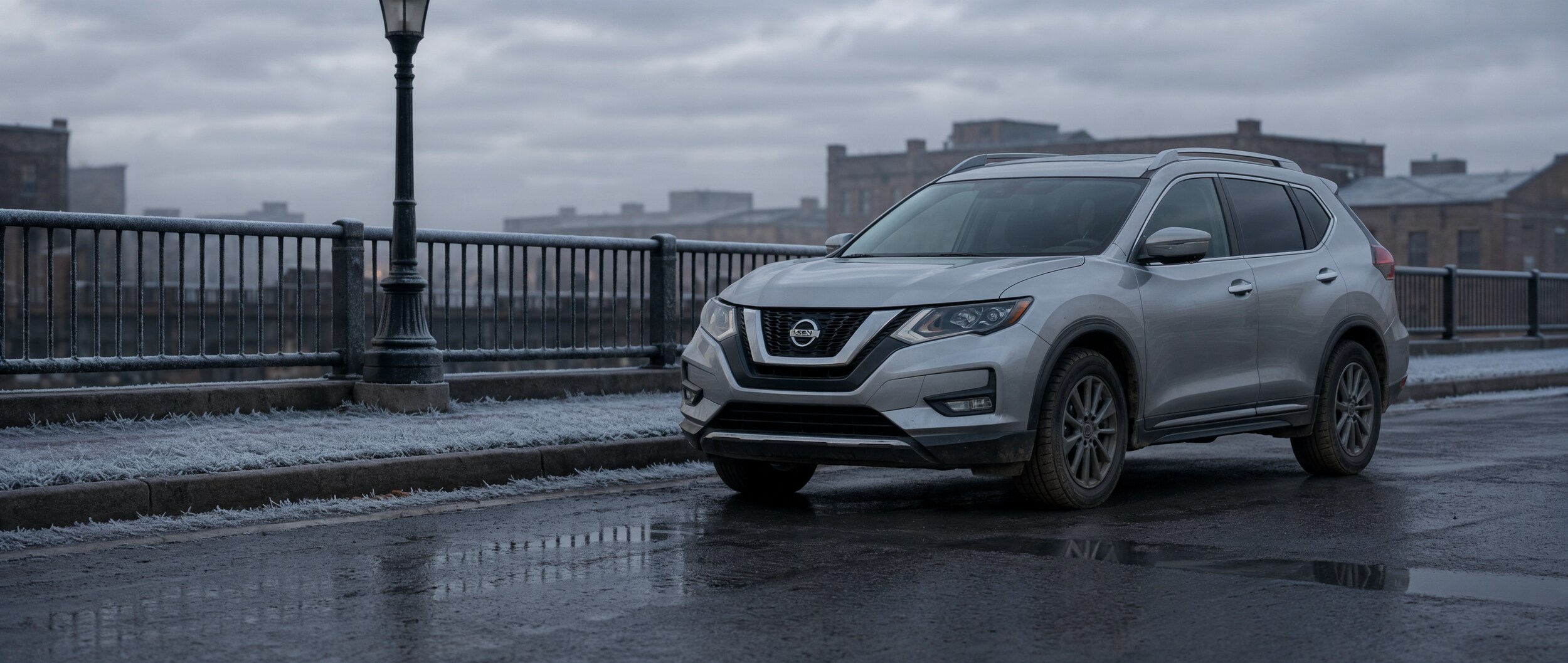
Birmingham winters don't look dangerous on a calendar. The city averages just 1.6 inches of snow per year, and most of that melts within a day. But the freeze counts tell the real story. Birmingham logs roughly 46 nights below 32F annually, and what follows those nights is freezing rain, black ice, and cold pavement that makes even a dry morning commute grip differently than you'd expect. The question isn't whether Birmingham drivers need to think about their tires before winter. It's knowing exactly what to look for.
The Nissan The Nissan Rogue and other Nissans we see coming through our service bay arrive in November wearing all-season tires that look perfectly fine from the outside. We watch for something you can't catch by glancing at the sidewall. Compound condition, tread depth relative to wet stops, and pressure after the first real cold snap all matter here, and all three have a Birmingham-specific answer.
- All-season tires are the right call for most Birmingham drivers, but only if tread depth is at or above 4/32" and pressure is checked after each cold front.
- Dedicated winter tires make sense if you regularly travel to higher elevations or north Alabama, or if your all-seasons are showing wear.
- Tire pressure drops about 1 PSI for every 10-degree Fahrenheit drop in temperature; a 30-degree overnight cold snap can pull 3 PSI from every tire before you leave the driveway.
- All-season rubber begins stiffening below 45F, reducing grip on cold, dry pavement well before ice appears.
- Birmingham's real winter hazard is bridges and elevated interchanges, which freeze before surface roads do.
What Actually Matters When Choosing Winter Tires in Birmingham?
The answer depends less on snowfall and more on three variables, which are how often temperatures dip below 45F, how worn your current tires are, and how much of your driving crosses bridges or elevated ramps. For Birmingham, that last one is the tie-breaker more often than you'd guess.
| Tire Option | Best For | Key Spec | Tradeoff |
|---|---|---|---|
| Quality all-season (M+S rated) | Most Birmingham commuters; temperatures that fluctuate above and below freezing | Tread depth at or above 4/32"; pressure at door jamb spec | Rubber stiffens below 45F; reduced grip on cold dry pavement |
| All-weather (3-Peak Mountain Snowflake symbol) | Drivers who travel to north Alabama or higher elevations frequently | Stays pliable in sustained cold; rated for light snow and ice | Shorter tread life than all-season; not necessary for pure in-town driving |
| Dedicated winter tires | Frequent travel to north Alabama, Tennessee, mountain routes in cold months | Flexible compound designed for temps below 45F; aggressive siping | Not cost-effective if stored 8+ months per year; wear faster above 45F |
| Summer tires | Warm-weather performance only | Optimized above 45F | Not suitable for Birmingham winters at all; replace or store before first freeze |
The most common mistake we see is a driver assuming the M+S marking on a standard all-season tire equals the 3-Peak Mountain Snowflake symbol. It does not. M+S means the tread pattern is designed for mud and snow. The snowflake symbol means the tire has been tested and certified to meet specific performance thresholds on packed snow. For most Birmingham winters, the M+S tire on a quality all-season is plenty. If your route includes I-65 north toward Cullman on a February morning, the snowflake-rated tire becomes a different conversation.
The 45-Degree Rule: Why Cold Dry Pavement Is the Real Test
Cold dry pavement tests your tires long before any ice forms, because all-season rubber begins stiffening below 45 degrees Fahrenheit. That stiffening starts above freezing, not below it. Grip starts dropping on cold, dry pavement before a single drop of freezing rain hits the road.
Birmingham's average first freeze date lands around November 9. By the time you're reading this in late November, overnight lows have already been flirting with that range for weeks. The morning commute, even on a clear day, can put a stiffened all-season compound to the test on a cold bridge deck.
What our service team checks in fall: tread depth, compound condition, and cold-inflation pressure. We focus on tires within legal limits but riding below 4/32" of remaining depth. Alabama's legal minimum is 2/32", which gets you past a registration check but doesn't give you the wet-road stopping margin you need when a cold front rolls through overnight and leaves bridge decks damp and near-freezing.
Pressure matters just as much. Cold air contracts, and tires lose roughly 1 PSI for every 10-degree drop in temperature. A 30-degree overnight swing can drop 3 PSI from every tire before you pull out of the driveway. A tire that read fine in October can be meaningfully underinflated by December, and that underinflation builds heat through sidewall flex while shrinking the contact patch that generates stopping traction.
Schedule a Tire Check Before the Cold Sets In
Birmingham's Ice Problem: Bridges, Overpasses, and the Morning Commute
Ice is what strands Birmingham drivers, not snow, and it forms in a pattern tied to local geography. Birmingham, Hoover, and central Alabama can see dangerous ice build up on bridges, elevated highways, and steep roads. Rain moves through overnight, temperatures drop to or below freezing, and by 6 a.m. the surface roads look wet while the bridge decks are glazed. The wet road that's fine at 45 mph becomes a completely different surface once it's frozen.
The interstates connecting Birmingham, including I-65, I-20, and I-59, run across elevated structures over and over. Those structures cool faster than surrounding pavement because air moves under them. When moisture freezes, it freezes there first. And because central Alabama doesn't run salt trucks the way northern cities do, treated pavement is no guarantee even on major routes.
So what does this mean for tire selection? The relevant question isn't whether you'll drive in snow. You want to know whether your tires can hold stopping distance on cold, wet, or lightly glazed pavement. A quality all-season tire in good condition handles that. One that's worn below 4/32" or consistently underinflated by 3-4 PSI does not. The gap between those two tires shows up most sharply on exactly the kind of marginal-freeze morning that Birmingham actually has.
The Nissan Pathfinder and other larger vehicles in our lineup come with higher ground clearance and more weight, which affects stopping distance on cold surfaces regardless of drivetrain. All-wheel drive helps you get moving. It won't shorten your stops. Tire condition does that.
Before Birmingham's freeze season is fully underway, verify these four things:
- Check tread depth with a quarter: if Washington's head is fully visible, you're at 4/32" or below and should budget for replacement before the new year
- Measure cold tire pressure in the morning before driving and compare it to the door jamb spec
- Look at the tire's age, not just its tread (rubber degrades internally with age and heat exposure, and Birmingham's long, hot summers accelerate that process)
- Confirm the tire type marking if you're shopping for replacements (M+S for Birmingham, 3-Peak Snowflake if your routes go north)
Match the Gear to How You Actually Drive in Birmingham
The right winter tire choice for a Birmingham commuter isn't necessarily what someone in Huntsville or Nashville would buy, since Birmingham's freeze profile runs mild and episodic rather than sustained. You're not in a city that justifies a full seasonal swap to dedicated winter tires and storage for eight months unless your work or travel patterns regularly take you into colder terrain.
For most of us driving the metro corridors, a quality all-season tire in good repair handles everything Birmingham actually throws at us. The annual average snowfall here is less than 2 inches. What the city does have is wet roads, cold mornings, and ice on elevated structures during the dozen or so genuinely cold snaps each winter. All-season tires are built for that. And it's a tread-depth and inflation problem before it ever becomes a tire-type problem.
Nissan Altima owners and commuters in front-wheel-drive sedans should pay particular attention to rear tire tread depth. In a FWD car on cold pavement, worn rear tires contribute to oversteer in hard stops, and that's the scenario that catches Birmingham drivers off guard on a wet bridge at 32 degrees.
Here's the honest call. If your all-seasons still carry 5/32" or more of tread and you're diligent about checking pressure after cold fronts, you're likely well-covered for Birmingham's winters. If you're below 4/32" heading into December, don't wait for the first ice event to find out how much margin you've lost. Get the inspection done now, while shops aren't backed up and the roads are dry.
Frequently Asked Questions About Winter Tires in Birmingham
Do Birmingham drivers actually need dedicated winter tires?
For most Birmingham commuters, no. Dedicated winter tires make the most sense where temperatures stay below 45F for weeks at a time and significant snow or ice accumulation is routine. Birmingham averages under 2 inches of snow per year and roughly 46 nights below freezing annually, with cold snaps that are real but relatively short. A quality all-season tire in good condition, properly inflated to the door jamb spec, handles the city's typical winter hazards. If your work or travel takes you regularly into north Alabama or Tennessee during winter months, or if your current all-seasons are worn below 4/32" and you're replacing them anyway, dedicated winter tires become worth considering.
Why does my TPMS light come on every time the temperature drops?
That light is responding to physics, not a slow leak. Tire pressure drops about 1 PSI for every 10-degree Fahrenheit decrease in temperature. A cold front that drops overnight temps by 30 degrees can pull approximately 3 PSI from every tire before you start the car. Most tire pressure monitoring systems trigger a warning when pressure falls 25% below the recommended spec, so a cold snap that crosses that threshold will light the warning even if the tire is otherwise healthy. The correct response is to inflate to the cold specification on your driver-side door jamb sticker, not the number on the tire sidewall. If the light reappears repeatedly even after inflation, have the tire inspected for a slow leak. Our service team can check both.