

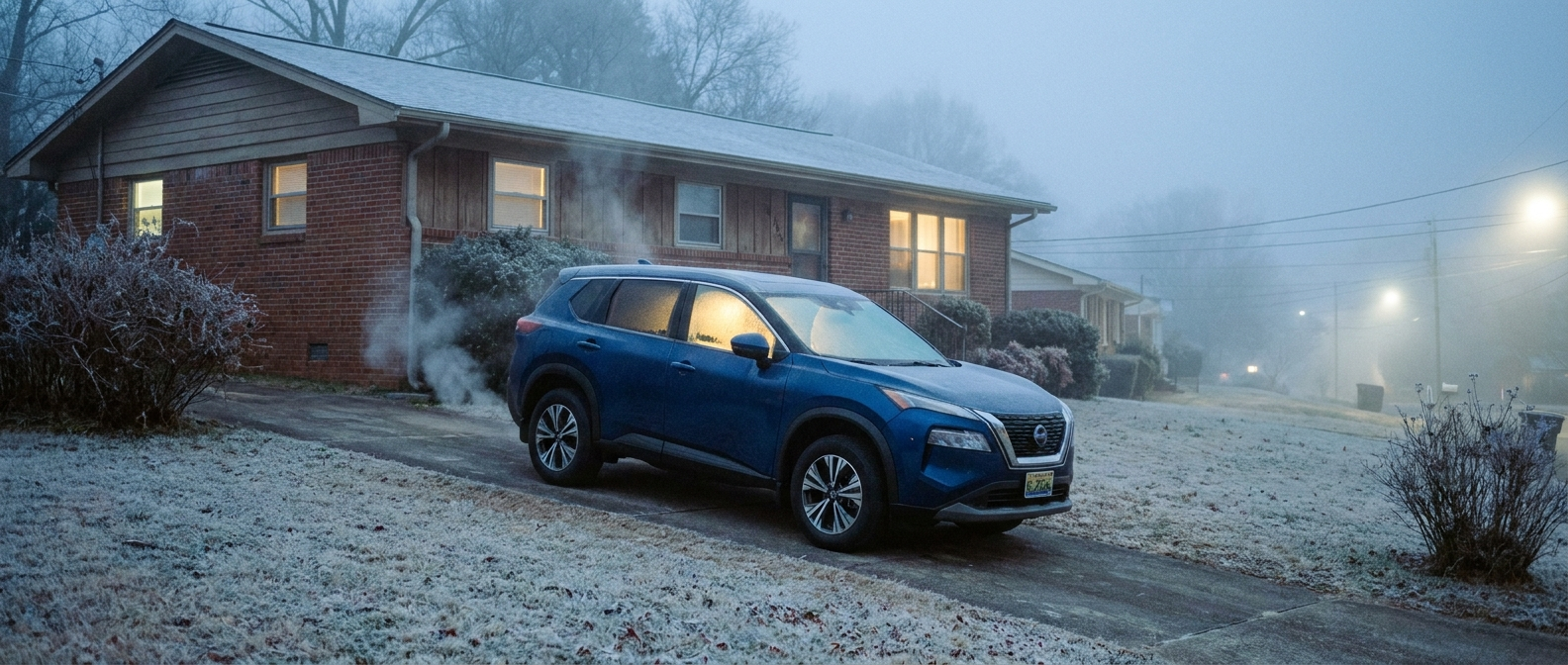
Birmingham winters sneak up on you. Through December and January, plenty of mornings your commute starts in the mid-30s. That's cold enough to make remote start feel essential, and cold enough to drag every old piece of car advice back into daylight. The engine needs 10 minutes, right? Let it idle until the temperature gauge moves. Run it long enough that the defroster clears everything. You've heard it all.
Most of it is wrong. And some of it is costing you.
The 2026 Nissan Rogue sits on our lot with remote start on nearly every trim, and the first cold snap brings the same old habits back around. Start with the myth worth killing first. Your modern Nissan engine does not need an extended warm-up idle. It needs about 30 seconds of oil pressure stabilization, then gentle driving does the rest faster than idling ever could. The finding comes from automotive engineers who study fuel-injected systems, and it shapes everything below.
Here are the five myths we'd most want a Birmingham Nissan owner to have straight before the cold snaps hit.
The Ranking at a Glance
| Rank | Myth | Why It Matters | Real Answer |
|---|---|---|---|
| 1 | "Idle 10+ minutes to protect the engine" | Actively increases cylinder wall wear | 30 sec stabilization, then drive gently |
| 2 | "Remote start harms the starter motor" | Causes owners to skip a genuinely useful feature | Modern starters handle it; auto shutoff protects them |
| 3 | "Remote start drains the battery" | Creates unnecessary anxiety | Capped run times minimize draw; keep the fob battery fresh |
| 4 | "The LEAF's remote start works the same as a gas engine's" | Leads to wasted range on cold mornings | LEAF preconditioning is mechanically different. Do it while still plugged in |
| 5 | "Birmingham doesn't get cold enough to matter" | Leads to skipping useful prep entirely | January lows average around 35 degrees Fahrenheit with cold snaps reaching the low 20s |
Myth 1: Your Engine Needs a Long Idle to Warm Up
No, your engine doesn't need a long idle to warm up, and the habit that feels protective is actually the one doing the most damage, because modern Nissan engines are fuel-injected and computer-controlled and don't wake up the way a carbureted engine from the 1970s did. Back then a mechanical carburetor mixed air and fuel poorly in the cold and really did require time to normalize.
In the first 30 seconds of a cold start, oil pressure builds and lubricant reaches the upper valvetrain. The oil pressure part is real. After that, the ECU manages fueling automatically. An engine at idle warms more slowly than one under light load, because load generates heat more efficiently. Extended cold idling also runs a rich fuel mixture that can wash raw fuel down cylinder walls, the opposite of protective.
So what's the right use of remote start on a cold Birmingham morning? Start it. Let oil pressure stabilize for 30-60 seconds. Then get in, drive gently for the first few miles, and let the engine warm under load. Remote start earns its keep by making the cabin comfortable and clearing the glass, not by doing extended engine prep that the engine doesn't need.
Schedule a Pre-Winter Service Check
Myth 2: Using Remote Start Wears Out Your Starter Motor
No, normal remote start use won't wear out the starter on a current Nissan, though the worry made real sense in an older era when starter motors and electrical systems had genuine fatigue limits. A system triggered four times a morning, every morning for years, could add up back then. That was a reasonable thing to worry about in 1998.
Modern starter motors are engineered for high cycle counts. The 2026 Nissan lineup's remote start systems also include automatic shutoff timers. On key-fob-activated systems, the engine shuts off after a set period if you don't enter the vehicle. The shutoff prevents the kind of extended unintended cranking that would stress any component.
The 2026 Nissan Altima and the 2026 Nissan Pathfinder both carry remote start on equipped trims, and the system on each includes that safety shutoff. It runs, it warms the cabin, it stops. Starter wear from normal remote start use on a current Nissan is not a meaningful concern.
Keep an eye on the key fob battery instead. A weak fob battery reduces range and can make the remote start appear to malfunction. Swap it at the first sign of shorter range or delayed response.
Myth 3: Remote Start Kills Your Car Battery
No, remote start won't drain a healthy battery in normal use, even though running the engine without driving feels like a net pull, because remote start run times on Nissan vehicles are capped, typically in the 10-to-15-minute range that keeps load well within what the charging system handles. The concern is understandable, but the math works out fine.
On a cold Birmingham morning (we're talking the mid-30s that NWS records as a typical January low), the weather isn't extreme enough to stress a healthy battery through remote start. Age is what stresses batteries. A battery that's three or four years old and hasn't been tested will struggle with cold starts regardless of whether you use remote start. Put that in the pre-winter service check column, not the remote start column.
One scenario does make battery drain relevant. Using the MyNISSAN app for remote start requires an active NissanConnect Services subscription. After the trial period that comes with equipped new vehicles ends, app-based remote start stops working until you renew. The key fob method, on trims that include it, doesn't require a subscription. Know which method your trim supports before the first cold morning.
Myth 4: The LEAF's Remote Start Works Just Like a Gas Engine's
No, the LEAF's remote start works differently from a gas engine's, and getting that wrong costs you real range on a cold morning, because on the 2026 Nissan LEAF, remote start is really preconditioning, and where the energy comes from changes everything. So let's be precise here.
On a gas-powered Nissan, remote start runs the engine. The engine generates heat. The cabin warms. Simple.
On the 2026 LEAF, "remote start" is really preconditioning. The LEAF uses its 75 kWh liquid-cooled battery pack and a standard heat pump to warm the cabin and bring the battery to an efficient operating temperature. The part that matters comes next. If you precondition while the LEAF is still plugged into your home charger, the energy to warm the battery and the cabin comes from the grid, and the battery pack stays untouched. Your estimated range when you unplug is essentially unaffected by the warm-up process.
If you unplug first, then precondition, the battery does that thermal work itself. Nissan estimates the 2026 LEAF S+ at up to 303 miles of range under EPA testing. Cold weather cuts real-world range. Testing in harsh winter conditions has shown drops of 25-35% depending on temperature severity. Preconditioning on grid power recovers a meaningful portion of that loss. Make it a habit to schedule or activate preconditioning before you unplug.
Myth 5: Birmingham Doesn't Get Cold Enough for Any of This to Matter
Yes, Birmingham's a mild-winter city, but mild here still means January lows averaging around 35 degrees Fahrenheit with cold snaps pushing into the low 20s in some winters, which is plenty cold enough for thick oil, dropped tire pressure, and frosted glass to matter. We know the reputation. The mornings don't always honor it.
The National Weather Service notes Birmingham sits in the Appalachian foothills, which means the city can see cold pocket weather that surprises drivers who moved here from further south.
At 35 degrees Fahrenheit, your engine oil is thicker than it is at operating temperature, your tire pressure has dropped roughly 1 PSI for every 10-degree fall from when you last checked it, and your windshield will have condensation or light frost that takes longer to clear than a rushed morning allows. None of that is dangerous with a little prep. All of it is worse when you're already running late and assumed it wouldn't matter.
Our service team can check tire pressure, battery health, and wiper condition before the cold season properly arrives, the kind of 20-minute visit that makes the 6:45 AM commute down I-65 a lot less eventful.
Remote start in that context isn't about babying your engine. It's about walking out to a car that's already clear, already warm enough to defrost fast, and ready to drive gently from the first block. That's all it needs to do. And that's exactly what it does.