

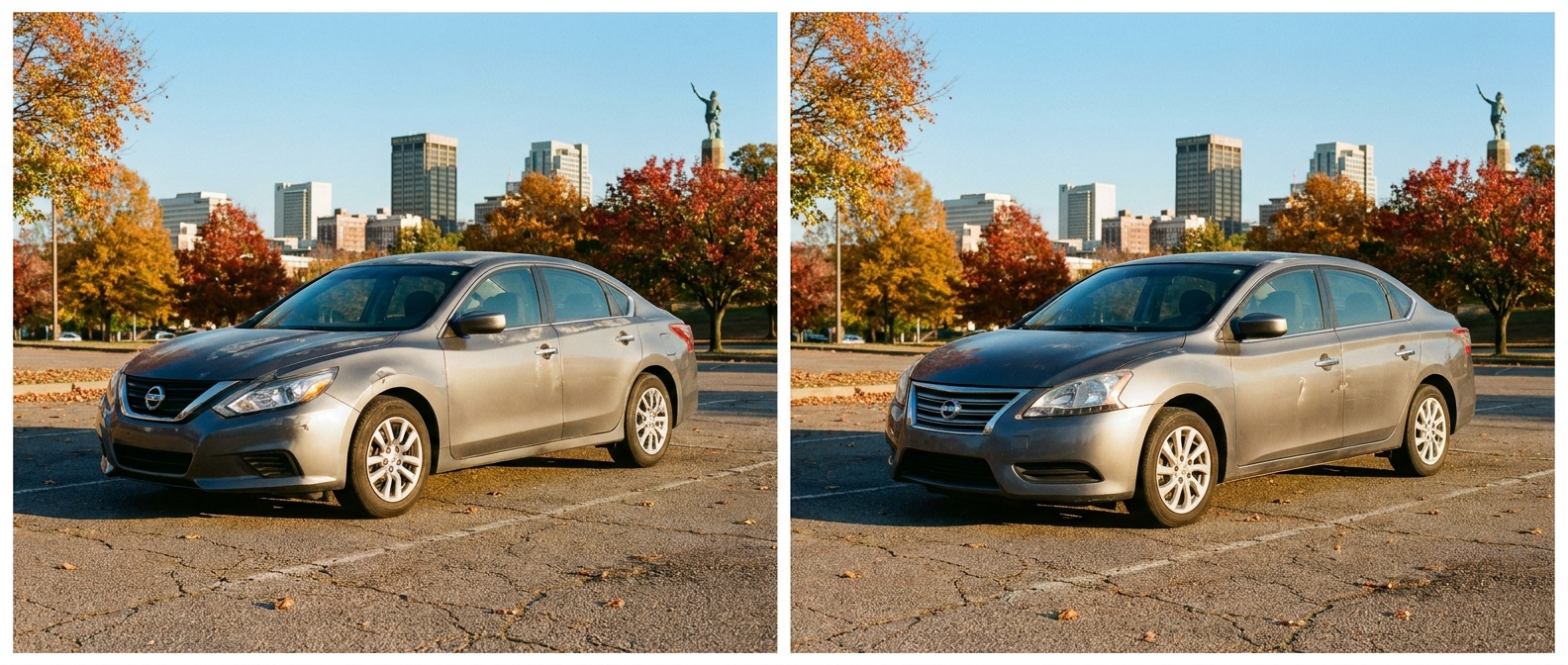
Shopping for a used Nissan sedan in Birmingham and torn between an Altima and a Sentra? The model year matters far more than which badge sits on the trunk. Both cars share a common trap. A generation of CVT transmission problems in the mid-2010s generated hundreds of NHTSA complaints, and that trouble still shows up on used lots today. Buy in the wrong window and you inherit the headache. Buy in the right window and you land one of the most sensible commuter sedans you can find for the money.
Shortest version possible, the Altima's 2021-2023 models are the strongest used buy if your budget stretches that far. The Sentra's 2021-2023 eighth-generation cars are the cleaner pick at a lower used-market entry point. Avoid anything from either car between 2013 and 2017, full stop.
- Sweet-spot Altima years: 2021, 2022, 2023 (sixth generation, lowest NHTSA complaint density in the model's history; verify any 2021 for completed NHTSA recall 21V138000 on the tie rod).
- Sweet-spot Sentra years: 2021, 2022, 2023 (eighth generation, redesigned powertrain; per NHTSA data, the 2023 logged only 18 complaints against a model median of 180 for older years).
- Years to watch on the Altima: 2013-2018 (fifth generation CVT failures, oil consumption; NHTSA logged over 1,500 complaints on the 2013 alone).
- Years to watch on the Sentra: 2013-2017 (seventh generation CVT and transmission issues; NHTSA flagged 638 complaints for the 2013, 380 for the 2014, 347 for the 2015).
- If you need more cabin room and AWD availability, the Altima is the right frame. If the monthly budget is tight and a Birmingham commute is the main use case, the Sentra is the smarter buy.
browse our used Nissan inventory
Which Altima and Sentra Years Are the Sweet Spot?
The best used years for both the Altima and the Sentra land in the same window, 2021 through 2023, and the reason is simple enough, because both nameplates got redesigned powertrains a couple of years earlier and the early production wrinkles were sorted by the 2021 model year. For the Altima, NHTSA data shows the 2021 at 69 complaints, the 2022 at 30, and the 2023 at just 14 (against a model average well above 500 for the troubled fifth-generation years). For the Sentra, NHTSA records as of late 2026 show the 2023 with 18 complaints total, one of the lowest counts for any year old enough to judge. These aren't arbitrary picks. The 2019 redesign of the Altima (sixth generation) and the 2020 redesign of the Sentra (eighth generation) both brought revised powertrains, and by the 2021 model year the early production wrinkles had been worked out of both.
One practical note on the Altima, Nissan dropped the VC-Turbo engine option starting with the 2025 model year. So if you're eyeing a used 2019 or 2020 Altima SR trim with the turbocharged 2.0-liter, check VIN status on NHTSA recall 25V437000 (engine bearing) before buying that specific configuration. The 2.5-liter naturally aspirated four-cylinder in those same years is clean. The 2021-2023 Altima runs only the 2.5-liter and sidesteps that issue entirely.
| Model Year | Model | Sweet Spot? | Key Recall to Verify | Notes |
|---|---|---|---|---|
| 2021-2023 | Altima | Yes | 21V138000 (tie rod, 2021 only) | Lowest complaint density in sixth gen; 2.5L only |
| 2021-2023 | Sentra | Yes | None active on standard powertrain | Eighth-gen redesign; 2023 has 18 NHTSA complaints |
| 2020 | Sentra | Acceptable | Fuel pump recall (verify by VIN) | Redesign year; more early production variance |
| 2019-2020 | Altima (2.5L) | Acceptable | 25V437000 only on VC-Turbo trims | 2.5L is clean; skip the turbo trims in those years |
| 2019-2020 | Altima (VC-Turbo) | Watch | 25V437000 (engine bearing) | Confirm recall completion before purchase |
| 2013-2018 | Altima | Avoid | Multiple (8 recalls on 2013 alone) | CVT failures, oil consumption, hood latch recall |
| 2013-2017 | Sentra | Avoid | Multiple (6 recalls on 2013) | CVT and transmission issues; 638 NHTSA complaints on 2013 |
Which Years Should You Watch Out For?
Both cars carry the same pain point from the same era, a mid-2010s CVT that wasn't built for stop-and-go torque, which makes the years to skip easy to name, and the short answer is to avoid 2013-2018 on the Altima and 2013-2017 on the Sentra. Same trap, both cars.
For the Altima, NHTSA's complaint database recorded over 1,500 complaints against the 2013 model year alone, with CVT transmission failures driving the majority. The 2016 and 2014 models aren't much better. Per NHTSA data, the 2014 Altima carries 1,113 complaints and 8 recall campaigns. The fifth-generation CVT simply wasn't up to the torque demands of the 2.5-liter in real-world stop-and-go driving. That matters especially if the car spent years on I-65 through Birmingham, where the merge at Malfunction Junction (the I-65 and I-20/I-59 interchange downtown) can turn a 20-minute commute into a 45-minute crawl. CVTs in that traffic pattern wear differently than highway miles suggest.
see current Altima models at Hallmark Nissan
For the Sentra, the story runs nearly identical. Per NHTSA records, the 2013 Sentra logged 638 complaints against a model median of 180 for other years, with transmission failures accounting for roughly half of all reported problems.
The 2014 follows at 380 complaints, the 2015 at 347. NHTSA flagged the 2013-2017 generation as the model's highest severity-weighted years.
If a used Sentra wears a sticker from that window, we'd walk it through a full transmission inspection before considering it, every time. We're not being alarmist. The federal complaint record is simply saying the same thing.
see current Sentra models at Hallmark Nissan
Which Year Fits Which Buyer?
Budget and life situation decide the right answer here more than anything else, because the Altima and Sentra are genuinely different cars even when you're comparing the same model year, and the better pick swings depending on how many people and how much cargo you're hauling day to day.
The Altima is a midsize sedan. At 192.9 inches long with 15.4 cubic feet of trunk space and 100.6 cubic feet of passenger volume, it's got noticeably more room than its smaller sibling. The EPA rates the 2024 Altima S FWD at 28 city / 39 highway MPG. Available AWD on most trims above the base S is a real selling point for buyers running to Hoover or Bessemer and back regularly, especially in the wet months when Alabama rain makes surface streets slick. The honest tradeoff is that sweet-spot Altima years (2021-2023) carry a higher used ask than comparable Sentra years. If your budget is firm, you may find yourself looking at a 2019-2020 Altima rather than a 2021-2023 (which is still a reasonable buy, just verify the powertrain first).
The Sentra is a compact. At 182.9 inches and 14.3 cubic feet of trunk space, it's smaller, lighter, and the EPA rates the 2024 Sentra S and SV at 29 city / 39 highway MPG. That edge in city fuel economy adds up for a commuter making daily runs down I-20 or I-65. The Sentra's eighth-generation redesign (from 2020 onward) also brought the standard Nissan Safety Shield 360 suite to every trim, the same six-system driver-assist package found on the Altima. For someone commuting solo or as a couple, the Sentra's smaller footprint fits the job.
explore financing options at Hallmark Nissan
| Buyer Profile | Better Pick | Why |
|---|---|---|
| Solo commuter, budget is the first question | 2021-2023 Sentra | Lower used-market entry; full Safety Shield 360 standard; strong fuel economy |
| Family of four, needs rear seat space | 2021-2023 Altima | 100.6 cu ft passenger volume vs 96.1 cu ft; available AWD |
| Hoover/Bessemer commuter, wet-weather concern | 2021-2023 Altima AWD trim | Available intelligent AWD; 5-star NHTSA overall rating (2024/2025 model) |
| Tight budget, flexible on model year | 2020 Sentra (verify VIN) | Redesigned powertrain; cleaner than any pre-2018 Altima at similar price points |
| Wants the most room in the used budget | 2021 Altima 2.5 (once recall 21V138000 is confirmed) | Spacious midsize cabin; lowest-complaint 2.5L Altima year relative to its price |
FAQ
Does the Nissan Altima or Sentra have better reliability in the used market?
It comes down almost entirely to the model year. Both cars share a troubled generation in the mid-2010s driven by CVT transmission problems. For the Altima, avoid 2013-2018. For the Sentra, avoid 2013-2017. The 2021-2023 model years for both cars are the strongest used buys by NHTSA complaint data, with the 2023 Sentra and 2022 Altima each logging under 30 total NHTSA complaints. Neither car's inherently more or less reliable than the other when you're comparing the same generation.
Is the Nissan Sentra big enough for a family in Birmingham?
For a couple or a small family using the car primarily as a commuter, the Sentra is a practical fit. It seats five and offers 14.3 cubic feet of trunk space, which handles grocery runs and weekend trips without drama. The Altima is the better call for a family of four that regularly fills all five seats, since it adds meaningful rear legroom and 15.4 cubic feet of cargo room. The Altima also offers AWD, which the Sentra doesn't.
What should I check before buying a used Nissan Altima or Sentra in Birmingham?
Run the VIN on NHTSA.gov before anything else. For a 2021 Altima, confirm recall 21V138000 (tie rod) is complete. For any 2019-2020 Altima SR with the VC-Turbo engine, verify recall 25V437000 on the engine bearing. For any 2020 Sentra, check for open fuel pump recall status. If none of those apply to the specific VIN, you're starting from a clean position. Beyond the recall check, verify maintenance records and ask for a pre-purchase inspection at a Nissan service center.