

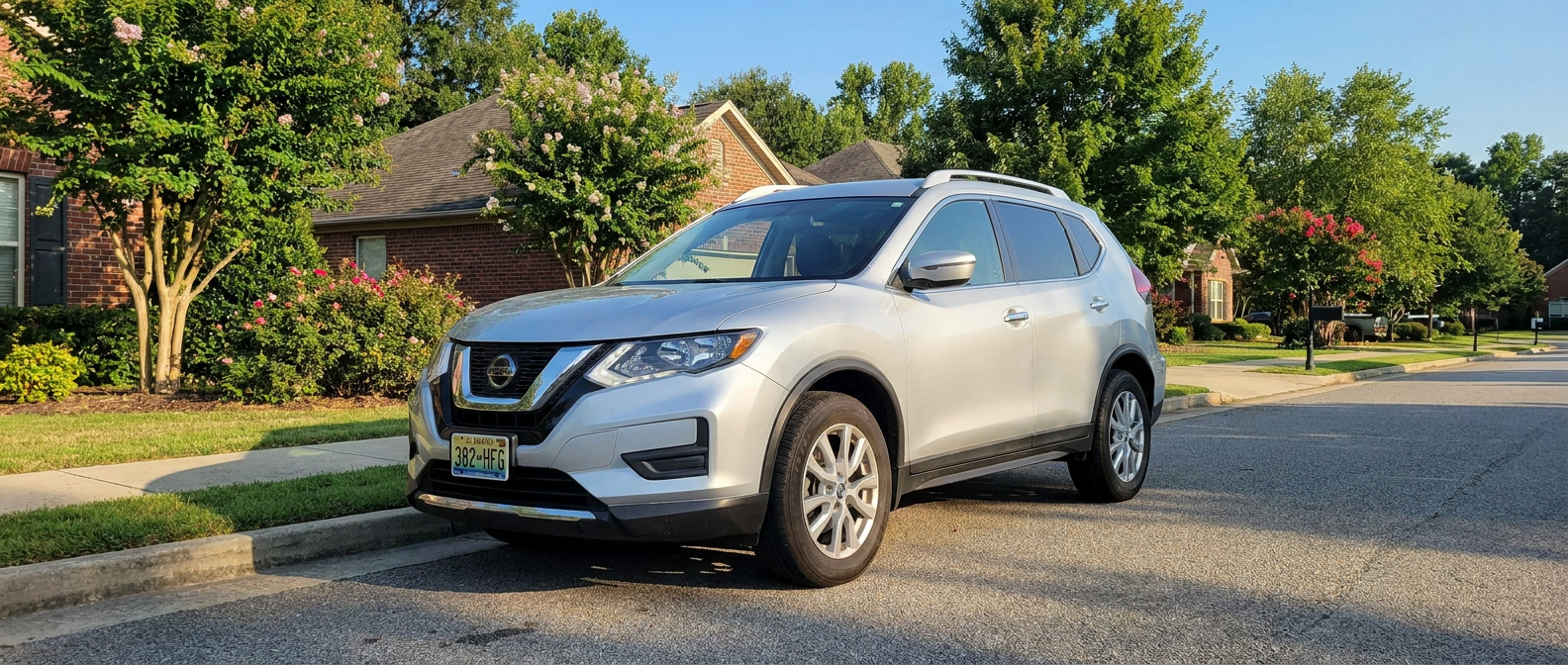
The Nissan Rogue ranks among the top-selling compact SUVs in the country, and we watch that play out right here on the lot. Demand stays strong in Birmingham, and that popularity cuts both ways. High demand means used Rogues move fast, so a buyer who skips the right questions can inherit someone else's deferred maintenance or an open recall they never knew existed.
NHTSA records show the 2017 Rogue carried 5 recall campaigns and 829 owner complaints, while the 2020 model had just 1 recall and roughly 185 complaints. Same nameplate, two very different ownership experiences. The year and the service history matter far more than the trim level.
We'll walk you through the questions worth asking before you sign anything. None of this is generic advice. Every point below ties back to federal recall data and the mechanical history of each Rogue generation, applied to what Birmingham driving actually looks like day to day.
Browse our Rogue inventory to see what's currently available while you read.
What Do the Specs Actually Mean for a Birmingham Buyer?
On paper the Rogue's numbers look similar across several model years, but the engineering underneath shifted a lot between the second generation of 2014 through 2020 and the third generation that began in 2021, so the spec sheet alone won't tell you which used Rogue is the smarter buy here. Below is a practical breakdown of what each spec means when you're shopping used in this market.
| Spec | 2019-2020 Rogue | 2021 Rogue | 2022-2024 Rogue |
|---|---|---|---|
| Engine | 2.5L 4-cyl, 170 hp | 1.5L VC-Turbo, 181 hp | 1.5L VC-Turbo, 201 hp |
| Torque | 175 lb-ft | 203 lb-ft | 225 lb-ft |
| EPA FWD (city/hwy) | 26/33 mpg | 27/35 mpg | 30/37 mpg |
| EPA AWD (city/hwy) | 25/32 mpg | 26/33 mpg | 28/35 mpg |
| CVT generation | Older belt design | New belt design | New belt design |
| Nissan Safety Shield 360 | Optional on SV+ | Standard | Standard |
| Divide-N-Hide cargo | No | Yes | Yes |
| NHTSA recall count | 1 (2020) / 3 (2019) | 10 | Lower |
The EPA rates the 2022 Rogue S/SV FWD at 30 city and 37 highway mpg, a meaningful jump from the 2020's 26 city and 33 highway. On a Birmingham commute that includes a stretch of stop-and-go on US-280 through Hoover or the I-20/59 interchange into downtown, the difference shows up over a year of fill-ups.
The 2021 model is a genuine generational leap in technology. But it also logged 10 NHTSA recall campaigns in its first production cycle, per federal records, the highest count of any Rogue model year. Redesign years often carry early production bugs, so none of that shocks us. Either way, run the VIN on every 2021 before you give it a serious look on the lot.
Why the CVT's Service History Is the Single Most Important Document to Request
The CVT service history is the one document we'd insist on seeing, because the Rogue runs a Continuously Variable Transmission, or CVT, across every model year in this range, and that transmission is excellent technology when it's kept to spec and a genuine liability when it isn't. Maintained right, it's smooth and durable. Neglected or serviced wrong, it gets expensive fast.
The 2014-2020 Rogue generation calls for Nissan's NS-3 CVT fluid in particular. Using NS-2 instead (a swap some independent shops have made by mistake) causes the belt to judder and slip. Once that wear pattern sets in, it rarely reverses. We've seen pre-purchase inspection reports that caught this exact scenario, where the fluid had been serviced but the wrong spec went in, and the CVT was already showing early stress symptoms.
A documented automatic emergency braking issue, or AEB, also hit the 2017 and 2018 model years. Nissan issued a software update service bulletin in early 2019 for affected 2017-2018 Rogue owners. The bulletin improved AEB/forward emergency braking performance. Ask directly whether that update was performed if you're looking at either of those years.
The 2022+ Rogue got a revised CVT belt design alongside the new engine, and that change improved durability substantially, with the complaint volume reflecting it.
See our current pre-owned Rogue listings to check available model years and trim levels. Our financing team can work through the numbers once you've narrowed it down.
What to watch for on any test drive: At a steady 35-40 mph, gently lift off the throttle and then reapply it gradually. A healthy CVT reengages smoothly. Any shudder, clunk, or hesitation in that moment is a yellow flag worth mentioning to a technician before you commit.
Before You Schedule That Test Drive
- Request the CVT fluid service records and confirm NS-3 fluid was used on any 2014-2020 model
- Run the VIN at NHTSA's free recall database to check for open (unrepaired) recalls before you visit the lot
- For 2014-2020 models, confirm whether the jackknife-key recall (NHTSA 23V-093) has been remedied
- For 2017-2018 specifically, ask whether the AEB software update was performed
- Check that Nissan Safety Shield 360 is standard (it is on every 2021 and newer Rogue)
Which Rogue Model Years Actually Fit This Market
Most Birmingham buyers are well served by the 2020 and the 2022-2024 Rogues, though the right year really comes down to how you drive and what service history you can verify, since the Rogue is a practical commuter at heart and not a weekend warrior build. Does Birmingham weather demand AWD? Rarely, because our roads stay smooth enough that it isn't the safety necessity it is in states with real winter. FWD saves a bit at the pump and trims drivetrain complexity. We do see buyers in Bessemer and in the foothills east of the city who prefer AWD for confidence in heavy rain season, and both are defensible choices.
Our read by generation runs like this.
2019-2020 (sweet spot for second-gen): The 2020 stands out clearly in NHTSA data, with one recall campaign and around 185 owner complaints, the cleanest year in the second-gen run by a meaningful margin. The 2019 is reasonable with clean records but carried 3 recalls and roughly 495 documented complaints. Both are high-mileage candidates at this point in their life cycle, so a pre-purchase inspection matters more than usual.
2021 (watch it carefully): The technology step-up is real. Nissan Safety Shield 360 standard, the new engine, the Divide-N-Hide cargo system. The 10 recall campaigns give us some pause, but most were remedied early. Pull the VIN and verify recall completion status.
2022-2024 (our preferred used range right now): The EPA's 30 city/37 highway rating on FWD trims, the stronger CVT belt, and lower complaint volume make these the easiest used Rogues to recommend. They're also priced higher because fewer of them have hit the used market yet, and that tradeoff is worth weighing. Decide whether peace of mind on the mechanical side justifies the difference.
The Rogue is not for everyone. If you're regularly hauling more than the Rogue's 1,500-pound tow rating, or if you need three rows for a larger family, the Nissan Pathfinder handles both needs in a different package entirely. A five-passenger two-row layout works brilliantly for Birmingham commuters and small families, and it stops being the right call only when cargo and passenger capacity genuinely maxes it out.
Is the Used Nissan Rogue Right for Your Birmingham Commute?
The used Rogue is the right call for a specific kind of Birmingham buyer, the one logging real commute miles, running school pickups and errands, and wanting comfortable, efficient transport that doesn't demand much weekend attention, which is exactly where this compact SUV earns its keep. It fits that life well when you buy the right year with the right service history. The 2020 is the cleanest second-gen choice. For the updated engine and lower long-term risk, we'd steer a buyer toward the 2022-2024 window. A 2021 is worth considering with a VIN check and a clean inspection. And for any model year before 2021, CVT fluid documentation is non-negotiable before you sign.
If you want to see what we currently have in pre-owned Rogues, or if you're curious whether a specific VIN has open recalls, our service team can run that check for you. A quick VIN check now saves a headache later, and there's no pressure either way. Come ask us.
Frequently Asked Questions
Does the Nissan Rogue hold up past 100,000 miles?
It can, and the data supports it for the right model years. The 2020 Rogue and the 2022-2024 third-generation models show lower NHTSA complaint volumes and, when maintained with correct CVT fluid and regular service intervals, commonly reach well beyond 100,000 miles without major drivetrain repairs. The 2017 and 2018 models are more variable. Their transmission and braking-system complaint rates are higher, and without documented service records the risk profile changes significantly. Mile count tells you less than service history does on a Rogue.
Is AWD worth it on a used Rogue in Birmingham?
For most Birmingham drivers, FWD is the better value choice. Alabama's mild winters rarely produce the ice or snow that would make AWD a daily necessity, and the EPA rates FWD models 2-3 mpg more efficiently than AWD equivalents. The one case where AWD makes practical sense locally is if you're regularly navigating unpaved roads, steep driveways, or heavy rainfall on elevated terrain east of the city. Otherwise, the FWD trims give you more efficiency and fewer drivetrain components to maintain over the long run.
Categories:
Social