

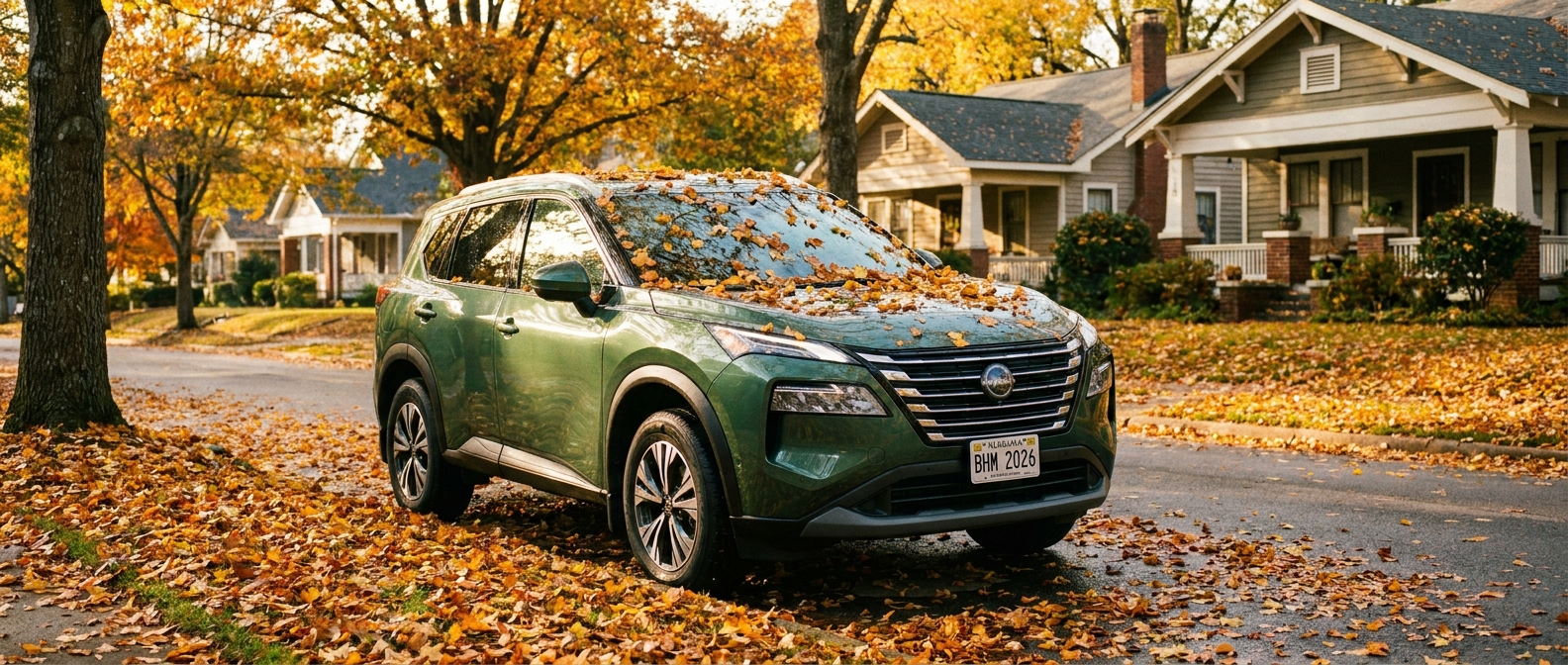
Birmingham's fall foliage peaks late October into early November, and it's genuinely beautiful out there. Red Mountain Park, Oak Mountain State Park down in Pelham, the tree-lined streets of Homewood and Mountain Brook, all of them going orange and gold. The catch is that same leaf drop is quietly working on your clearcoat every time it rains.
Wet leaves don't just dirty your Nissan. They press tannic acid straight against your paint and hold it there, the way a tea bag brews against the bottom of a cup. Left for more than a day or two, that acid can etch a permanent leaf-shaped outline into the clearcoat. Our team sees what fall leaves do to paint season after season. The fix is a specific sequence done in a specific order, and that's what this guide walks through.
The single most important move is to lift wet leaves off by hand before you wash. Dragging or brushing a leaf across paint while grit is underneath it scratches the clearcoat. Pick, rinse, then wash.
If you're driving a Nissan Rogue, a Frontier, or any other Nissan with a sunroof or a cabin air intake, pay particular attention to Steps 2 and 5 below. Those areas trap debris and hold moisture in spots you can't see until something smells wrong.
What You'll Need Before You Start
Gather everything on this list before you pull your Nissan into the driveway, because having it all on hand is what keeps the process from turning into three separate trips back inside.
| Item | Why You Need It | Notes |
|---|---|---|
| Garden hose or pressure washer | Float leaves off before touching paint | Keep pressure washer on low setting |
| Microfiber wash mitt | Scratch-free paint contact | Never use a sponge or brush |
| pH-neutral car wash soap | Won't strip existing wax | Dish soap removes wax protection |
| Microfiber drying towels (2-3) | Prevent water spots | Have extras ready |
| Soft-bristle detailing brush | Cleans cowl drain channels and wheels | A soft paintbrush works too |
| Vacuum with hose attachment | Interior leaf debris and mat grime | Handheld vac won't reach crevices |
| Paste wax or spray sealant | Final protection layer after wash | Applied last, never first |
The item that's easy to skip is the detailing brush. Birmingham's streets layer road grime, brake dust, and organic matter in a way that's different from a dry-climate city. The fall rain we get in October and November turns all of it into a paste that packs into wheel wells and drain channels. The brush earns its place.
Removing Fall Leaf Grime From Your Nissan: Step by Step
Step 1. Check Your Parking Situation First
Before you do a single thing to the Nissan, look at where it's been sitting. Parked under a big oak or sweetgum overnight? Leaves have been pressed against your hood and roof since before dawn, and moisture from overnight dew has been running the tannic acid into your clearcoat the whole time.
If you have a garage, this season is the time to use it. No garage? Move the Nissan away from overhanging trees for washing, and think about relocating it at night if your street is particularly heavy with leaf drop.
Step 2. Clear the Cowl Drain and Windshield Channels First
Clearing the cowl first prevents the grossest outcome of the whole job. The cowl, the plastic tray between your windshield base and hood, is where leaves pile up out of sight. On Nissan models with a sunroof, there are also drain channels at each corner of the sunroof frame. When those channels clog, standing water migrates down into the headliner and eventually into the cabin electronics.
Open the hood. Look at the base of the windshield. Use your gloved hand to pull out any leaf matter, then work the soft-bristle brush through the drain openings. Don't pack leaves further in by hosing aggressively. Pull them out first. Then rinse gently from above.
Step 3. Lift Leaves by Hand, Then Pre-Rinse
Do not run a brush or broom across your Nissan's hood. Full stop. Leaves trap grit against the paint surface, and anything you drag across them drags that grit too. Lift each leaf from its edge using your fingers. Get the roof, hood, and trunk lid.
Once the leaves are off by hand, pre-rinse the entire exterior with a gentle stream of water. The pre-rinse floats remaining debris free before you apply any soap or touch the paint with a mitt. Skip it and a mitt grinds what's left into the clearcoat. The pre-rinse is not optional.
Nissan Frontier owners, check the truck bed and the area behind the cab. Leaves pile in the bed corners and against the rear window, and the exposed metal in the bed is more susceptible to the moisture those leaves hold.
Step 4. Wash With a pH-Neutral Soap in Sections
Start at the roof and work down. Use the two-bucket method if you have it (one bucket for soapy water, one for rinsing your mitt between passes) so you're not dragging extracted grime back onto the paint. Work panel by panel, roof, hood, trunk, each door, front and rear.
Rinse each section before the soap dries. In late October Birmingham, afternoon temperatures can still reach the upper 60s, and soap drying on paint leaves its own residue. Keep the sections small. Keep them wet.
The step that's easy to get wrong: Wash the wheel wells and wheels last rather than first. Wheels are loaded with brake dust and road grime. If you wash the paint first and then aggressively rinse the wheels, you're flinging contaminated water back across panels you just cleaned. Wheels go last, with their own dedicated mitt or brush that you don't touch the paint with.
Step 5. Check the Cabin Air Filter
Checking the cabin air filter isn't glamorous, but it matters. Your Nissan's cabin air filter sits just behind the glove box on most models, and it catches everything the fresh-air intake pulls in, including fine leaf particles and damp organic matter. A clogged fall filter makes your heat and defrost noticeably less effective, and it starts to smell by December if you leave it.
Check it by pulling the filter out. If it's grey-brown with visible debris, replace it. Expect about a five-minute job on most Nissan models. If you're not comfortable doing it yourself, our service team can check it during any visit.
Step 6. Dry Completely, Then Apply Wax or Sealant
Dry with clean microfiber towels, not a chamois, not an old bath towel. Water spots form fast when minerals in the water dry against bare paint, and they're harder to remove than the leaf stains they follow.
Once the Nissan is dry, apply a paste wax or spray sealant. Wax is your actual protection layer. It creates a sacrificial barrier between your clearcoat and the next round of tannic acid that lands on the hood. Wet leaves sitting on waxed paint do less damage than wet leaves sitting on bare clearcoat, full stop. Apply wax in the shade, let it haze, and buff off with a clean microfiber.
One honest tradeoff comes with the timing. A wax job in October needs to be repeated before February. Wax doesn't last forever, and Birmingham's winter rainfall will wear it down. One application is not a season-long solution. Spray sealants last longer per application but typically cost more upfront.
Nissan Pathfinder owners, this applies double. A larger SUV means more horizontal surface area on the hood and roof, which means more leaf contact area. Budget an extra few minutes on those horizontal panels.
Insider note: If you notice a yellow-brown outline on your paint that doesn't come off after washing, that's a tannin etch, not surface dirt. A mild clay bar treatment followed by polishing compound can lift it if it's shallow. Run your fingernail lightly across it, and if you feel the edge, the acid is into the clearcoat, which makes it a job for a detailer with a machine polisher. Don't let it sit until spring hoping it improves, because it won't.
A Print-and-Go Fall Wash Checklist
Run through this after every heavy leaf event or significant rainfall between now and the end of November.
| Task | Done? |
|---|---|
| Parked away from trees or in garage | |
| Cowl drain and sunroof channels cleared by hand | |
| All leaves lifted by hand before pre-rinse | |
| Full pre-rinse before soap contact | |
| pH-neutral soap, roof to bottom, rinsed in sections | |
| Wheels cleaned last with dedicated brush | |
| Cabin air filter checked and replaced if dirty | |
| Dried fully with microfiber before wax | |
| Wax or sealant applied to all painted surfaces |
Save this list on your phone and run it after the next round of rain. Late October through November is the window in Birmingham where the leaf drop and the rainfall overlap. Getting ahead of it is much easier than fixing the etching afterward.
If you want our service team to handle the cabin air filter, the wiper blades, or anything else that needs attention heading into winter, we're easy to reach. Book your service appointment online and we'll take care of it from there.
Frequently Asked Questions
Does the color of my Nissan affect how much leaf damage shows up?
Yes, noticeably. Darker paint colors tend to reveal tannin etching and water spotting more readily than lighter finishes. Dark grey, black, and deep navy panels show the leaf-shaped outlines clearly even when the etching is shallow. That doesn't mean light colors avoid the damage underneath, just that they hide it longer. Whatever color your Nissan is, the cleaning sequence is the same.
How quickly can a wet leaf actually damage car paint?
A wet leaf pressed against clearcoat during warm, humid conditions can begin leaching tannic acid within hours. A leaf that stays in place through a full overnight dew cycle and into the next warm afternoon is operating long enough to begin etching. The practical rule is simple. If you see leaves on your hood in the morning, remove them before you drive, not when you get home.
Categories:
Social