

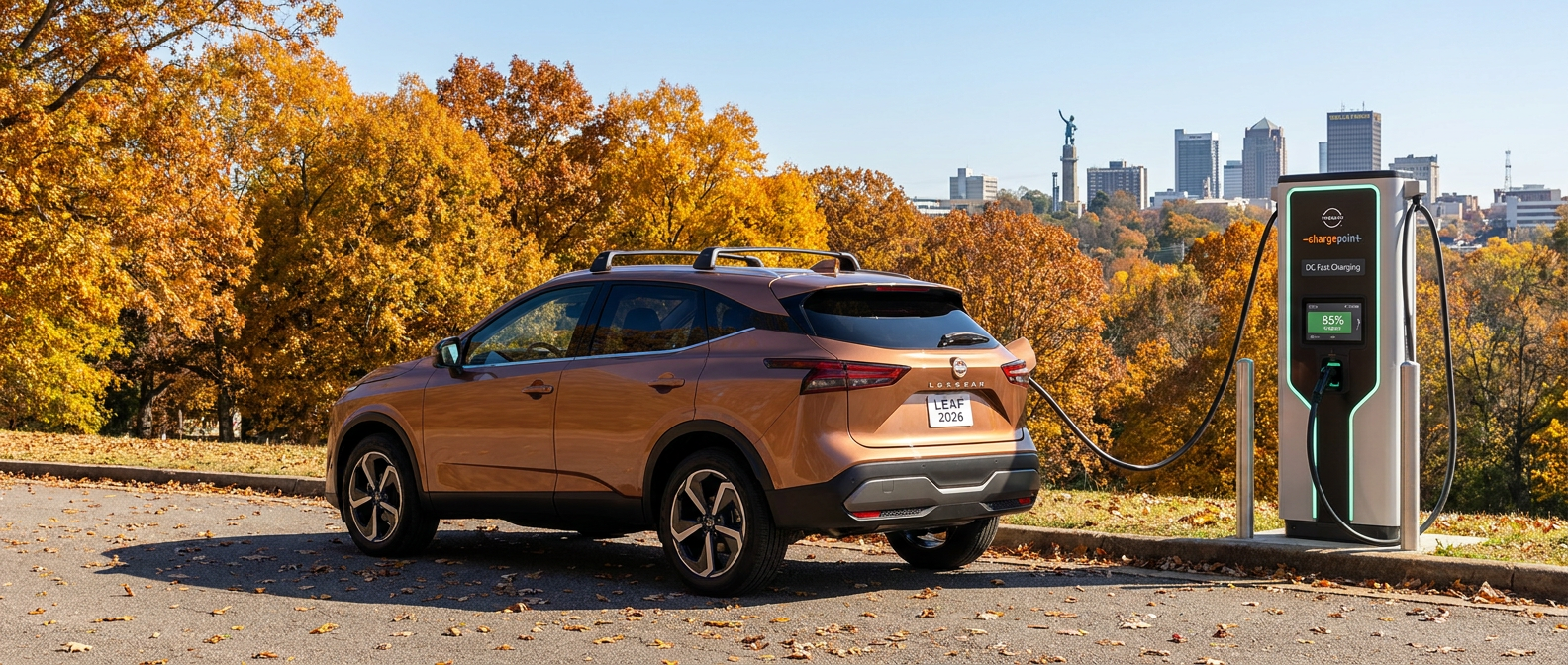
If you came here for Ariya fall efficiency tips, we'll level with you up front. Nissan paused US Ariya production after the 2025 model year, and no 2026 Ariya was built for this market. The good news is that Nissan replaced it with something better for everyday Birmingham drivers, the completely redesigned 2026 Nissan LEAF, which arrives with up to 303 miles of EPA-estimated range, dual charging ports (NACS and J1772), and a 75 kWh liquid-cooled battery that handles fall temperatures more competently than the old hatchback ever did. This guide is for anyone planning to live with that LEAF through an Alabama October and November.
In the 50s and 60s, fall in Birmingham is actually one of the gentler seasons for an EV battery. Temperatures in that band sit comfortably inside the U.S. Department of Energy's identified optimal range for lithium-ion efficiency (roughly 68-86 degrees Fahrenheit). You won't face the steep range penalties that northern drivers deal with in February. Cooler mornings still move the real-world numbers, though, and cabin heat pulls more energy than you'd guess. Learn those two facts going in. You'll plan well.
How Far Will the 2026 LEAF Really Go Around Birmingham?
The EPA rates the 2026 LEAF S+ at 303 miles of range on its 75 kWh battery, the SV+ at 288 miles, and the Platinum+ at 259 miles (the larger 19-inch wheels on the top trim account for most of that gap). Those are the paper numbers. In mild fall weather at typical Birmingham commute speeds, real-world range on the S+ trim runs around 255-270 miles on the highway at 70 mph, based on testing data published by InsideEVs and Edmunds. Around town, you'll do even better.
Birmingham's fall climate matters in one specific way. The U.S. Department of Energy's research found that EV fuel economy is about 8% lower at 20 degrees Fahrenheit compared to 75 degrees, and that's before cabin heat enters the equation. Turn on the interior heater and the same DOE research shows range can drop as much as 41% in extreme cold. Birmingham in October and November rarely approaches 20 degrees, which puts most fall days solidly in the moderate-loss zone. Still, an overnight low of 42 degrees on a Wednesday morning means your battery warms up as you drive, and the first 10-15 minutes draw more energy than you'd see at noon.
| Trim | EPA Range (75 kWh) | Est. Mild Fall Range (55-65 F) | Est. Cool Morning Range (40-45 F) | DC Fast Charge (10-80%) |
|---|---|---|---|---|
| LEAF S+ | 303 mi | ~280-290 mi | ~255-270 mi | ~35 min |
| LEAF SV+ | 288 mi | ~265-275 mi | ~245-260 mi | ~35 min |
| LEAF Platinum+ | 259 mi | ~240-250 mi | ~220-235 mi | ~35 min |
*EPA figures sourced from Nissan USA and fueleconomy.gov. Fall range estimates reflect the U.S. DOE's documented efficiency curve at moderate temperatures and are not guaranteed outcomes.*
The honest trade-off at this price point is the charging speed. The LEAF's DC fast charging tops out at 150 kW, which is slower than some rivals. A 10-to-80% fill takes about 35 minutes at a compatible station. That's fine for an errand stop at the US-280 Target Supercharger. It does mean road trips to Montgomery or Atlanta require a bit more schedule padding than a 250 kW charging vehicle would.
Where Do You Charge in Birmingham?
Where you'll charge in Birmingham comes down to a healthy public network and a smart port layout, and the setup rewards a mix of home charging plus a couple of trusted fast-charge stops you keep coming back to. Birmingham's public charging network has grown to 52 stations with 100 DC fast-charging ports as of NREL AFDC data from October 2026. The 2026 LEAF's dual-port setup is the key piece here, with a J1772 port on the driver's side for Level 2 home and workplace charging, and a NACS port on the passenger's side for DC fast charging, including the Tesla Supercharger network.
The dual-port layout matters in Birmingham because Tesla Superchargers hold the largest share of the city's fast-charging infrastructure. Three stations stand out.
- US-280 at the Inverness Target (4616 US-280): 16 Tesla Supercharger stalls with both NACS and CCS connectors, open to the public 24 hours
- 1st Ave South Supercharger (2115 1st Ave S): 28 NACS stalls, confirmed active as of June 2026, right in the urban core
- Gadsden Highway Supercharger (1481 Gadsden Hwy, Trussville): 16 NACS stalls, good option for the northeast corridor
And we're not just pointing you down the road. Hallmark Nissan keeps CCS, CHAdeMO, and J1772 ports on site, so you can top off while the team handles a service appointment or while you browse the lot.
Range planning note: The 2026 LEAF's NACS port opens access to the Tesla Supercharger network, but the LEAF's 150 kW maximum charging speed means it won't pull at the station's full rated output at every stall. Plan for 35 minutes to recover 10-80%, not 20. That number holds at a well-maintained DC fast charger in comfortable fall temperatures.
Print-and-go fall charging checklist
- [ ] Set your home charger to finish by 7 a.m. so you leave on a full battery (not warming one up on the road)
- [ ] Use the LEAF's remote climate app to precondition the cabin for 10-15 minutes while still plugged in on cool mornings
- [ ] Keep tire pressure at the door-placard spec (the LEAF's recommended pressure). Cold morning air drops pressure by about 1 PSI per 10-degree temperature drop, and underinflated tires increase energy consumption
- [ ] Target 20-80% as your daily charge range for battery longevity; reserve 100% charges for longer trips
- [ ] Identify one DC fast charger on each regular long route before you need it, not during
- [ ] If you park outdoors overnight, check the morning forecast, a 40-degree start draws more cabin heat than a 60-degree one
Plan It This Way
Treat fall as the LEAF's tune-up season rather than its stress season, because Birmingham's mild climate hands you a real window to lock in the habits that carry you through tougher winter conditions later, without the range anxiety a northern driver would feel. Those habits are consistent home charging, knowing two or three public fast-charge locations, and preconditioning so the battery already sits at working temperature when you pull out of the driveway. All three cost nothing, and they recover most of any cool-morning efficiency dip.
The last thing worth adjusting your expectation on is highway-speed cruising with the heater running on a 45-degree morning. Highway heat on a cold start is where real-world range diverges most from the EPA sticker. The S+ at 303 miles EPA is genuinely a 260-270 mile car in that scenario. That's still more than enough for a Birmingham-to-Nashville run or a round-trip to Montgomery and back, with margin to spare. Just plan your charge stop the way you'd plan a fuel stop on a long drive: early, not desperate.
When you're ready to look at what's available and talk through which trim makes sense for your commute, the team at Hallmark Nissan is straightforward about the numbers. Come in or reach out and we'll walk you through the LEAF lineup without the pressure.
Frequently Asked Questions
Does Birmingham's fall weather significantly reduce my 2026 LEAF's range?
In the 50s and 60s, fall temperatures land within the range where EV battery chemistry runs close to its peak efficiency. The U.S. Department of Energy notes that significant lithium-ion range loss sets in below freezing (32 degrees Fahrenheit), which is rare for Birmingham in October and November. You might see a modest dip of 5-15% on cool mornings when the cabin heater is working harder, but the steep reductions documented in northern-winter testing don't apply to a typical Birmingham fall.
Can the 2026 Nissan LEAF use Tesla Superchargers in Birmingham?
Yes. The 2026 LEAF has a standard NACS charging port on the passenger side, which gives it direct access to the Tesla Supercharger network without an adapter. Birmingham has multiple Supercharger locations, including stalls on US-280 at the Inverness Target and on 1st Avenue South downtown. The LEAF charges at up to 150 kW at a compatible DC fast charger, so expect a 10-to-80% session to take about 35 minutes.
What happened to the Nissan Ariya? Can I still buy one?
Nissan paused US Ariya production after the 2025 model year as the company shifted resources toward the all-new 2026 LEAF. If you spot a 2025 Ariya in new-inventory stock at a dealer, it's a legitimate sale of remaining inventory. Nissan confirmed it will keep supporting Ariya owners with service, parts, and warranty coverage. For buyers shopping a new Nissan EV today, the 2026 LEAF is the current model in the lineup.
Categorías:
Social