

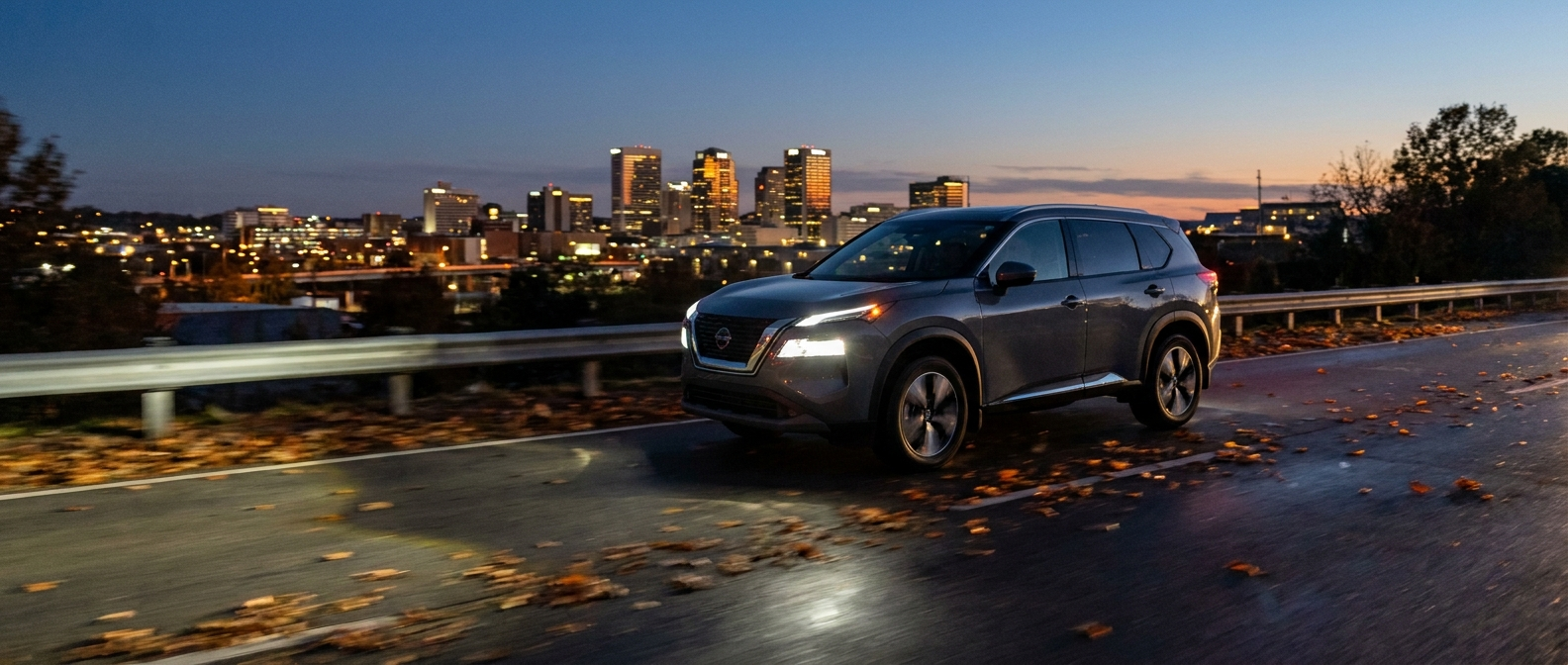
Birmingham's sun sets at 6:00 PM today. Your evening commute, your run out to Hoover for dinner, your quick errand along I-65. All of it happens in the dark now, and Daylight Saving Time doesn't even end until November 1. Once it does, darkness arrives even faster.
Before you head out for any fall evening drive, run through these four steps. Each one tackles something that makes Birmingham night driving harder in October than it is the rest of the year, and several take under two minutes to handle. We stock and service the 2026 Nissan Rogue because it comes with full LED headlights and High Beam Assist standard across every trim. None of that hardware performs at its best, though, if you skip the basics below.
What's the Route?
The route breaks into four stops, and only one of them is a place you actually drive to. One stop is your driveway, one is your windshield, one is your headlight lens, and one is the road itself. They fit together as a short evening prep plan, and here's the order.
| Stop | Time Needed | What to Do | What to Have Ready |
|---|---|---|---|
| 1. Interior windshield wipe | 2 min | Clean the inside glass with a microfiber cloth | Clean microfiber, glass cleaner |
| 2. Headlight lens check | 3 min | Look for haze or yellowing; test beam pattern on a flat wall at 25 ft | Flashlight for daytime check |
| 3. High Beam Assist check | 1 min | Confirm the system is on; locate the manual override | Owner's manual if unfamiliar |
| 4. Route adjustments | Ongoing | Buffer speed near wooded stretches; use low beams in fog | Habit change only |
None of this is a road-trip checklist. It separates an ordinary six-mile Tuesday night commute from a harder one in late October.
The Four Stops in Detail
Stop 1: Wipe the Inside of Your Windshield
Wiping the inside of the windshield matters because the glass picks up a film you can't see in daylight. The outside gathers rain and road grime, so it tends to get cleaned. Inside, a thin haze builds from the off-gassing of plastic and vinyl in the cabin, and that haze stays nearly invisible until dark. After sunset, oncoming headlights hit it and scatter across your whole field of vision.
Clean it once with a proper glass cleaner and a folded microfiber. Work in overlapping strokes, and flip to a clean side of the cloth for the final pass. You'll notice the difference the very next time headlights come at you after dark.
Season timing: Do this check before it's dark, ideally in your driveway. Interior glass haze is nearly invisible in bright conditions and becomes obvious the moment glare hits it after sunset.
Stop 2: Check the Lens Housing, Not Just the Bulb
Checking the lens housing matters as much as checking the bulb, because a clear housing is what lets the light actually reach the road. Confirming the headlights switch on is easy, and it's easy to stop right there. The check that's easy to skip is whether the plastic lens is still clear enough to let the beam out correctly.
Our service team sees vehicles, not just high-mileage ones, where the lens has developed a yellow or cloudy haze from Alabama's UV exposure and summer heat. That haze scatters light before it ever leaves the housing. A working LED behind a fogged lens puts noticeably less usable light on the road ahead than the same bulb behind a clear one.
The field test for this is simple enough to do in a driveway. Park 25 feet from a garage door or flat wall at night, turn on low beams, and look at the pattern on the surface in front of you. You want a sharp upper edge and a bright center cone that's aimed right, not at oncoming drivers. A diffuse, washed-out spread that blooms in all directions points to lens haze or aim drift. Lens polishing is a straightforward service, and aim adjustment is simpler still.
On the 2026 Rogue, those integrated LED headlights produce a peak low-beam reach of 396 feet and a peak high-beam reach of 565 feet, according to independent headlight performance testing. The reach puts it in the 90th percentile among all tested vehicles. The numbers assume the housing is clear and the beam is aimed correctly. The Nissan Pathfinder runs the same full-LED architecture if you need a larger family hauler through the same October commutes.
Stop 3: Use High Beams When the Road Is Clear, and Low Beams in Fog
AAA research finds that high-beam settings improve sight distance by 28%, and 64% of American drivers admit they don't use high beams regularly even on unlit roads. On I-20/I-59 past the eastern edge of the city, or on surface streets heading south toward Bessemer, you'll hit stretches with no street lighting and no oncoming traffic nearby. High beams belong there.
The 2026 Rogue's High Beam Assist handles the switching automatically, dimming when it detects oncoming light and returning to high beam once the road clears. Learn where the manual override sits anyway. There are times you'll want to stay on low by your own choice.
Fog flips the logic, and one rule stays firm. In fog, use low beams only. High beams reflect off suspended water droplets and bounce light straight back at your eyes. Low beams aim downward toward the roadway surface and keep things visible. Running less light in worse conditions feels backward. Low beams are the correct call.
In fog, low beams keep the road visible because the beam angles downward rather than reflecting off suspended moisture the way high beams do.
Schedule a Headlight Inspection
Stop 4: Adjust Your Speed Buffer for October Roads
October is peak deer movement season across the southeastern U.S., which is why your speed buffer deserves a second look right now. The breeding rut runs roughly October through December, the period when deer range well outside their usual territory and cross roads with far less predictability than in summer. Dawn and dusk are peak activity windows, and your 5:30 PM drive home falls squarely inside one.
The practical adjustment here isn't complicated at all. Add a slightly larger following-distance buffer on any stretch with a wooded median, a tree-lined residential corridor, or an overpass with heavy vegetation on both sides. When one deer crosses in front of you, expect others, since they tend to follow the same line.
Birmingham's fall road mix also brings wet leaves, especially on surface streets. Wet leaves cut traction noticeably and can hide lane markings and curb edges that drivers usually navigate without thinking.
Tweak It to Your Crew
The interior windshield film check from Stop 1 matters even more when kids are along for the drive. Children tend to find scattered headlight glare more disorienting than adults do, and they may not connect the discomfort to a dirty interior windshield. Clean the glass, and the discomfort usually fades on its own.
If your household runs a larger Nissan, the Armada carries the same full-LED headlight system with High Beam Assist standard, so every step in this guide applies directly. Drivers commuting between Birmingham and Hoover or Bessemer along I-65 lose street lighting in several stretches, and the high-beam habit is the single highest-value change for that corridor.
For drivers newer to fall night driving, the Nissan Sentra also comes standard with automatic high beams and Nissan Safety Shield 360, which includes forward-collision warning with pedestrian detection. The features that matter most in fall conditions aren't limited to the larger or more expensive vehicles in the lineup.
Why handle this now? Daylight Saving Time ends November 1, and after that Birmingham's 5:00 PM commute runs in full dark. If you've been putting off the windshield wipe and the lens check, do it this week, before the clocks change. It's ten minutes of work, and the payoff shows up that same evening.
By the Hallmark Nissan Team | October 2026
Categories:
Social