

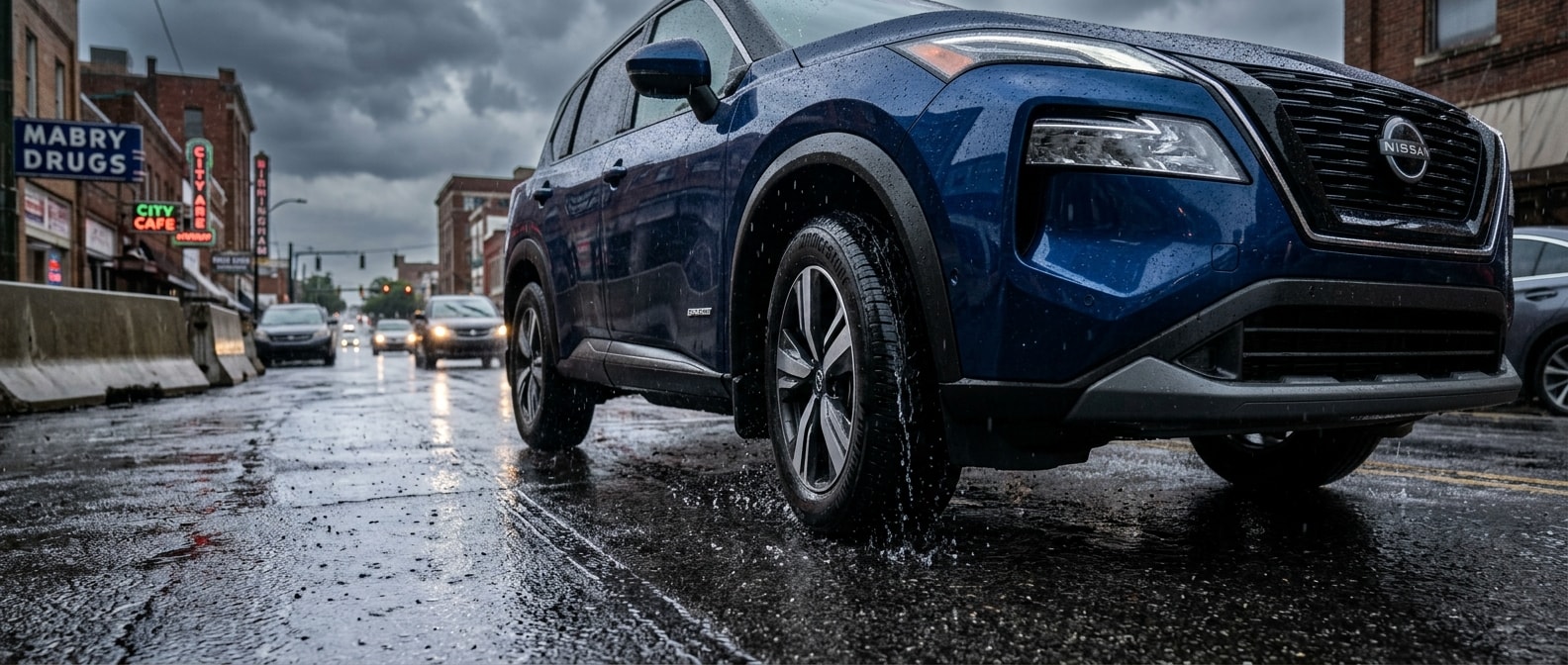
September in Birmingham doesn't ease you back into wet weather. The rain shows up fast, roads stay slick longer than you'd expect at summer temperatures, and a tire can cross the real safety threshold weeks before it crosses the legal one. Alabama law (Code Section 32-5-210) says your tires are legal down to 2/32 of an inch of tread. AAA's controlled track testing at 60 mph says tires at 4/32 of an inch (still twice the legal depth) already need 87 additional feet to stop on wet pavement compared to new rubber. That is a 43 percent increase in stopping distance. A meaningful gap sits between "technically legal" and "actually ready for a Birmingham downpour."
We think every Nissan driver heading into fall deserves to know where their tires actually stand.
The short version
- Legal vs. safe aren't the same number: Alabama's legal minimum is 2/32 of an inch; the wet-road planning threshold is 4/32 of an inch. Two very different calls.
- The quarter test beats the penny test for rain: If George Washington's hairline disappears in the groove, you're below 4/32 of an inch and wet stopping distance is already compromised.
- Highway commuters (Altima, Rogue, Murano): 4/32 of an inch is your firm replace-or-plan point when September showers are already here.
- Heavier family SUVs (Pathfinder, Armada): More vehicle weight amplifies every reduction in wet grip; don't ride these down to 3/32 of an inch.
- Check the inside shoulder of front tires, not just the easy center tread. That's where wear runs ahead on front-wheel-drive Nissans.
Schedule a tire tread check with our service team before the next storm rolls in.
What Actually Matters When Choosing Tire Tread for Wet Roads?
Two numbers run this whole decision, 4/32 of an inch and 2/32 of an inch, and the difference between them separates a legal tire from a tire that's ready for rain. The legal floor gets all the attention, though the wet-weather threshold sits well above it and matters far more once the roads turn slick.
Alabama sets the legal floor at 2/32 of an inch. Modern tires carry wear indicator bars molded into the grooves at exactly that depth, and when those bars sit flush with the surface, you've hit the line. Run the penny test to confirm it. Press a penny into a groove with Lincoln's head pointing down, and if the top of his head shows, replace them now. No debate. A tire down there has lost its margin, wet or dry.
Wet-weather performance starts falling apart at 4/32 of an inch, well before you're illegal. AAA's testing at 60 mph found that tires worn to 4/32 of an inch required 87 additional feet to stop on a wet road compared to new tires. NHTSA research indicates that tires worn to 2/32 of an inch can approach nearly double the wet stopping distance of new tires. The mechanism is simple. Tire grooves channel water out from under the contact patch, and as they get shallower they move less water, so at speed the tire begins to float rather than grip.
| Tread Depth | What It Means | Best For | Key Spec | Honest Tradeoff |
|---|---|---|---|---|
| 8/32 to 10/32 in. | New tire range | Any weather, any speed | Full water-channeling capacity | None at this depth |
| 5/32 to 7/32 in. | Good working range | Daily commuting, highway rain | Strong wet grip, normal stopping | Monitor quarterly |
| 4/32 in. | Wet-road planning threshold | Light rain only; start shopping | 43% longer wet stop vs. new (AAA, 60 mph) | Don't delay once rain season starts |
| 2/32 to 3/32 in. | At or near legal minimum | Dry roads only until replaced | Near-double wet stopping distance (NHTSA) | Replace without waiting |
| Below 2/32 in. | Illegal under Alabama Code 32-5-210 | Nothing (replace immediately) | Wear bars flush or cords exposed | Citation plus genuine grip loss |
The quarter test gives you a practical trigger for that 4/32 threshold. Turn a quarter upside down in a tread groove, and if you can see the top of George Washington's head, you're at or below 4/32 of an inch. Time to shop.
Tread Depth Matters More in Birmingham Than Generic Advice Accounts For
A Nissan Rogue on a wet Birmingham street faces something the same vehicle never meets on a dry stretch of Alabama highway, and that gap is exactly why generic tread advice comes up short here. Late-summer storms leave standing water on surface streets in lower-elevation neighborhoods, and Interstate 65 and Interstate 20/59 through downtown don't drain the instant a cell dumps several inches (the older asphalt holds water longest). Birmingham averages roughly 8 to 12 rainy days in September. The rain arrives in heavy bursts. A sudden downpour like that puts a tire at 3/32 of an inch underwater before you can react.
Generic tire advice misses that local pattern. A few things compound the problem on Birmingham roads specifically.
- Speed plus standing water on grade changes: I-65 and I-20/59 run through elevation changes and older asphalt sections where water pools. A shallow-tread tire reaches hydroplaning conditions at lower speeds than you'd expect.
- Uneven wear from skipped rotations: Nissan recommends rotating tires every 5,000 to 7,500 miles. Skip two or three cycles and your front or rear pair may be a full 2/32 of an inch shallower than the other pair. That difference shows up as unexpected pull or oversteer in a wet turn.
- Pressure drop with the September temperature swing: Highs run near 87 degrees Fahrenheit in early September, lows drop to around 65 degrees overnight. Per NHTSA guidance, tire pressure drops approximately one PSI for every 10 degrees Fahrenheit of temperature decrease. Underinflation distorts the contact patch and speeds up edge wear, which reduces a tire's water-channeling capacity.
At 4/32 of an inch of tread depth, wet stopping distance increases 43 percent over new tires at 60 mph (per AAA controlled testing) even before a tire fully hydroplanes.
One thing our service team sees consistently on Nissan front-wheel-drive models: after a Birmingham summer, the inside shoulder of front tires often wears faster than the center tread. The Altima and Sentra push all their steering and braking forces through those front tires, so the inside edge reaches the 4/32 threshold first. A quick glance at the center tread won't catch it. Check the inside edge of both front tires with a gauge, not just a visual scan.
The Nissan Altima is one of the models where inside front-tire wear runs ahead the most on Birmingham's surface streets. Worth checking before the next heavy rain.
Book a Tire Inspection at Hallmark Nissan
Match Your Replacement Timing to How You Actually Drive
Not every Nissan driver needs to replace at exactly 4/32 of an inch, and not every driver can safely wait until 3/32 of an inch. Where you land depends on the vehicle you drive, your typical load, and your daily route. Read your own driving before you read the tread gauge.
- Light city driving (Kicks, Versa, Sentra): More low-speed stops than highway miles. Wet stopping performance matters most at intersections and on wet surface streets. Replace at 4/32 of an inch for the clearest margin.
- Highway commuters (Altima, Rogue, Murano): Speeds above 50 mph are where hydroplaning risk climbs sharply. Treat 4/32 of an inch as a firm replacement point, not a "watch and wait" moment.
- Heavier family SUVs (Pathfinder, Armada): A loaded Nissan Pathfinder carries more momentum into every wet stop. More vehicle weight means any reduction in wet grip translates to longer stopping distances. Don't let tires on these vehicles ride below 4/32 of an inch.
- Rock Creek trims (Rogue, Pathfinder): These ship from the factory on all-terrain tires. All-terrain tires start with deeper tread, but they wear differently from standard all-season tires. The 4/32 of an inch planning threshold still applies.
The honest tradeoff is worth naming plainly. Replacing at 4/32 of an inch means leaving usable tread life on the table, and you might squeeze another 3,000 to 5,000 dry-road miles out of those tires. But the weather won't wait. Birmingham's fall rain doesn't schedule itself around a convenient weekend, and if the tread check reads 4/32 of an inch with September showers already here, the math on waiting doesn't favor you.
Frequently Asked Questions
Is the penny test good enough for checking rain readiness, or should I use a quarter?
The penny test checks for 2/32 of an inch (Alabama's legal minimum). It's a useful "must replace now" signal, but it tells you nothing about wet-weather performance above that line. For rain readiness, use the quarter test: insert a quarter with George Washington's head facing down into a tread groove. If the top of his head is visible, you're at or below 4/32 of an inch, which is where AAA testing shows wet stopping distance has already increased by 43 percent over new tires at 60 mph. Run the penny test to catch a tire that's illegal. Run the quarter test to catch a tire that's ready to let you down in a Birmingham downpour.
My TPMS light isn't on (does that mean my tires are fine for wet roads)?
Your TPMS (Tire Pressure Monitoring System) monitors air pressure, not tread depth. NHTSA's TireWise guidance is explicit that TPMS does not substitute for a regular tread depth inspection. A tire can hold perfect pressure and still be worn past the 4/32 of an inch wet-road threshold. The two systems measure entirely different things. Check tread depth with a gauge or the quarter test on its own schedule, separate from any warning light. If you're waiting for the TPMS light to tell you wet grip has degraded, you're relying on the wrong system. By the Hallmark Nissan Team | September 2026
Categories:
Social