

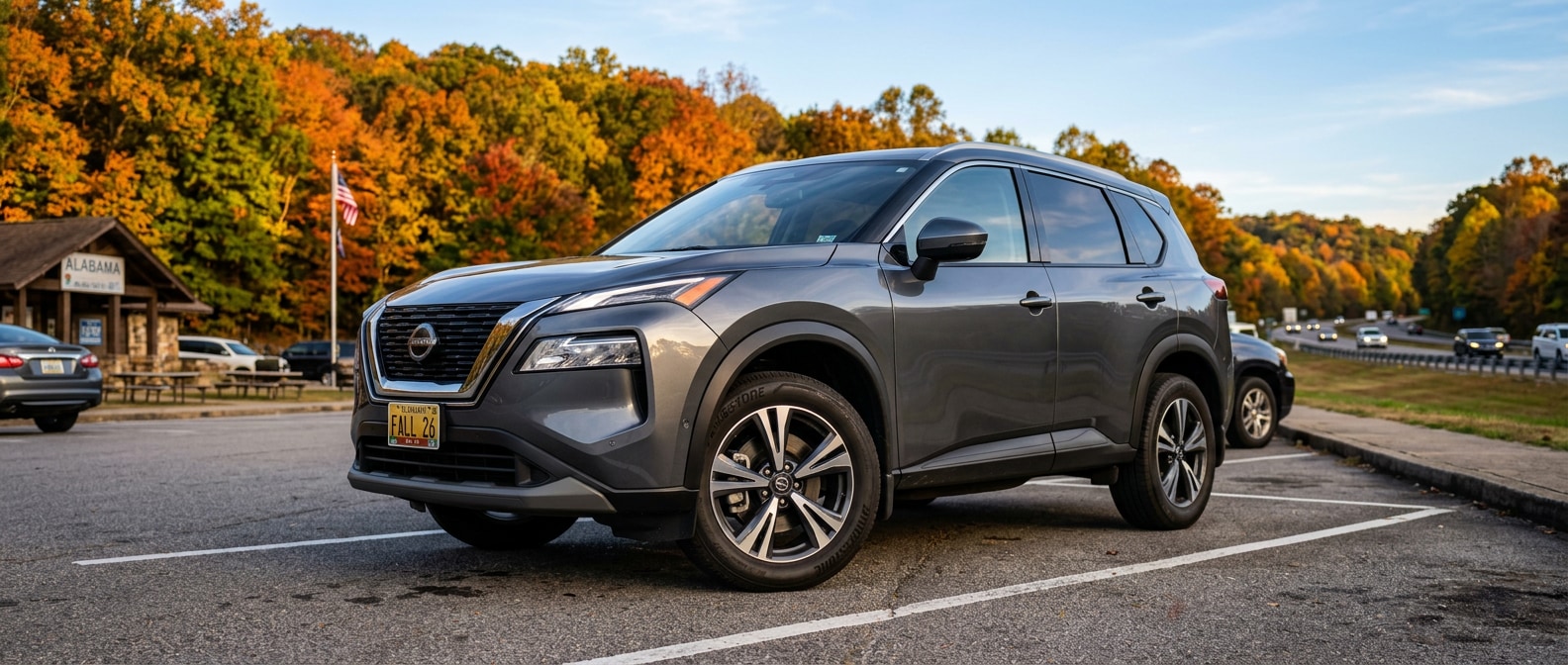
You've spent all summer driving Birmingham. Stop-and-go on I-65 through Hoover, merging at Malfunction Junction, braking hard in Bessemer where the surface streets funnel onto the interstate. All those heat cycles add up on your brakes, and fall trip season is already here. Before we get into the detail, here's the short version. Check your pad thickness, your rotor condition, and your brake fluid before any trip longer than a couple of hours. All three work together, and all three take a beating from what a Southern summer does to a vehicle.
Schedule your brake inspection at Hallmark Nissan before fall trips begin
What Goes on the Brake Checklist?
The list below covers every part of the braking system worth checking before a long drive, and you can print it, carry it to the service bay, or run through it yourself in the driveway. We've grouped it by component so nothing gets skipped, though a shop can confirm the measurements you can't eyeball at home.
Your Pre-Fall-Trip Brake Inspection Checklist
- [ ] Brake pad thickness (front): measure or have measured; minimum safe threshold is 2-3mm of friction material (your owner's manual has the exact spec for your model)
- [ ] Brake pad thickness (rear): rear pads typically wear 20-30% more slowly than fronts; don't assume they're fine just because you replaced fronts recently
- [ ] Brake pedal feel: firm and consistent throughout the stroke; a spongy or pulsing pedal signals air in the lines or fluid degradation
- [ ] Brake fluid level and color: fluid should be at or near the MAX line; dark amber or brown color means it has absorbed moisture and needs replacement
- [ ] Rotor surface condition: no deep grooves, scoring, or visible lip at the rotor edge; a lip you can catch with your fingernail means the rotor has worn unevenly
- [ ] Rotor thickness: every rotor has a minimum discard thickness stamped on the hat; if a tech measures below that, it's out regardless of how it looks
- [ ] Caliper movement: a sticking caliper causes uneven pad wear and a vehicle that pulls left or right under braking; ask the tech to check during the pad inspection
- [ ] Brake lines and hoses: look for cracks, swelling, or any sign of seeping fluid, especially on vehicles with more than 60,000 miles
- [ ] Parking brake function: engage it, make sure it holds on a slope, release it fully
Nine items in all, and the whole inspection takes well under an hour at a qualified service center.
Why Each Item on That List Actually Matters
The items on that list aren't created equal, and knowing which ones tend to bite first is worth your attention before any long fall drive out of Birmingham, especially after a summer's worth of heat cycles has worked on the system. Pad thickness is the obvious one, the number you can almost watch wearing down. Brake fluid is the one that's easy to skip, because it looks fine long after it stops working the way it should.
Pads and rotors: the front/rear split is real
Because weight shifts forward under braking, manufacturers build front pads to handle roughly 60-70% of stopping force. Front pads on most vehicles wear down faster than rears as a result, often needing replacement twice in the time it takes rear pads to reach the same point. On a vehicle that sees regular city commuting through downtown Birmingham and the interstate exchanges, that gap accelerates. The general service guidance from most manufacturers is that pads should be inspected every 10,000 to 15,000 miles and replaced before friction material drops below the 2-3mm threshold. Get below that, and the metal backing plate begins contacting the rotor surface directly. A pad-and-rotor replacement job costs more than a pad-only job. No scare tactic, just physics.
Brake fluid: the part Birmingham's humidity makes worse
We want to spend time on brake fluid, because it behaves in a way that feels counterintuitive. Brake fluid is hygroscopic, which means it actively pulls moisture from the surrounding environment, through the rubber brake lines and seals, and holds it inside the system. DOT 3 fluid, which is what many everyday vehicles use, can absorb roughly 2% water per year under normal conditions. In a high-humidity environment, that rate goes up. Birmingham's average relative humidity in September sits around 72%, and the city runs humid through the entire summer. A vehicle that spent June through August in stop-and-go traffic near Malfunction Junction, where repeated hard-braking events heat the fluid over and over, has been stressing that fluid for months.
Why does absorbed water matter? Because water lowers the boiling point of the fluid. The U.S. Department of Transportation sets a minimum wet boiling point of 284 degrees Fahrenheit for DOT 3 fluid and 311 degrees Fahrenheit for DOT 4. Fresh DOT 3 starts well above that. Fluid that has absorbed moisture for two or more years can fall toward that floor, and when it gets there, repeated heavy braking (the kind that happens on a downhill stretch or in an emergency stop) can cause vapor pockets to form in the hydraulic lines. Vapor compresses. Liquid doesn't. That gives you the spongy pedal and, in severe cases, reduced braking response. The general manufacturer recommendation is to replace brake fluid every two to three years, though your owner's manual will specify the interval for your model.
Service note: If your brake fluid has gone from its original light amber or clear color to a dark brown, that's visible contamination. It doesn't need a boiling-point test to flag it for replacement.
Nissan Armada owners towing trailers on fall trips should pay particular attention here. A heavier load means the braking system generates more heat per stop, and that heat accelerates the vapor-formation risk if fluid is already moisture-laden.
Item / Why It Matters
| Checklist Item | Why It Matters Before a Fall Trip |
|---|---|
| Front pad thickness | Front brakes handle 60-70% of stopping force; city driving accelerates wear |
| Rear pad thickness | Wear is slower but still finite; often skipped and then neglected too long |
| Pedal feel | Sponginess indicates air or vapor in hydraulic lines (both require immediate attention) |
| Fluid color and level | Dark color signals moisture contamination; low level may signal a slow leak |
| Rotor surface and lip | A worn lip means uneven contact and extended stopping distances |
| Rotor minimum thickness | Below the stamped discard spec, structural integrity is reduced under heat |
| Caliper condition | A sticking caliper causes a pull under braking and uneven pad wear |
| Lines and hoses | Cracks or swelling in rubber lines can fail under sustained high-speed braking |
| Parking brake | Needs to hold on a grade; often the last thing checked and the first thing that fails |
Print-and-Go Recap: What to Do This Week
Fall trips out of Birmingham tend to run I-65 north toward Huntsville or Nashville, or I-20 east toward Talladega and Atlanta, and those highway miles are generally easier on brakes than city stop-and-go. The catch is that every one of those trips starts in Birmingham traffic, and after a summer of heat cycles, that's exactly when you want verified brakes under you.
Book a brake inspection online at Hallmark Nissan
Take this short version with you.
- Schedule a brake inspection if it's been more than 15,000 miles or more than two years since your last one.
- Ask specifically about front pad thickness and rear pad thickness as separate numbers. They're not the same job on the same schedule.
- Ask about brake fluid condition (color, moisture content if they test it, and when it was last replaced).
- Confirm rotor thickness is above the discard spec for your specific model and year.
- Test your parking brake before you load the vehicle for a trip.
- Note any pulling, pulsing, or sponginess you've noticed under braking and mention it at the service appointment. Those are symptoms, not quirks.
If everything checks out, great. You leave Birmingham knowing the braking system is ready for highway miles. If something's borderline, it's a lot better to know that in the service bay than somewhere on I-65 between here and Cullman.
Frequently Asked Questions
How do I know if my brake fluid needs to be replaced before a fall trip?
The most direct visual check is fluid color. Brake fluid starts out pale amber or nearly clear, and once it has absorbed significant moisture over two or more years of use, it turns dark brown. If you can spot that color change in the reservoir (it's usually a translucent plastic tank near the firewall), the fluid is due for replacement regardless of the mileage on the vehicle. Some service centers also use an inexpensive test strip that measures moisture content directly. The U.S. Department of Transportation's minimum wet boiling point standard for DOT 3 is 284 degrees Fahrenheit, and fluid approaching that threshold has lost a meaningful margin of safety under sustained hard braking.
Does city driving in Birmingham really wear brakes faster than highway driving?
Yes, and the gap is significant. City stop-and-go generates far more individual braking events per mile than highway cruising, and each event adds heat and friction wear to the pads and rotors. Front pads wear faster than rear pads in any environment, because the front axle handles the majority of braking force under weight transfer. A vehicle spending its daily miles on Birmingham surface streets and the I-65/I-20 interchange area accumulates that wear faster than the same vehicle driven primarily on open highway. The practical result is that a Birmingham commuter vehicle may reach the recommended pad inspection threshold in fewer years than the mileage-based service interval alone would suggest. That's why the calendar interval (every 10,000 to 15,000 miles, or with every other oil change) exists alongside the mileage guideline.
Categories:
Social