

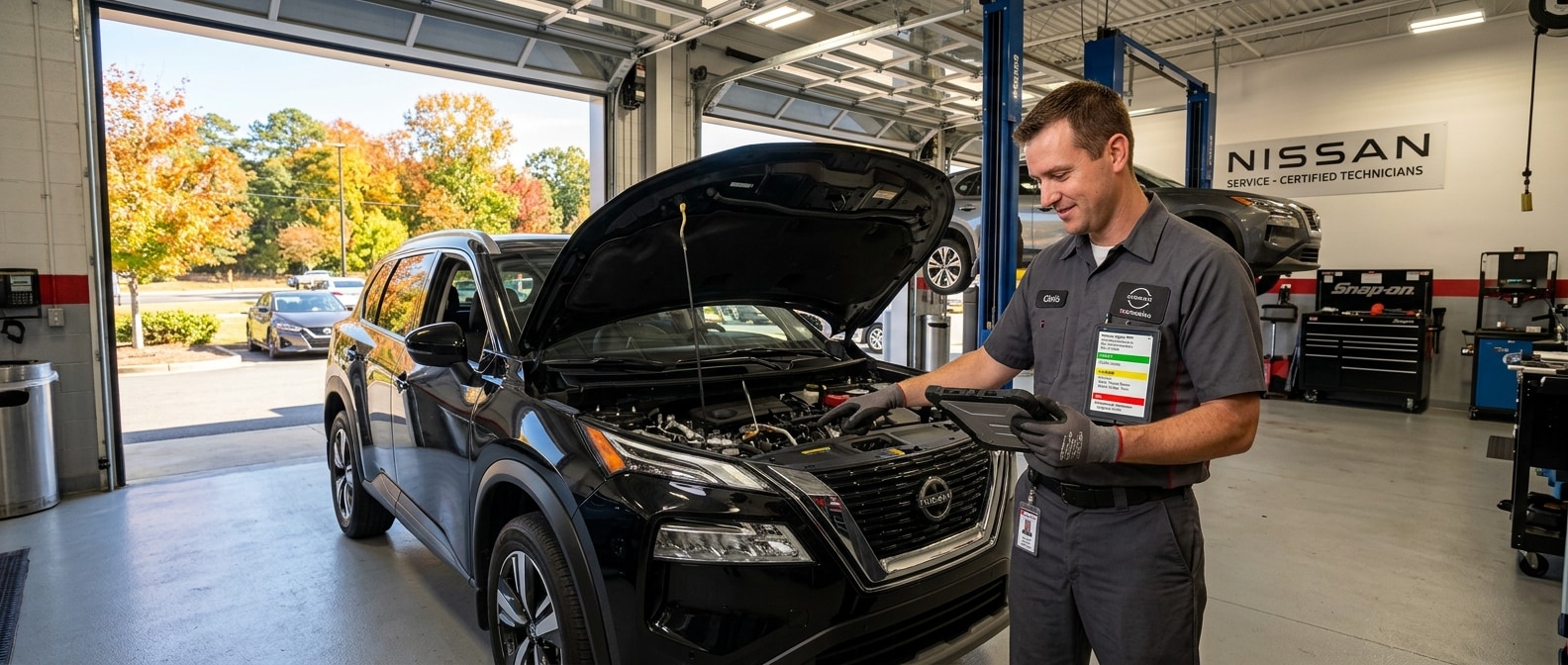
Book the multi-point inspection now, before October's cooler mornings settle in. Birmingham has just spent four-plus months punishing vehicles with heat and stop-and-go traffic, and the fall transition is when that summer stress starts turning into something you can measure. A battery that barely kept up with the A/C load. Tires that lost pressure every other week in the heat. Belts that sat on the edge of their service window all summer long.
A Nissan Rogue or an Altima holds its reliability when you catch those things now, before the first cold front shocks a weakened system. That's the straightforward reason our service team leans on the fall inspection window, and it's what this guide walks through.
What's the Plan at a Glance?
The Nissan multi-point inspection works through the vehicle systematically, from the interior lights and wiper blades all the way down to the underbody, and while the check itself is thorough, the results come back to you as a simple color-coded report you can read at a glance. Green means you're good. Yellow means watch it and plan. Red means address it soon. Below is what each zone covers and where the Birmingham fall context changes the conversation.
| Inspection Zone | What Gets Checked | Why It Matters This Fall | Best Window |
|---|---|---|---|
| Tires | Tread depth (all four corners), pressure, sidewall condition, uneven wear | Summer heat accelerates tread wear; pressure swings 1-2 PSI per 10-degree temperature change | Right now, during the transition |
| Battery | Terminals, cables, full capacity test under load | A/C-heavy summers drain reserve capacity; first cold morning exposes a borderline battery | Before October lows hit the high 50s |
| Brakes | Pad thickness, rotor condition, brake fluid level and condition | Heavy stop-and-go builds brake heat all summer; now is when wear shows up clearly | Anytime; always included |
| Fluids | Engine oil, coolant, transmission fluid, brake fluid, power steering fluid, washer fluid | Coolant condition (not just level) matters as temps start to swing | Before the first cool snap |
| Under Hood | Engine air filter, drive belts, hoses, A/C and heater hose connections, radiator cap | Belts and hoses degrade faster in sustained Alabama heat | The September-October window |
| Underbody | Front and rear suspension, subframe, differential, CV boots, exhaust, fluid leak check | Highway miles on I-65 and I-20 stress suspension components; leaks are invisible from the driveway | Every 12 months |
| Lights and Visibility | Headlights (high and low beam), turn signals, fog lights, brake lights, wiper blades, in-cabin microfilter | Birmingham daylight drops to about 6:30 PM sunset by month's end | Before the time change in November |
The Battery and Tire Story: Birmingham's Summer Leaves a Mark
Coming off a Birmingham summer, batteries and tires carry more deferred stress than any other systems on the inspection form, and while both can look perfectly fine on a quick glance, the measured numbers are where the summer damage actually turns up. The Nissan multi-point inspection form rates tires on a three-band scale. Tread at 6/32 of an inch or greater is green. Four to five thirty-seconds is yellow. Three thirty-seconds or less is red. At 2/32 of an inch, stopping distance in wet conditions increases sharply, and the federal threshold considers a tire legally worn at that point.
Birmingham's heat index ran near 93 degrees Fahrenheit through much of September 2026. Tires running underinflated in that kind of sustained heat build sidewall stress that compounds wear patterns in ways a quick visual walk-around won't catch. So the tread depth measurement (a physical gauge, per corner, per the official Nissan inspection form) is where the summer's damage most often turns up unnoticed. The gauge tells the story.
Frontier owners and Pathfinder owners have extra reason to care. The added vehicle weight at highway speeds is harder on tires and brakes than what a Sentra or Kicks carries, so the measured numbers matter even more.
On the Inspection Itself: The battery capacity test isn't a check of whether the car starts. It loads the battery and measures output in cold-cranking amps under real demand. A battery that handled the summer A/C draw just fine may test borderline before the first real cold morning. Sustained heat shortens battery service life, and the full effect only shows once temperatures fall. Our technicians run this with current diagnostic equipment, not a visual look at the terminals alone.
Under the Hood: What the Heat Does to Belts and Hoses
The under-hood portion is the widest single section of the inspection, and while most of it is quick fluid work, the belts and hoses are where sustained heat does its slow, quiet damage. The section covers engine oil, coolant level and condition, power steering fluid, brake fluid, windshield washer fluid, automatic transmission fluid, the radiator core and cap, and both the heater and A/C hose connections. Then the drive belts and the engine air filter.
Drive belts crack in sustained heat over time. They don't fail all at once. They develop surface cracks that only become visible when a technician physically flexes and examines the belt up close. A fall inspection is the right moment to catch a belt that got through the summer with minor cracking but won't make it through a cold-morning commute in December.
Same logic for coolant. The condition of the fluid, not just the level, tells you whether the cooling system is genuinely protected as the temperature starts to swing. A coolant due for a flush will carry the right level and the wrong chemistry.
Schedule Your Fall Multi-Point Inspection
The Underbody Check: What You Can't See From the Driveway
When you schedule your service visit, our team runs the full underbody inspection as part of the multi-point check, and because none of it shows without getting the vehicle off the ground, it's the section that surfaces problems you had no way of spotting yourself. That covers front and rear suspension systems, the subframe, the differential, the drive shaft, CV boots, the muffler and exhaust system, and a visual scan for any oil, transmission fluid, or coolant leaks underneath.
Most of the underbody stays out of sight in day-to-day driving, which is why so little of it registers as something to look at. Our service advisors flag suspension wear and underbody leaks that haven't tripped a warning light yet but are worth knowing about before they grow into a larger repair.
The Nissan multi-point inspection covers more than 20 components across seven zones (lighting, fluids, battery, tires, brakes, under-hood systems, and the full underbody) and delivers a green-yellow-red report so you know exactly what needs attention now, what to watch, and what can wait.
Bringing Your Nissan In: What to Expect
The inspection is complimentary and runs concurrently with whatever other service you're scheduling, which means you won't need a separate appointment just for the check, and the results come back to you on the same visit. Oil change, tire rotation, any routine service (the multi-point check happens alongside it, and your service advisor walks through the results with you when the work is complete). One honest limit worth naming: the inspection tells you what's wrong, but it doesn't fix anything on its own.
Armada owners, Rogue drivers, Sentra commuters (the report reads the same way for every model). It tells you what's green, what's yellow, and what's red. You decide what to act on and when. A fall visit now means you head into October and November with the full picture, when overnight lows in Birmingham drop to the high 50s and driving conditions shift in ways that matter for tires, batteries, and visibility systems.
Swing by 1300 3rd Ave N in downtown Birmingham and let our team run through it. The service experience is the destination. You'll leave knowing exactly where your vehicle stands.
Categories:
Social