

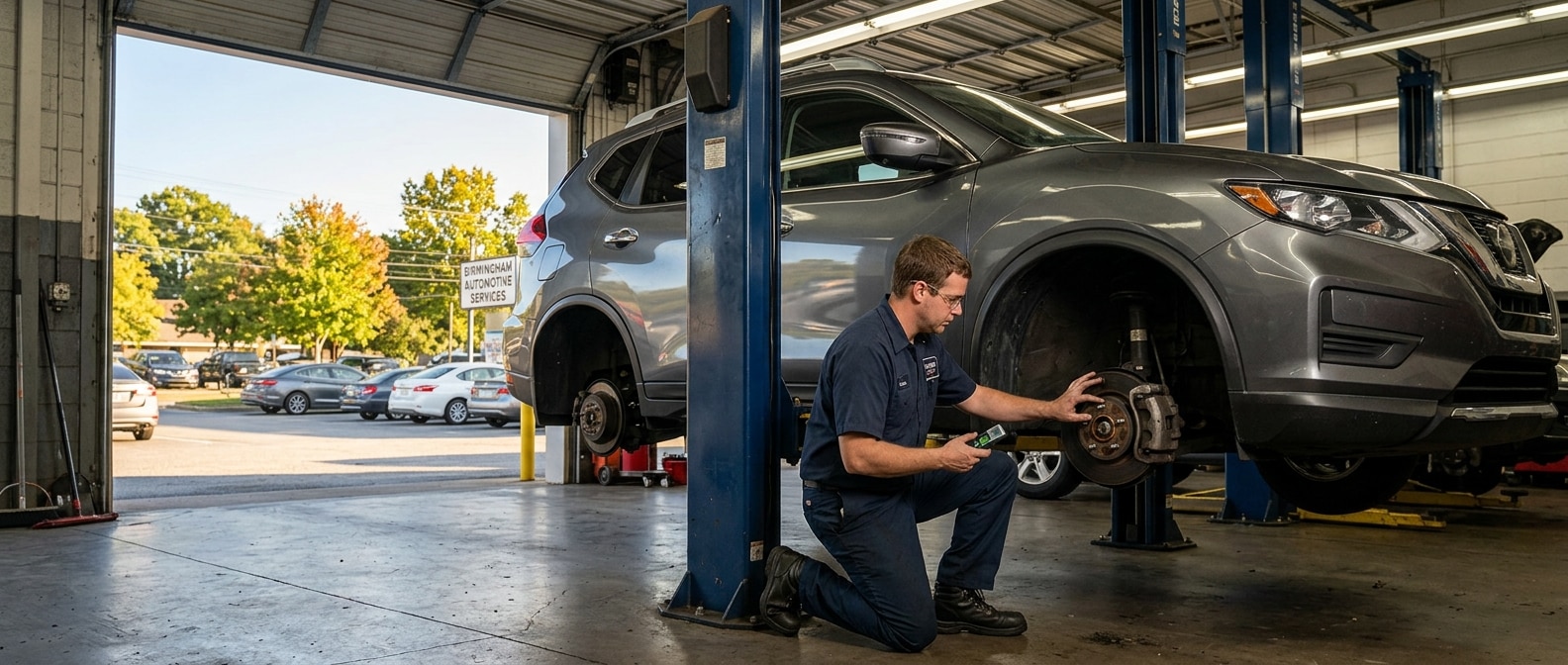
September in Birmingham won't hand you a clean break from summer. Schedule your service visit before the week's heat index climbs back into the low 90s, which it's forecast to do by Thursday. Your calendar says fall while the thermometer keeps stalling, and that gap is exactly when deferred battery and tire decisions catch drivers off guard.
The good news is worth stating plainly. Both checks take under fifteen minutes, and the thresholds are specific. You don't need to guess.
The short version
- Battery: Have any battery over three years old load-tested, not just voltage-checked. Heat accelerates internal wear; AAA data shows batteries in hot southern climates average 17 months less life than those in cooler northern regions.
- Tires: The Alabama legal minimum is 2/32" of tread, but wet-weather stopping distance grows sharply before you reach that floor. Plan your replacement at 4/32".
- Pressure: Check cold (car parked at least three hours). Tire pressure rises roughly 1 PSI for every 10 degrees Fahrenheit of temperature gain, so a reading taken after a noon drive is not your baseline.
- Timing: Late September is the practical window, not because it's cold but because your battery and tires just finished the hardest months of the year. Check now, while it's still convenient to act.
What Actually Matters When You're Choosing a Battery Test or Tire Threshold?
For both the battery and the tires, a glance that says "looks fine" won't cut it, because each measurement carries a legal number and a practical number that don't line up, and the practical one is the number that keeps you safe on a wet road. Alabama Code Title 32 sets 2/32 of an inch as the minimum legal tread depth, and AAA's wet-braking research puts the practical replacement point at 4/32". Those two numbers sound close, but at 4/32" of remaining tread, stopping distances in wet conditions are already measurably longer than on a new tire. For Birmingham in September (averaging 12 or more rainy days and around 72% relative humidity), that gap matters.
Battery testing carries the same fine print. A voltage check tells you a battery isn't dead. A load test tells you whether it can actually hold a charge under demand. Those are two different questions. The table below shows where the two checks diverge.
| Check | What to select | Best for | Key threshold | Honest tradeoff |
|---|---|---|---|---|
| Battery voltage test | Quick pass/fail | Batteries under 2 years old | 12.6V at rest = fully charged | Misses a weak battery that passes voltage but fails under load |
| Battery load test | Full capacity under demand | Any battery 3+ years old | Fails if it can't hold charge during simulated crank | Requires a technician and takes a few more minutes |
| Tread depth at 4/32" | Wet-weather margin | Drivers in rain-prone markets | 4/32" is where AAA wet-braking tests show stopping distances grow 43% vs. new | Legal until 2/32", so you're replacing early (that's the point) |
| Tread depth at 2/32" | Legal compliance only | Dry climates, minimal rain | Alabama Code 32-5-210 minimum | Wet traction is already significantly reduced at this depth |
| Cold-pressure check | Accurate baseline | All drivers, all seasons | Set to door-jamb placard, not sidewall max | A hot reading after driving is not your true baseline |
Battery Age Is the Real Variable Here
Age moves the odds on a battery more than any single test reading does, though a three-year-old battery isn't automatically finished, which is why the smart move is to test at that age rather than assume the worst or ignore it. Our service team sees the pattern in the field, where the battery that coasted through three Alabama summers without complaint is the one likeliest to leave you sitting in a parking deck in October.
Heat is harder on a battery than cold. Cold makes a weak battery obvious fast. Heat degrades it quietly over months. AAA reports that batteries in hotter southern states average 17 months less life than those in cooler northern climates, because elevated temperatures accelerate internal corrosion and cause electrolyte to evaporate more quickly.
Three years is the checkpoint. It isn't that the battery is definitely bad at three years, but the load test is quick and inexpensive and the failure mode after that age is no longer gradual.
A few symptoms are worth knowing, and none of them require a gauge.
- Slow crank on startup. The engine turns but takes noticeably longer than it used to.
- Electrical oddities. Dashboard warnings, accessories resetting, headlights that seem dim at idle.
- Swollen case. Run a hand along the battery housing. Any bulging is a physical sign of heat damage.
If you're noticing any of these, don't wait for a convenient day. The battery that's borderline in late September is often the one that quits in November when temperatures drop and demand on the electrical system spikes.
Quick check: Look at the sticker on your battery or the date code stamped into the case. The format is usually month/year (09/23 means September 2023, for example). If that date is three or more years back, book the load test.
Book a Battery + Tire Inspection
Tire Tread: Why the Legal Floor and the Practical Floor Aren't the Same Number
Whether you drive a Nissan Rogue or a Pathfinder full of family around greater Birmingham, the legal tread floor and the practical tread floor sit at two different depths, and you can legally run right down to the lower one even though wet traction fades well before you get there. Alabama law says 2/32" is the minimum, while NHTSA advises replacing before that point.
AAA's testing gets more specific. At 4/32" of remaining tread, wet-weather stopping distances are already 43% longer than on a new tire, about 87 extra feet from 60 mph.
Here's the tradeoff, stated plainly. You can legally drive to 2/32", and the tires will pass. Replacing at 4/32" means buying tires that are still perfectly legal. We'd tell you to do it anyway so a wet on-ramp never surprises you.
How to check right now, in the driveway:
- Find a penny. Put Lincoln's head upside-down into the deepest tread groove facing you.
- If you can see the top of his head, NHTSA advises replacing the tires. You're at or near 2/32".
- For the 4/32" check, use a quarter instead. Insert Washington's head the same way. If you see the top of his head, you're at or below 4/32" and approaching the practical replacement window.
- Check multiple grooves on each tire. Wear is rarely even across the width; the outer shoulders often go first.
- Rotate which tire you check first. It's easy to spot-check one and miss the one that's actually thin.
Birmingham September piles one more factor on top. September averages more than 12 rainy days, and a tire at 3/32" handles a dry I-65 on-ramp differently than a wet one. The tread depth that felt adequate last month is worth a second look now.
Sidewall tip: Run your fingers along the tire sidewall while you're down there. If you feel small hairline cracks across the rubber (called weather checking), heat degradation of the rubber compound is already underway. Tread depth alone won't tell you that story.
Pressure: Check Cold, Compare to the Door Jamb
Check pressure cold, and don't panic when the number climbs after a hot drive, because a higher reading on warm tires is expected physics rather than a real change in inflation. Tire pressure rises roughly 1 PSI for every 10 degrees Fahrenheit of temperature change, so a tire set correctly at 7 a.m. will read higher at noon after highway miles.
That reading isn't wrong. Blame physics.
The mistake is bleeding air from a hot tire to match the cold-spec number. You'll be underinflated by morning. NHTSA's guidance is clear. The door-jamb sticker figure is a cold-tire number, checked after at least three hours parked.
The practical rule for Birmingham in September:
- Check pressure in the morning before your first drive, or after the car has sat at least three hours.
- Match the PSI on the driver's door jamb sticker. That number, not the maximum stamped on the tire sidewall.
- If one tire is consistently lower than the others after cooling down, that's a slow leak, not a heat quirk. Worth investigating before it becomes a problem on the highway.
NHTSA's tire pressure guidance: use the cold figure on the driver's door jamb sticker, not the maximum PSI stamped on the sidewall. A reading taken after driving in hot weather is not your baseline.
Pros and cons of the two main pressure-check approaches:
| Pros | Cons | |
|---|---|---|
| Morning cold check (before first drive) | Accurate baseline; matches door-jamb spec | Requires planning; easy to skip on busy mornings |
| Gas-station check after driving | Convenient; available everywhere | Reading will be 3-5+ PSI higher than cold spec; adjustments made here will leave you underinflated once the tires cool |
Match the Check to How You Actually Drive
Which check to prioritize depends on how you actually drive, since the same battery or set of tires can wear on very different timelines depending on whether your miles are short hops or long highway pulls. If your route is mostly surface streets and short hops, your battery charges less fully on each trip. Short-cycle driving is harder on a battery than highway miles, because the alternator never gets the time to bring the charge fully back up. A battery that's three years old and lives on short commutes through Birmingham summer heat is the one we'd send to the load test first.
If you're putting highway miles on a Nissan truck or using any Nissan truck for work loads, tire wear on the outer shoulders accelerates with heavier payloads and repeated cornering. The 4/32" threshold applies, but you'll want to check wear across the full width of the tread, not just the center groove.
For a typical Birmingham commute, the September window is the practical one because the car just finished the most demanding season of the year. You're not checking because fall is coming. You're checking because summer just left.
Frequently Asked Questions
How often should I test my car battery in Alabama?
Have your battery load-tested at least once a year once it reaches three years old, and again after any summer with sustained temperatures above 90 degrees. AAA reports that batteries in hot southern climates average 17 months less service life than those in cooler northern regions, because heat accelerates internal corrosion and causes electrolyte to evaporate faster. A voltage test tells you if the battery is dead. A load test tells you whether it can hold a charge under real demand, which is the question that actually matters.
Is checking tire pressure before or after driving more accurate in hot weather?
Before driving is the accurate check. Tire pressure rises roughly 1 PSI for every 10 degrees Fahrenheit of temperature increase, so a reading taken after highway miles in a Birmingham September afternoon can run 3 to 5 PSI higher than your true cold baseline. NHTSA's guidance specifies that the recommended PSI on your driver's door jamb sticker is a cold-tire figure, checked before driving or after the vehicle has been parked at least three hours. Do not bleed air from a hot tire to match the cold spec; the tire will be underinflated once it cools down. FAQ:
How often should I test my car battery in Alabama?
Have your battery load-tested at least once a year once it reaches three years old, and again after any summer with sustained temperatures above 90 degrees. AAA reports that batteries in hot southern climates average 17 months less service life than those in cooler northern regions, because heat accelerates internal corrosion and causes electrolyte to evaporate faster. A voltage test tells you if the battery is dead. A load test tells you whether it can hold a charge under real demand, which is the question that actually matters.
Is checking tire pressure before or after driving more accurate in hot weather?
Before driving is the accurate check. Tire pressure rises roughly 1 PSI for every 10 degrees Fahrenheit of temperature increase, so a reading taken after highway miles in a Birmingham September afternoon can run 3 to 5 PSI higher than your true cold baseline. NHTSA's guidance specifies that the recommended PSI on your driver's door jamb sticker is a cold-tire figure, checked before driving or after the vehicle has been parked at least three hours. Do not bleed air from a hot tire to match the cold spec; the tire will be underinflated once it cools down.
Categorías:
Social