

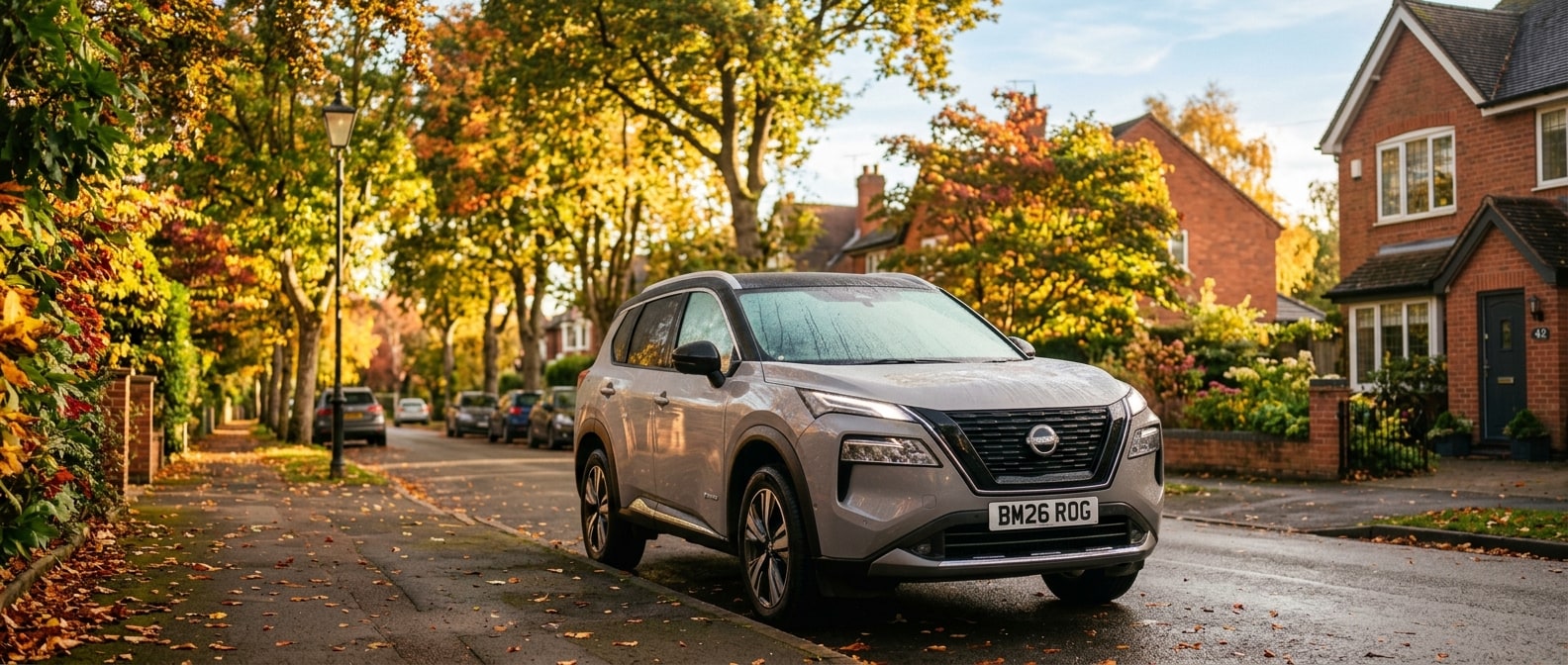
Our simplest advice for fall is to stop treating it like flipping a switch. Birmingham's early fall asks your Nissan to cool you down at noon and defrost your windshield at 7 a.m., sometimes on the same Tuesday. What that overlap means for your system, your cabin filter, and that first burst of warm air that smells a little like a basement is what we'll walk through here.
The Nissan Rogue is the model we probably see this in most, but every vehicle in the lineup goes through the same transition. Read on before that first truly cold morning sneaks up on you.
What's the Plan at a Glance?
Birmingham's fall changeover isn't a single date on the calendar so much as a five-to-six-week window that runs from early September through mid-October, and across that whole stretch your Nissan's climate system has to do different jobs at different hours of the day. So the plan shifts as the temperatures do.
| Season phase | Typical temp range | What your Nissan needs | Key action |
|---|---|---|---|
| Early September (now) | Highs near 85 degrees F, lows near 65 degrees F | A/C still active midday; fresh-air vent in evenings | Skip recirculation after 6 p.m. |
| Late September | Highs in the low 80s, lows near 60 degrees F | Shorter A/C runs; first defroster mornings | Check cabin air filter now |
| Early October | Highs 70-75 degrees F, lows in the low 50s | Full heat mode mornings; A/C optional midday | Run defrost, expect A/C interlock |
| Mid-October onward | First frost possible (NWS historical average: October 28 for Birmingham) | Heat daily; fresh air intake in AUTO | Schedule service if filter is overdue |
Understanding Birmingham's Dual-Season Problem
September in Birmingham still runs warm through the middle of the day, with average highs around 85 degrees F, yet average lows near 65 degrees F hand you genuinely cool air on some mornings by 7 a.m., which means you're not really switching from one mode to the other. You're managing both.
Running your Nissan's climate system hard all summer in recirculation mode (exactly the right call in July) sets up a specific condition by September. The evaporator core has collected moisture and, in some cases, a little mold. Owners notice a musty smell when they turn on the climate control system, and while running the A/C briefly clears it, switching to heat alone without the compressor running lets the smell linger.
None of that is a defect. Call it humidity biology, and it's especially pronounced in Birmingham, where September relative humidity averages 72%. The fix is straightforward, and we'll get to it below.
The Defroster Behavior That Surprises a Lot of Nissan Owners
A cool morning in your driveway is where this one shows up. You see a film of condensation on the windshield, you hit the front defroster button, and the A/C indicator light comes on. The light looks like a fault, but it's intentional, and it's the right call.
The Nissan Altima, the Pathfinder, the Rogue, and essentially every Nissan with automatic or manual climate control is engineered to run the A/C compressor when you activate the front defroster. That compressor pulls moisture out of the incoming air before it reaches your glass. Heat alone would warm the glass and spread the condensation around, while the compressor running briefly alongside the heat dehumidifies the air first. Your windshield clears faster. Leave it.
The only time it's worth overriding that behavior is if your battery is marginal coming out of summer. A cold morning plus defrost plus compressor plus headlights is a meaningful load.
If your battery is more than four years old, get it tested before October.
Next step: If your Nissan's defroster seems slower than it used to be, a clogged cabin air filter is often the first thing to check before assuming a bigger problem. A restricted filter limits the airflow the defroster needs to clear glass quickly.
The Cabin Air Filter: The Overlooked Fall Checkpoint
The cabin air filter is the fall checkpoint that's easiest to let slide, and after a full summer of the climate system running on maximum with recirculation on, the housing behind the glove box tends to be packed with the dust, pollen, mold, and bacteria it's meant to catch. A filter that full can overload the blower fan.
Check the filter housing behind the glove box before you lean on the defroster this fall. Nissan's official maintenance guidance calls for replacing the cabin microfilter at required service intervals, with more frequent replacement for dusty or severe driving conditions. In dusty or urban environments, every 15,000 miles is the practical target. Birmingham's summer air, with high humidity, construction dust on I-65 and US-280, and a pollen season that runs well into June, qualifies as demanding. If you haven't replaced yours since last fall, September is the time to handle it.
A clogged filter doesn't just affect air quality. The cabin air filter directly affects heating and defroster performance because a blocked filter restricts the airflow the system needs to clear windows and maintain comfortable temperatures.
Book your cabin filter replacement here.
Tying It Together: What Your Nissan Actually Needs This Season
Whether you've been hauling materials through Jefferson County all summer or running school pickups around Hoover in the Rogue, your Nissan is in the same spot right now, having worked its climate system hard for months, so September is the window to close out summer maintenance before the first properly cold stretch arrives. Hoover is a city in Jefferson County.
We'd run the checklist in this order.
- Replace the cabin air filter if it's been a year or 15,000 miles since the last change. Do this first. Everything else the HVAC system does depends on adequate airflow.
- Run the A/C one last time before switching to heat-only mode. Running it clears out any accumulated condensate smell from the evaporator. Give it five to ten minutes on a cool morning before you switch over.
- Let the defroster's A/C interlock do its job. Don't override it unless you have a specific reason. It's working as intended.
- Switch to fresh-air intake (not recirculation) on evenings below 65 degrees F. Recirculation traps humidity in the cabin, which accelerates the conditions that produce that musty smell. The cabin filter is designed to clean incoming air of dust, pollen, mold, and bacteria, and it can only do that when fresh air is flowing through it.
- Check your battery if it's more than three years old. Heating systems and defrosters put real load on the electrical system, and a battery that coasted through summer can struggle on the first cold start of fall.
Our service team here at Hallmark Nissan can go through all of this in one visit. Cabin filter, battery, defroster function check. You'll be in and out in a reasonable hour, and you'll skip the conversation you don't want to have on a cold October morning.
Categories:
Social