

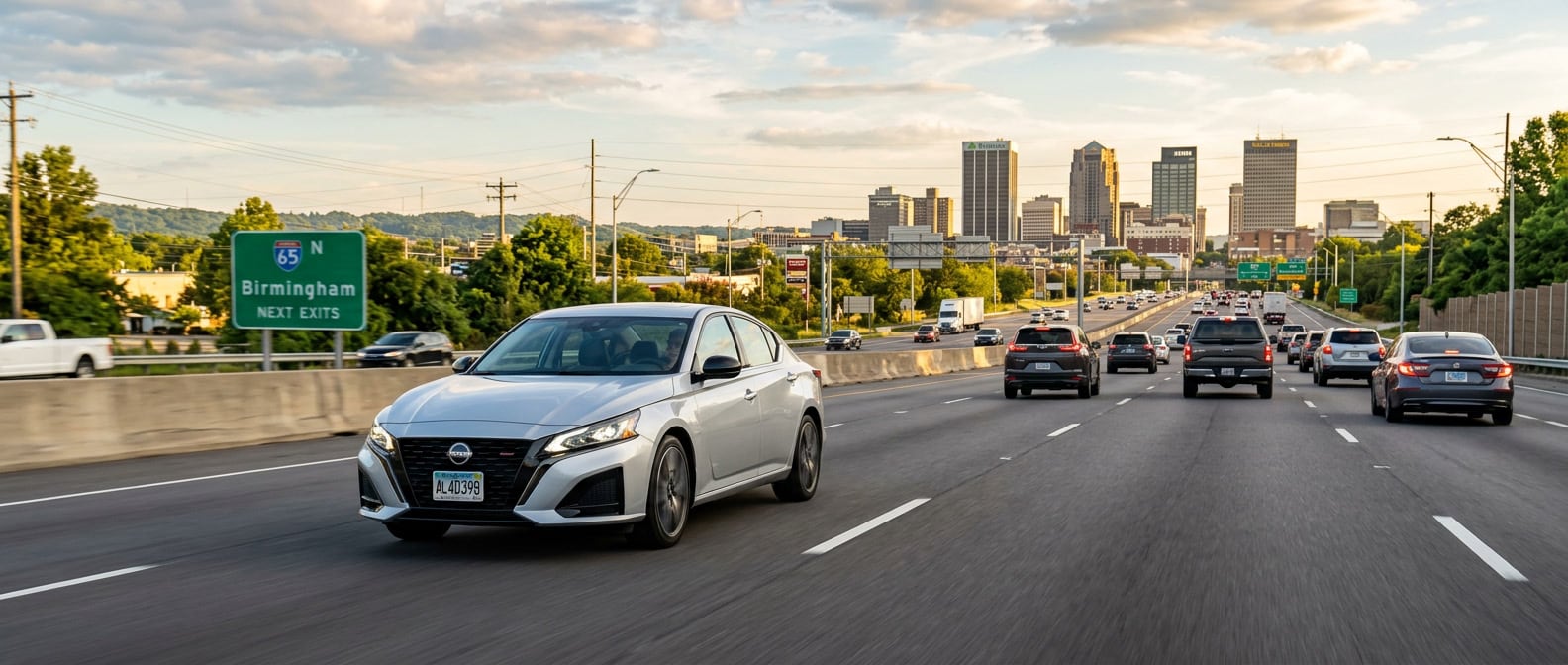
If you make that run every workday, you already know what you're in for. I-65 between Hoover and downtown Birmingham isn't a highway commute in the traditional sense. You get a stop-and-go crawl through the I-459 interchange, a compression through the Oxmoor Road corridor, and then the full pinch of Malfunction Junction where I-20, I-59, and I-65 all decide to converge at once. That merge alone can add fifteen minutes to an otherwise predictable morning.
The vehicle you pick for this specific run matters more than you'd guess. Not every Nissan in our lineup is the right answer for a five-day-a-week I-65 commuter. So we ranked four of them, from the one we'd tell a friend to buy first down to the one that fits a narrower profile. The 2026 Nissan Altima is our top pick for this commute, and the full reasoning follows below.
The I-65 Commuter Ranking
Every figure below comes straight from Nissan's published specifications or EPA estimates, so you're not guessing.
| Rank | Model | Best For | Standout Spec |
|---|---|---|---|
| 1 | Altima FWD | Solo or two-person commuter who wants sedan efficiency and a quiet cabin | EPA-estimated 30 mpg combined, 36 mpg highway |
| 2 | Sentra SV | Tighter budget, city parking emphasis, solo driver | EPA-estimated 33 mpg combined, 38 mpg highway |
| 3 | Rogue FWD | Families or anyone needing cargo room and a taller seating position | EPA-estimated 32 mpg combined, 36 mpg highway |
| 4 | Kicks FWD | First-time buyer or anyone who parks downtown and needs a smaller footprint | EPA-estimated 31 mpg combined, 35 mpg highway |
Every model on this list uses a CVT, and that's deliberate. Stop-and-go on I-65 through Malfunction Junction is exactly the use case a continuously variable transmission handles well. It holds the engine in its efficiency band without hunting between fixed gear ratios the way a traditional automatic does. Over a year of bumper-to-bumper traffic, that mechanical reality shows up at the pump.
Rank 1: The Altima Earns Its Spot
The Altima sits at the top because it balances efficiency and long-commute comfort better than anything else in our lineup for this use case. Nissan's published specs for the 2026 Altima FWD land at 26 city / 36 highway / 30 combined mpg on regular fuel. That highway number is real money if you're logging 300-plus miles a week on I-65.
The cabin is where the Altima separates itself from a spec sheet. Nissan's Zero Gravity front seats are engineered to distribute pressure across the thighs and lower back rather than concentrating it. The design borrows from NASA seating research. On a commute that sometimes stretches a 20-minute drive into an hour, that's a feature you'll feel by Wednesday. Standard Nissan Safety Shield 360 includes Automatic Emergency Braking with Pedestrian Detection and Blind Spot Warning. Blind Spot Warning is particularly useful near the I-459 split in Hoover, where lanes narrow and traffic merges without a lot of warning.
The Altima's tradeoff is that it's a sedan. If you haul anything regularly that won't fit in a 15.1-cubic-foot trunk, or if you want a higher seating position to see over I-65 traffic, the Rogue at rank three serves you better. The Altima is the right tool when the commute itself is the main event.
Rank 2: The Sentra Deserves a Harder Look
The Sentra earns rank two on numbers that surprise on paper, since Nissan lists EPA estimates of 30 city / 38 highway / 33 combined mpg for the 2026 Sentra S and SV trims, though it still slots one notch below the Altima. That highway figure actually beats the Altima's. The reason it lands at rank two rather than one comes down to interior space and refinement at highway speeds. The Altima's cabin runs quieter and the seats carry you further before fatigue sets in. But for a solo driver doing mostly city legs and parking in a tight structure near UAB or Five Points South, the Sentra makes a genuinely strong argument.
The 2026 Sentra is all-new this year. One useful change for commuters is the available dual 12.3-inch monolith display, which puts navigation and audio controls in eyeline without reaching. The powertrain is a 2.0-liter four-cylinder producing 149 horsepower, paired to Nissan's Xtronic CVT. Small engine, efficient tune.
The tradeoff is back-seat space that's tighter than the Altima's. If you've got car seats or regular passengers, the Altima or Rogue makes more sense. The Sentra's lane is solo commuters who want the highest mpg number for the lowest entry point.
The 2026 Sentra S and SV trims earn an EPA-estimated 38 mpg highway on regular fuel, the highest highway rating in the Nissan sedan lineup.
Buying caution: AWD is tempting, but Birmingham rarely delivers the winter conditions that justify the efficiency trade. The Rogue AWD drops from 32 to 31 mpg combined, and the Altima AWD falls from 30 to 28. Unless your weekends regularly take you to higher-elevation roads in winter, FWD is the sharper daily choice for this commute.
Rank 3: The Rogue for Families or Anyone Who Hauls Gear
The Rogue slots in at rank three because it trades raw efficiency for space, and we won't pretend otherwise, but for anyone dropping kids off in Hoover before merging onto I-65 or hauling gear on Fridays, that trade is the right one. Its 36.5 cubic feet of cargo space behind the second row changes the entire calculation.
Don't let the small displacement scare you off. The 2026 Rogue runs a 1.5-liter VC-Turbo three-cylinder producing 201 horsepower, and it doesn't feel small at the I-459 on-ramp when you need to get up to speed in a short distance. Nissan's variable compression technology continuously adjusts the engine's compression ratio (that's what lets a 1.5-liter make 201 horsepower while returning an EPA-estimated 29 city / 36 highway / 32 combined mpg in FWD trim). The seating position sits higher than either sedan, which some commuters prefer for visibility in dense interstate traffic.
The Rogue costs more than the sedans, and the driving feel is more utility than sport. Both of those things are simply true. If family logistics or regular cargo are part of your daily commute, it earns its rank three position clearly.
Rank 4: The Kicks as a Downtown Commuter
The Kicks takes rank four not because it's the least capable of the four, but because it fits a narrower profile, the single commuter who parks downtown, wants the smallest practical footprint in a tight garage or on a tight street, and is watching ownership costs. For that driver, the Kicks makes real sense.
The 2026 Kicks runs a 2.0-liter four-cylinder and returns an EPA-estimated 28 city / 35 highway / 31 mpg combined in FWD. Not the highest number on this list. But the Kicks is also the most city-nimble of the four, and its subcompact crossover dimensions make parallel parking on Second Avenue North or squeezing into a downtown structure a lower-stress job than doing the same in a midsize sedan or SUV. It also sits higher than the sedans without going full SUV, which gives better sight lines through traffic without the width of the Rogue.
The honest limitation is highway refinement. At sustained I-65 speeds, the Kicks is quieter than you'd expect for its size, but it doesn't absorb road texture the way the Altima does. If your commute is heavily weighted toward highway miles, the Altima or the Rogue will feel more settled over long stretches. If downtown parking and city maneuvering dominate your daily routine, the Kicks is a serious contender worth driving before you decide.
The Bottom Line on This Commute
The 2026 Altima is the Nissan our team would recommend first for the Hoover-to-downtown commute. The EPA-estimated 36 mpg highway and the Zero Gravity seats address the two things that pile up over months of daily I-65 driving, fuel costs and physical fatigue. It's not the smallest or the cheapest entry point, and it's not the most practical if cargo is a regular priority. But for the specific task of surviving the I-459 interchange and Malfunction Junction five days a week without arriving depleted, the Altima is the most purpose-fit tool in our lineup. Come in and drive it on an actual commute day. That's the test that settles it.
By the Hallmark Nissan Team | September 2026
Categories:
Social