

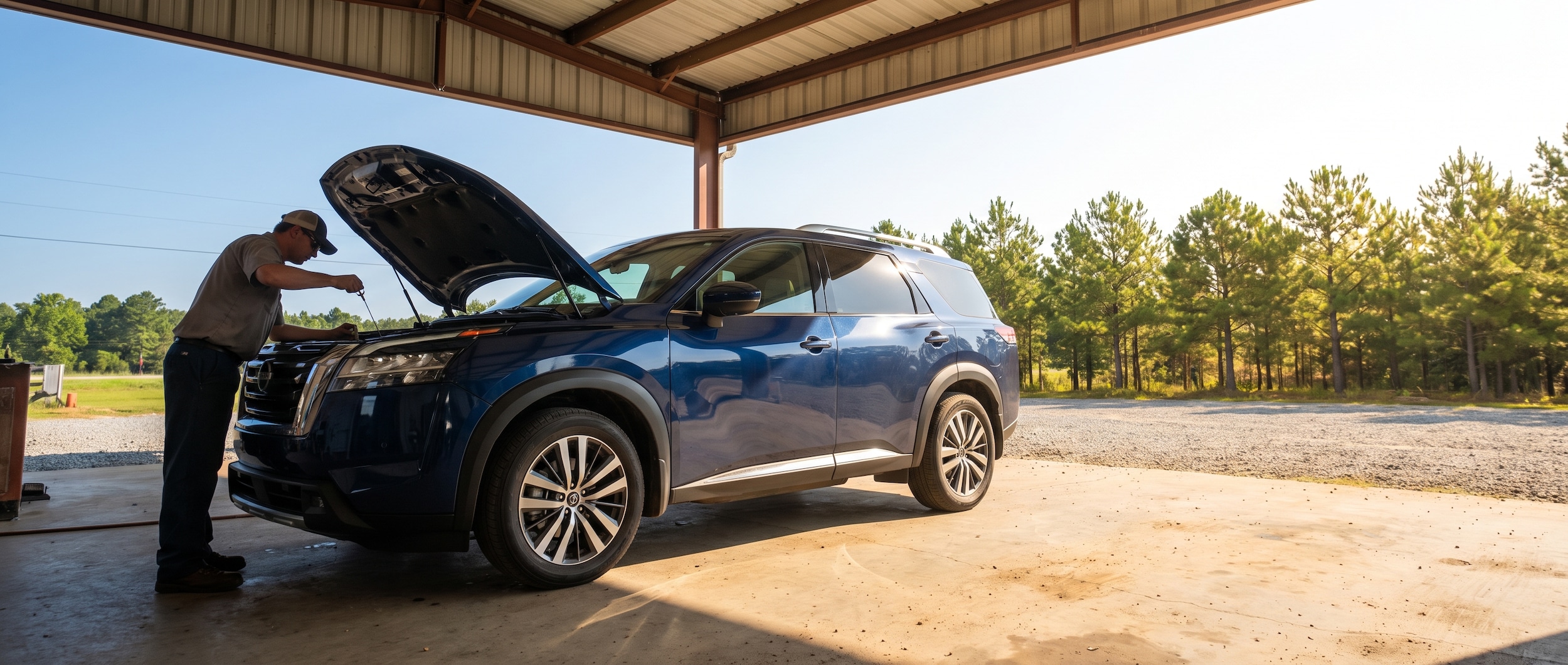
Alabama's heat index has been climbing above 100 degrees this week, and if you are planning to point your Nissan south toward the Gulf or north up I-65 toward Nashville, the gap between "car seems fine" and "car is actually ready" matters more in July than any other month. Heat is hard on tires, batteries, cooling systems, and belts in specific, predictable ways. This checklist walks you through seven service steps, ordered by consequence, so you leave Birmingham with genuine confidence instead of crossed fingers.
The single most important pre-trip move is checking coolant level and tire pressure together -- heat stresses both systems at the same time, and skipping either one is how a great trip turns into a roadside situation on I-20.
Nissan Armada owners and Frontier drivers have a few extra items to cover -- towing systems and payload considerations -- so those are called out where they apply.
What You Need Before You Start
Run through this checklist the day before departure, not the morning of. If any item flags a problem, you want time to schedule service, not time to panic in the driveway.
| Item to Check | What You Need | Takes About |
|---|---|---|
| Tire pressure gauge | Any quality digital gauge | 5 minutes |
| Owner's manual (or door-jamb sticker) | In the glovebox or door frame | 1 minute |
| Clean cloth or paper towel | Check fluid levels and dipstick | 2 minutes |
| Flashlight | Inspect belts, hoses, spare tire | 3 minutes |
| Note of your Nissan's VIN | NHTSA recall lookup at nhtsa.gov | 2 minutes |
Total active time: roughly 15-20 minutes. Most of it is looking and confirming; you are not doing repairs here.
Seven Steps to Get Your Nissan Road-Trip Ready
These steps run in order from highest-consequence to lowest. Do not rearrange them.
Step 1: Check tire pressure against the door-jamb spec -- not the tire sidewall.
The number printed on the tire sidewall is the maximum the tire can hold, not what your Nissan actually needs. Per NHTSA, the correct pressure is on the sticker inside the driver-side door jamb or in your owner's manual. Check tires cold, meaning the Nissan has been sitting overnight. On a Birmingham summer day, tires sitting on hot pavement can read two to four PSI higher than their true cold pressure, which masks underinflation. Underinflated tires on hot asphalt are a documented blowout risk -- NHTSA consistently lists this as one of the leading causes of summer tire failures.
Do not forget the spare. It sits unused for months and loses pressure quietly. Confirm it is inflated to spec and that the jack and lug wrench are still in the vehicle.
Step 2: Inspect tire tread with a quarter.
Push a quarter upside down into the tread groove with Washington's head going in first. Per NHTSA, minimum safe tread is 2/32 of an inch. If you can see the top of Washington's head above the tread, the tire needs replacement before the trip, not after. Worn tires and summer heat are a particularly bad combination.
While you are at it, look at the sidewalls for any bulges, cuts, or cracking. Hot pavement accelerates sidewall degradation on tires that have been sitting for a few years.
Step 3: Check coolant level and inspect hoses and belts.
Wait for the engine to be fully cold before you open the coolant reservoir cap. Per NHTSA, check that the level sits between the MIN and MAX marks. If you are coming up on the interval your owner's manual recommends for a cooling system flush, do it before the trip -- old coolant loses its heat-transfer efficiency, and on a sustained highway run in 95-degree Alabama heat, that matters.
While the hood is open, run a flashlight along the radiator hoses and drive belts. NHTSA advises looking for bulges, blisters, cracks, or soft spots. Rubber degrades faster in sustained heat, and a hose that was borderline in spring can let go on a long summer highway pull.
Pathfinder owners towing a trailer: a heavy load puts additional strain on the cooling system. If you are near the towing interval on your transmission fluid, change it before the trip.
Step 4: Confirm battery health -- especially if it is three or more years old.
Heat is harder on car batteries than cold is. Prolonged exposure to high temperatures can shorten a battery's typical three-to-five-year lifespan, sometimes significantly. Slow starts, dashboard warning lights, and corrosion around the terminals are signs of a battery losing capacity. If your battery is approaching the three-year mark and you have not had it tested, have a technician run a load test before you leave. A battery that handles daily commutes in Birmingham may not handle the extra draw of sustained highway speeds, air conditioning at full blast, and USB charging for four people simultaneously.
Schedule a Pre-Trip Battery and Fluid Check
Step 5: Test the A/C before you are on the road.
Per NHTSA, checking A/C performance and the cabin air filter before summer travel is a specific recommendation, not a general suggestion. With heat index values above 100 degrees across central Alabama this week, a weak A/C system is a safety issue, not just a comfort issue -- particularly for children and older adults in the cabin. Turn the system to its coldest setting and confirm it is blowing genuinely cold air within a minute or two. If airflow is weaker than normal or the air is cool but not cold, there may be a refrigerant issue or a clogged cabin air filter.
Step 6: Top off all fluids -- and check for leaks on the ground underneath.
Engine oil, brake fluid, transmission fluid, and windshield washer fluid all need to be at the correct levels before a long run. Engine oil thins slightly in high heat, which reduces its ability to protect engine components during sustained highway driving. Per NHTSA, if you are near or past your oil change interval, do the change before the trip, not after you return. Check underneath the vehicle for any fresh spots on the driveway -- a fluid leak you live with on a daily commute can escalate on an extended drive.
Step 7: Check your lights and clean your Nissan Safety Shield 360 sensors.
All four lights (headlights, brake lights, turn signals, and emergency flashers) should work before you leave. This is a five-minute check and one that gets skipped. For Nissan models equipped with Safety Shield 360 -- including the Rogue and Pathfinder -- take a moment to clean the front camera lens and the side radar sensors with a soft cloth. Road grime, bug splatter, and pollen can reduce sensor accuracy on ProPILOT Assist and automatic emergency braking. After a Birmingham spring, those sensors may be dirtier than you think.
The step most people skip: Checking the spare tire's pressure and confirming the jack and lug wrench are actually in the vehicle. A flat tire on I-65 between Birmingham and Montgomery with no working spare is a fixable problem turned expensive. Takes two minutes. Do it the day before.
Clean Safety Shield 360 sensors before a highway trip -- a lens coated in bug residue from spring driving is less effective at the highway speeds where you need it most.
Don't Forget to Check for Open Recalls
Before you leave, look up your VIN at nhtsa.gov. Per NHTSA, recall repairs are performed at no charge to the owner. An open recall on a safety system -- brakes, steering, airbags -- is worth resolving before a long trip, not after. It takes about two minutes to look up your VIN.
Your Quick Pre-Trip Recap
Print this or keep it on your phone for the day before departure.
Nissan Rogue and larger SUV owners: this list covers everything.
- [ ] Tire pressure checked cold against door-jamb spec (including spare)
- [ ] Tread depth confirmed at 2/32" or better with a quarter
- [ ] Coolant level between MIN and MAX; hoses and belts inspected for cracks or bulges
- [ ] Battery health confirmed (load test if three or more years old)
- [ ] A/C blowing cold at maximum setting; cabin air filter checked
- [ ] All fluids topped off; no leaks on the ground underneath
- [ ] All lights working; Safety Shield 360 sensors wiped clean
- [ ] VIN checked for open recalls at nhtsa.gov
- [ ] Spare tire inflated; jack and lug wrench in the vehicle
- [ ] Registration, insurance card, and roadside assistance number in the glovebox
Contact Hallmark Nissan before your trip if any item on that list needs professional attention. The service team can handle the battery test, cooling system check, and fluid top-offs in one visit.
Categorías:
Social