

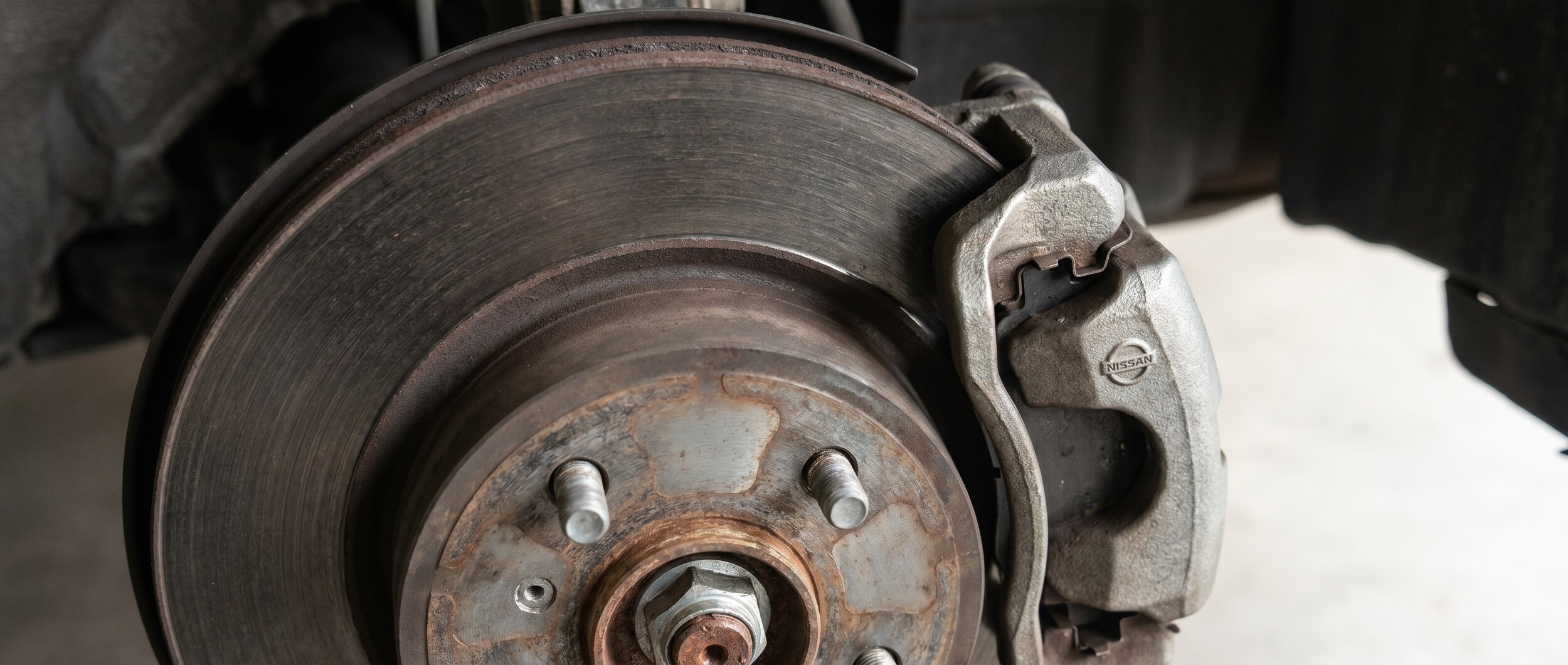
Your brake pads might last 40,000 miles on flat terrain, but Birmingham, AL's notorious hills can cut that lifespan by 30% - and that's before we factor in what our humid summers do to your rotors. Understanding how these critical safety components wear differently helps you budget for maintenance and avoid that heart-dropping moment when your brakes don't respond as expected on Red Mountain Expressway.
Most drivers know brakes wear out, but few understand why rotors and pads deteriorate at different rates or how our local driving conditions accelerate the process. This guide breaks down the science behind brake wear, shows you what to watch for, and helps you plan maintenance that keeps you safe on everything from Shades Creek Parkway's steep grades to I-65's stop-and-go traffic.
Understanding Your Nissan®'s Brake System Components
Modern disc brakes generate stopping power through friction between two main components: the brake pads that squeeze and the rotors they squeeze against. Think of it like pressing your palms together - your hands are the pads, and if you were holding a spinning plate between them, that's your rotor.
Your brake pads consist of a steel backing plate bonded to friction material. This friction material does the hard work, converting your vehicle's kinetic energy into heat every time you slow down. Semi-metallic pads, found on many Frontier™ and Pathfinder™ models, contain 30-65% metal particles mixed with binding resins. Ceramic pads, common on the Altima™ and Sentra™, use ceramic fibers and copper threads instead.
Brake rotors are the metal discs mounted to your wheel hubs. When you press the brake pedal, hydraulic pressure forces the pads to clamp down on both sides of these spinning rotors. The resulting friction brings your vehicle to a stop, but it also generates tremendous heat - up to 1,200 degrees Fahrenheit during aggressive braking.
Did you know? Your rotors can warp from heat stress if the temperature difference between their inner and outer surfaces exceeds 150 degrees. That's why proper cooling vents in the rotor design matter so much for vehicles navigating Birmingham's hills.
The relationship between these components determines their wear patterns. Softer pad materials typically wear faster but preserve rotor life. Harder, more aggressive pad compounds last longer but can accelerate rotor wear. Finding the right balance depends on your driving style and the demands of our local terrain.
How Birmingham's Terrain Impacts Brake Component Lifespan
Elevation changes define Birmingham driving, and your brakes bear the burden of managing momentum on every descent from Vestavia Hills to downtown. Unlike drivers in flat regions who primarily use brakes for stopping at intersections, we constantly modulate speed on grades that would make a mountain goat nervous.
Consider your daily commute down Highway 280 from Oak Mountain toward the city center. That sustained downhill grade forces your brakes to work continuously rather than in short bursts. This extended friction time generates more heat, accelerating both pad and rotor wear. The same physics apply whether you're descending Shades Mountain or navigating the steep residential streets near Samford University.
| Terrain Type | Typical Pad Life | Typical Rotor Life | Primary Wear Factor |
|---|---|---|---|
| Flat city driving | 40,000-60,000 miles | 70,000-80,000 miles | Stop-and-go friction |
| Birmingham hills | 25,000-40,000 miles | 50,000-60,000 miles | Sustained heat buildup |
| Mountain driving | 20,000-30,000 miles | 40,000-50,000 miles | Extreme heat cycles |
| Highway cruising | 50,000-70,000 miles | 80,000-100,000 miles | Minimal brake use |
Our unique geography creates what brake engineers call "duty cycles" - patterns of use that determine component stress. Short, intense brake applications followed by cooling periods cause less overall wear than prolonged, moderate braking. Unfortunately, Birmingham's topography often demands the latter, especially during rush hour when traffic prevents you from using engine braking effectively.
Summer humidity compounds the challenge. Moisture in the air increases surface oxidation on rotors, creating a thin layer of rust that gets scraped away with each brake application. While this surface rust is normal, the constant cycle of oxidation and removal gradually reduces rotor thickness. Factor in our occasional severe thunderstorms that leave standing water on I-459, and you have a perfect recipe for accelerated brake wear.
Recognizing the Warning Signs: Pads vs Rotors
Brake pads announce their demise through unmistakable sensory cues, while rotors often suffer in silence until the damage becomes severe. Understanding these different warning signs helps you address problems before they compromise safety or require expensive repairs.
Brake Pad Warning Signs:- High-pitched squealing when braking (built-in wear indicators)
- Grinding or growling sounds (metal-on-metal contact)
- Increased stopping distance
- Brake pedal traveling closer to the floor
- Vehicle pulling to one side during braking
- Visible thickness less than 1/4 inch
- Vibration or pulsing in the brake pedal
- Steering wheel shake during braking
- Visible grooves or scoring on rotor surface
- Blue discoloration from overheating
- Thickness variation exceeding 0.001 inches
- Visible cracks or heat checking patterns
Pro tip: Check your brake components every time you rotate your tires. Viewing through the wheel spokes, you should see at least 1/4 inch of pad material remaining. The rotor surface should appear smooth without deep grooves or discoloration.
The timing of these symptoms matters. Pads typically show warning signs gradually over several thousand miles. You might notice slightly longer stopping distances before hearing the telltale squeal of wear indicators. Rotors, however, can deteriorate rapidly once they reach critical thickness. A rotor that seems fine during your spring inspection might develop severe pulsation by summer's end, especially after repeated hard stops descending Red Mountain.
Take a look at our new inventory to explore models with advanced brake cooling systems designed for challenging terrain.
The Science Behind Different Wear Rates
Understanding why pads and rotors wear at different rates requires examining the materials science and physics at play during every stop. This knowledge helps explain why your Rogue™ might need new pads at 30,000 miles while the rotors last another 20,000.
Brake pads sacrifice themselves by design. The friction material contains sacrificial elements that transfer to the rotor surface, creating a thin transfer layer that enhances stopping power. This transfer process means pad material constantly migrates away, reducing thickness with each application. Semi-metallic pads lose approximately 0.001 inches per 1,000 stops under normal conditions.
Rotors wear through different mechanisms:
Mechanical Wear:- Abrasive particles in pad material gradually machine the rotor surface
- Harder pad compounds accelerate this process
- Contamination from road debris creates additional scoring
- Repeated heating and cooling causes metal fatigue
- Extreme temperatures lead to heat checking (surface cracks)
- Rapid cooling from puddles can cause thermal shock
- Oxidation removes surface material
- Pad transfer materials create corrosive compounds
- Road salt accelerates deterioration in winter
The wear rate differential becomes more pronounced with aggressive driving. During a panic stop from 70 mph, rotor temperature can spike by 600 degrees in under three seconds. This thermal stress causes microscopic changes in the metal structure, gradually reducing the rotor's ability to dissipate heat effectively.
Your driving habits directly influence these wear patterns. Gentle, progressive braking allows heat to dissipate evenly, preserving both components. Habitually late, hard braking creates temperature spikes that accelerate deterioration. The difference can mean replacing pads twice as often and rotors 40% sooner.
Maintenance Schedules: What Birmingham Nissan Drivers Should Expect
Real-world brake maintenance schedules for Birmingham, AL drivers differ significantly from manufacturer estimates based on ideal conditions. Our combination of hills, humidity, and heavy traffic creates unique replacement intervals you won't find in your owner's manual.
| Vehicle Type | City/Hills Pad Replacement | City/Hills Rotor Replacement | Highway Pad Replacement | Highway Rotor Replacement |
|---|---|---|---|---|
| Altima/Sentra | 25,000-35,000 miles | 50,000-70,000 miles | 40,000-50,000 miles | 70,000-90,000 miles |
| Rogue/Murano™ | 30,000-40,000 miles | 60,000-75,000 miles | 45,000-55,000 miles | 75,000-95,000 miles |
| Pathfinder/Armada™ | 25,000-30,000 miles | 45,000-60,000 miles | 35,000-45,000 miles | 65,000-80,000 miles |
| Frontier | 20,000-30,000 miles | 40,000-55,000 miles | 35,000-45,000 miles | 60,000-75,000 miles |
These intervals assume normal driving patterns around Jefferson County. Factors that accelerate wear include:
- Daily commutes involving Shades Mountain or Red Mountain descents
- Frequent towing (especially relevant for Frontier and Armada owners)
- Stop-and-go traffic on I-65 during rush hour
- Aggressive driving style or frequent high-speed stops
Your maintenance strategy should account for our seasonal variations. Spring's heavy rains mean more frequent wet braking, which can accelerate pad wear by 15%. Summer's heat reduces the effectiveness of brake cooling systems, potentially shortening rotor life. Plan inspections accordingly - ideally checking components in April before summer heat and again in October after the hottest months.
Did you know? Nissan's brake pad wear indicator system activates when approximately 2mm of friction material remains - enough for about 2,000 miles of careful city driving or one trip down Lookout Mountain with a loaded trailer.
Ready to check your pre-owned inventory for vehicles with recently serviced brake systems.
Cost Considerations: Planning Your Brake Service Budget
Smart budget planning for brake maintenance requires understanding both immediate costs and long-term implications of deferred service. Birmingham drivers face unique considerations that affect both timing and total expense.
Typical Service Costs by Component:- Brake pad replacement (per axle): Parts plus 1-1.5 hours labor
- Rotor replacement (per axle): Parts plus 1.5-2 hours labor
- Pad and rotor combination: Often includes labor savings
- Brake fluid flush: Recommended every 2-3 years
The relationship between pad and rotor condition affects your options. New pads can sometimes be installed on rotors with minor wear, but severely grooved or warped rotors will quickly destroy fresh pads. Conversely, installing new rotors with worn pads wastes money and compromises the precise mating surface needed for optimal performance.
Money-Saving Strategies:- Replace pads before metal backing contacts rotors
- Address pulsation or vibration immediately to prevent rotor damage
- Maintain proper brake fluid condition to prevent caliper problems
- Consider quality aftermarket options for older vehicles
- Time replacements to coincide with other scheduled service
The false economy of cheap brake components becomes apparent quickly in our demanding environment. Premium pads might cost 40% more initially but last 60% longer while treating rotors more gently. Similarly, quality rotors resist warping better when descending from Oak Mountain State Park or navigating the steep grades near Vulcan Park.
Consider lifetime replacement costs rather than individual service events. A Murano driven primarily on Highway 280's hills might need three pad replacements and two rotor replacements over 100,000 miles. Planning for these expenses prevents surprise budget impacts and unsafe driving conditions.
When to Replace Together vs Separately
Deciding whether to replace pads and rotors simultaneously involves evaluating current condition, cost efficiency, and safety margins. Not every brake service requires complete component replacement, but understanding when combination service makes sense saves money and ensures reliability.
Replace Pads Only When:- Rotor thickness exceeds minimum specification by at least 2mm
- Rotor surface shows minimal wear (light surface rust acceptable)
- No pulsation or vibration present
- Rotor runout measures within specification
- Previous pad material compatible with rotor surface
- Rotor thickness approaches minimum specification
- Visible grooves exceed 0.5mm depth
- Any pulsation or vibration during braking
- Blue discoloration indicates overheating
- Installing different pad material type
- Thickness variation exceeds manufacturer limits
- Cracks visible in any location
- Heat checking covers more than 25% of surface
- Minimum thickness specification reached
- Any structural damage present
The mathematics of combination replacement often favor doing both. Labor costs for accessing brake components remain constant whether replacing one or both parts. If rotors show 60% wear when pads need replacement, the minimal additional labor cost makes simultaneous replacement logical. This approach also ensures components wear together, optimizing performance throughout their service life.
Your driving patterns influence this decision. Drivers who frequently descend from Vestavia Hills or navigate the steep grades near Birmingham-Southern College typically benefit from combination replacement. The severe service conditions mean rotors deteriorate faster, making concurrent replacement more cost-effective than returning for rotor service within 10,000 miles.
Time to schedule service for a professional brake inspection before our summer heat arrives.
Common Questions About Brake Rotor vs Pad Wear in Birmingham, AL
How do Birmingham, AL's humid summers affect my Nissan's brake rotors specifically?
Birmingham's summer humidity accelerates surface oxidation on brake rotors, creating rust that forms within hours of parking. This surface rust gets scraped away during your first few brake applications each day, gradually thinning the rotor material. While normal surface rust isn't dangerous, the constant oxidation-removal cycle in our 70%+ humidity can reduce rotor life by 10-15% compared to arid climates.
What's the minimum brake pad thickness I should maintain for safe driving on Red Mountain Expressway?
Maintain at least 4mm (roughly 5/32 inch) of brake pad material for safe driving on Birmingham's steep grades like Red Mountain Expressway. While 2-3mm might suffice for flat terrain, our dramatic elevation changes demand extra margin. This additional thickness ensures adequate heat dissipation during extended downhill braking and provides a safety buffer for unexpected traffic situations on our challenging roads.
Can I extend my Nissan's brake life by engine braking down Birmingham's hills?
Yes, using engine braking (downshifting in manual mode) when descending from areas like Shades Mountain or Oak Mountain significantly extends brake component life. This technique can reduce brake applications by 40-60% on long descents, lowering component temperatures and wear rates. Even CVT-equipped models like the Altima and Rogue offer manual mode or gear limiting features that enable effective engine braking.
How often should I inspect my brakes if I commute daily on Highway 280 through Mountain Brook?
Inspect your brakes every 5,000 miles or with every other oil change when regularly driving Highway 280's demanding Homewood-to-Hoover corridor. This route's combination of steep grades near Mountaindale and stop-and-go traffic creates severe service conditions. Visual inspections through your wheel spokes take just minutes but can identify developing problems before they require expensive repairs.
Do ceramic or semi-metallic brake pads work better for Birmingham, AL driving conditions?
Semi-metallic pads generally perform better for Birmingham's hilly terrain, offering superior heat dissipation during repeated downhill braking. While ceramic pads produce less dust and noise, semi-metallic compounds handle our elevation changes and humid conditions more effectively. They're particularly recommended for heavier vehicles like the Armada or Pathfinder that work harder on our steep grades.
Where can I get my Nissan's brakes inspected near the Birmingham, AL area?
Get your Nissan's brakes professionally inspected at certified service centers throughout greater Birmingham, including locations near major corridors like I-459 and Highway 31. Look for technicians familiar with how our local terrain affects brake wear patterns. Regular inspections at facilities equipped with proper measurement tools ensure your brake components meet safety specifications for our challenging driving environment.
Understanding brake component wear empowers you to make informed maintenance decisions that keep you safe on Birmingham, AL's challenging roads. The interplay between our steep terrain, humid climate, and heavy traffic creates unique wear patterns that demand proactive attention. Whether you're descending into downtown from Vestavia Hills or navigating the grades near Samford University, properly maintained brakes provide the confidence and control you need.
Remember that brake pads and rotors work as a system - neglecting one compromises both. By recognizing early warning signs and planning maintenance around our local driving conditions, you avoid emergency repairs and maintain optimal stopping power when you need it most. The team at Hallmark Nissan understands how Birmingham's unique geography affects your vehicle and can help you develop a maintenance strategy that maximizes component life while ensuring safety.
Categories:
Social